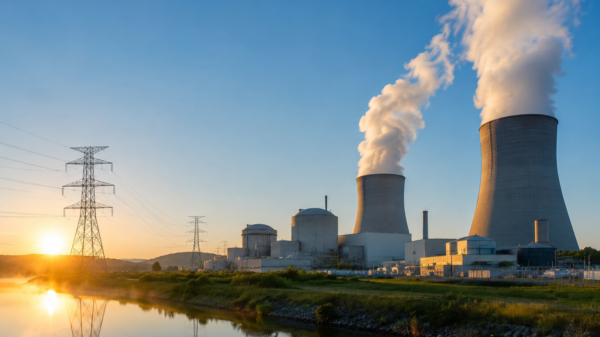

Cameco Corp. (TSE: CCO) (NYSE: CCJ) welcomed a conditional USD$17.5-billion U.S. Department of Energy loan package aimed at accelerating the construction of 10 new nuclear reactors across the United States.
On Tuesday, the company said the financing would support five projects, each featuring two reactors. Consequently, the initiative could help expand U.S. nuclear generating capacity while strengthening domestic supply chains.
The Department of Energy’s Office of Energy Dominance Financing said the loans would fund long-lead components that often delay reactor construction. The agency expects the financing to shorten project timelines and reduce overall development costs.
The projects would use Westinghouse Electric Co.’s AP1000 reactor design. Currently, AP1000 units are the only licensed large-scale advanced commercial reactors operating in the United States.
Cameco and Brookfield Asset Management Ltd. (TSE: BAM) (NYSE: BAM) jointly own Westinghouse. The company said several technical, legal, environmental and financial conditions must be satisfied before the department finalizes financing agreements and releases funds.
Meanwhile, the Department of Energy said each project would be jointly owned by Westinghouse and a utility or energy company partner. Both parties must commit USD$500 million in equity before accessing loan funding.
Each reactor would generate about 1.1 gigawatts of electricity. Consequently, the 10 reactors would produce enough power to supply nearly 10 million households.
The announcement builds on U.S. efforts to expand nuclear energy. In May 2025, President Donald Trump signed executive orders targeting a fourfold increase in domestic nuclear power production over the next 25 years.
Read more: Cameco expands ownership of Cigar Lake through TEPCO deal
Read more: Deep Fission, NX Atomics tap partners to advance SMR deployment
A global nuclear renaissance is increasing demand for uranium
Cameco Chief Executive Officer Tim Gitzel said recent U.S. policy measures are creating conditions that could speed AP1000 deployment across the country. He added that new reactor construction would create opportunities for both Westinghouse and Cameco.
Furthermore, Gitzel said Westinghouse could see increased activity in its energy systems business during equipment procurement and construction phases.
U.S. Energy Secretary Chris Wright said the loans would help rebuild the country’s reactor supply chain. Additionally, he said the financing could accelerate reactor construction by as much as three years while supporting the administration’s broader energy expansion plans.
Growing electricity demand, energy security and decarbonization goals are driving a global nuclear renaissance that is increasing demand for uranium. Countries are extending the lives of existing reactors while planning new builds to support rising power consumption from industries, electrification and artificial intelligence data centres.
The next generation of nuclear technology differs significantly from the large reactors built during the early decades of the industry. Small modular reactors (SMRs) use standardized designs that can be manufactured in factories and assembled on site. This could potentially reduce construction costs and timelines. Developers are also advancing microreactors, which produce only a few megawatts of electricity and can supply power to remote communities, military installations and mining operations.
Nuclear safety expert Edwin Lyman of the Union of Concerned Scientists has noted that modern Western reactors rely on robust containment structures and multiple safety systems that differ significantly from the Soviet-era RBMK design involved in the Chernobyl disaster. He has also argued that advanced reactors must continue to meet stringent safety standards as the industry expands.
.