Global assembly warns artificial intelligence and nuclear arms demand stronger human safeguards
The Rome Declaration for an Unarmed and Disarming Peace was signed at Rome's Capitoline Hill
 Joseph Morton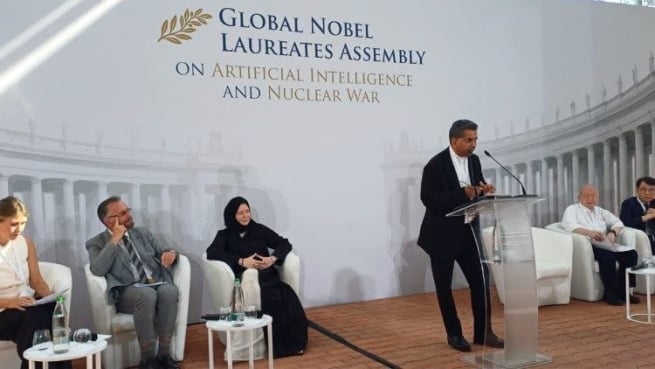
World leaders, Nobel laureates, scientists and Vatican officials signed a declaration in Rome on Thursday calling for stronger human control over artificial intelligence and renewed efforts to reduce nuclear weapons, warning that rapid technological progress could increase the risk of global catastrophe without clear ethical safeguards.
The Rome Declaration for an Unarmed and Disarming Peace was signed at Rome’s Capitoline Hill after the Global Nobel Laureates Assembly on Artificial Intelligence and Nuclear War. The gathering brought together more than 200 researchers, peace advocates and international representatives to examine how artificial intelligence and nuclear weapons could reshape global security.
The three-day event followed discussions hosted by the Vatican from July 14 to 15 at Borgo Laudato si’ in the Pontifical Gardens of Castel Gandolfo. Organizers said Pope Leo XIV’s encyclical Magnifica humanitas, which focuses on protecting human dignity in the age of artificial intelligence, inspired the assembly.
Rome Mayor Roberto Gualtieri opened Thursday’s closing session with welcoming remarks before speakers outlined the risks they believe accompany increasingly powerful technologies.
Professor Daniel Holz of the University of Chicago said the world faces an unusually dangerous period because artificial intelligence and nuclear weapons continue advancing simultaneously. However, he also argued that governments and researchers already possess many practical tools that could reduce those dangers if they choose to act.
Holz said humanity faces unprecedented risks from both technologies. Additionally, he argued that policymakers can still lower those risks through international cooperation, stronger safeguards and better decision-making.
Read more: ‘Largest AI cheating scandal in Ivy League history’: Brown professor appalled
Read more: Number of students using AI to cheat grows at alarming rate
Several speakers worry that AI could influence military decisions
Cardinal Baldo Reina, the Vicar General of Rome, described the declaration as especially important during a period of geopolitical instability, weakening international cooperation and rapid technological change.
He said advances in artificial intelligence offer major opportunities in healthcare, education, environmental protection and poverty reduction. However, he warned those same technologies could become instruments of exclusion, domination or destruction if developers ignore ethics and dignity.
Furthermore, Reina argued that machines should never make decisions involving war, peace or humanity’s survival. He said meaningful human oversight must remain at the center of every life-and-death decision rather than autonomous systems or algorithms.
Father Andrea Ciucci, Chancellor of the Pontifical Academy for Life, reflected on humanity’s long history of using innovation for both constructive and destructive purposes.
He said human creativity has produced remarkable achievements throughout history. Meanwhile, it has also created weapons capable of enormous destruction, making ethical responsibility just as important as scientific progress.
Ciucci said artificial intelligence represents another example of that dual nature. He explained that the technology itself remains neutral, while people ultimately decide whether it serves peaceful or destructive purposes.
Cardinal Silvano Maria Tomasi also addressed delegates during the closing session. Additionally, Nobel Peace Prize laureate Maria Ressa of Columbia University urged governments and technology developers to adopt stronger moral standards as competition over advanced technologies intensifies.
Several speakers expressed concern that artificial intelligence could influence military decisions more directly if governments fail to establish international limits.
Read more: Artificial Intelligence may push older workers into retirement sooner, Boston College study finds
Read more: Robotic lung biopsy system brings earlier cancer detection closer to patients
Actress and peace ambassador Sharon Stone addressed the assembly
Professor David Gross, who received the Nobel Prize in Physics, said he now considers the nuclear threat greater than it was three decades ago. He says this is because arms control agreements have largely disappeared while more countries possess nuclear weapons.
He said nine nations now maintain nuclear arsenals. Furthermore, he described the current international environment as an accelerating arms race that threatens future generations.
Gross urged nuclear-armed governments to adopt policies that reduce the likelihood of conflict and lower the possibility of nuclear war. He said the recommendations remain straightforward even though political leaders have heard similar appeals for decades.
Additionally, Gross encouraged governments to place humanity ahead of political rivalry. Drawing on a well-known appeal from the Cold War era, he urged leaders to remember their shared humanity.
Actress and Peace Ambassador Sharon Stone also addressed the assembly. She argued that moral responsibility must expand alongside increasingly capable artificial intelligence systems.
Stone said technological progress should never diminish respect for individual dignity. Consequently, she argued that people who design advanced systems are responsible to ensure those technologies remain aligned with human values.
The declaration calls for meaningful human control over artificial intelligence systems. These include those connected to military decisions, while also urging renewed international efforts toward nuclear disarmament and emerging technologies. Additionally, participants said ethical principles should guide future technological development rather than allowing innovation alone to determine humanity’s direction.
.