
NioCorp Developments Ltd. (NASDAQ: NB) released an updated feasibility study for its Elk Creek Critical Minerals Project in Nebraska on Tuesday.
The study significantly expands the project’s scope, extends its mine life to 40 years and projects stronger economics through the production of eight critical mineral products instead of three.
The study estimates a pre-tax net present value, discounted at 8 per cent, of USD$4.1 billion and an after tax net present value of USD$3.4 billion. It also forecasts a pre-tax internal rate of return of 24 per cent and an after tax internal rate of return of 22.8 per cent.
Over the life of the mine, the project is expected to generate approximately USD$37.4 billion in revenue, average annual earnings before interest, taxes, depreciation and amortization of USD$608 million and annual operating cash flow averaging USD$519 million.
The updated study builds on more than a decade of engineering, metallurgical testing and mine planning. It also reflects a redesigned processing plant, revised mining methods, updated capital and an expanded suite of critical mineral products.
Chief executive officer Mark Smith said the revised study transforms Elk Creek into a strategically important domestic source of critical minerals at a time when the United States continues to depend heavily on imports. He said few U.S. projects combine a four decade mine life, major construction permits and the ability to produce eight critical minerals from a single ore body.
The project’s economics improved substantially because of its broader product mix. Revenue is expected to average USD$815 per ton of ore processed while average operating costs are projected at USD$255 per ton.
Read more: Strategic U.S. antimony resource emerges in NevGold’s Nevada MRE
Read more: NevGold launches 20,000-metre drill campaign at Nevada antimony-gold project
Niocorp expects project to strengthen domestic supply chains
The company believes the additional products will create more stable cash flow by reducing dependence on any single commodity market.
Additionally, no individual product is expected to account for more than 39 per cent of total revenue under the new study. That diversification could reduce the project’s exposure to price swings affecting individual critical minerals while allowing the company to serve multiple industrial markets.
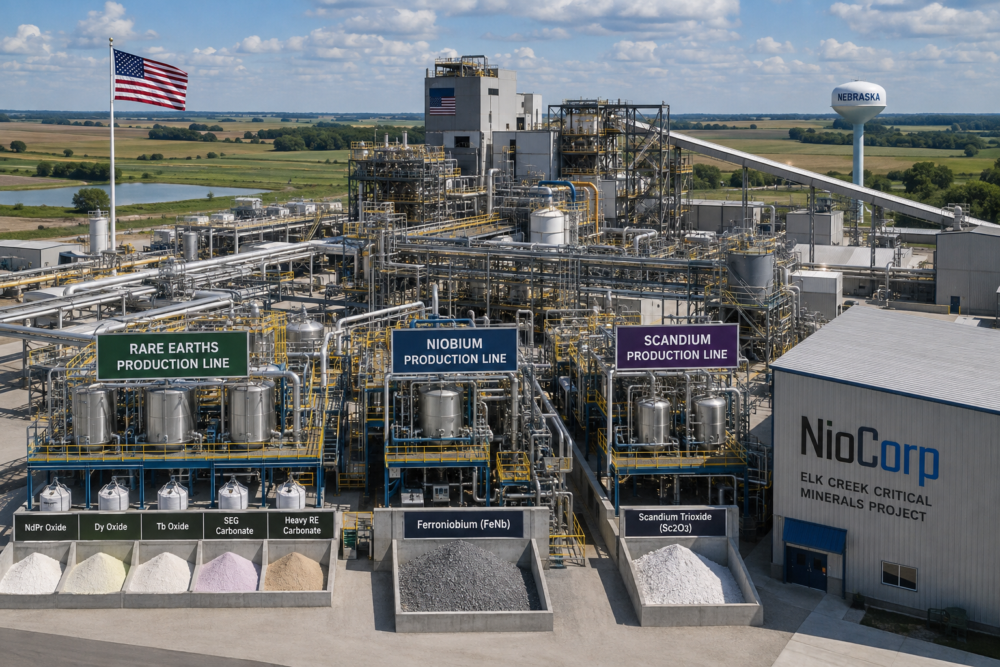
The Elk Creek operation would produce ferroniobium, scandium trioxide, titanium tetrachloride, neodymium-praseodymium oxide, dysprosium oxide, terbium oxide, samarium-europium-gadolinium carbonate and heavy rare earth carbonate. All eight products appear on the U.S. government’s critical minerals list because of their importance to advanced manufacturing, defence technologies and energy infrastructure.
NioCorp expects the project to strengthen domestic supply chains for materials that currently rely heavily on imports. The company also believes domestic production could reduce exposure to export controls, market concentration and pricing volatility associated with Chinese supply chains.
Meanwhile, the updated feasibility study assumes pricing outside China for scandium and several rare earth products. China dominates global production and processing of those materials, but export restrictions have tightened supplies in international markets.
Scandium demand could also benefit from deployment of solid oxide fuel cells that supply reliable electricity to AI data centres. In addition, neodymium, praseodymium, dysprosium and terbium remain essential ingredients in high performance permanent magnets used in electric vehicles, robotics, defence systems and industrial automation.
However, the company acknowledged that those pricing assumptions carry risks. Future market conditions could change if trade restrictions ease. This means competing supplies increase or anticipated demand from emerging industries develops differently than expected.
Read more: NevGold Corp. reports antimony grades up to 53.7 per cent at Nevada project
Read more: NevGold appoints Nevada government affairs veteran Scott Bensing to board
Redesign eliminates a dedicated sulfuric acid plant
The updated study also incorporates several engineering changes designed to improve operating efficiency and lower processing costs. NioCorp redesigned the processing circuit by adding calcination and ammonium chloride leaching before acid leaching. According to the company, those changes reduce acid consumption and improve reagent recovery throughout the operation.
Furthermore, the redesign eliminates a dedicated sulfuric acid plant included in the 2022 feasibility study. Instead, the operation would regenerate hydrochloric acid and neutralize sulfuric acid on site to recover and reuse processing reagents.
The mining plan also changed significantly. The company plans to access the underground ore body through twin ramps extending from a mine portal currently under construction. The revised design would allow ore to move using a Railveyor system while supporting electric underground haulage equipment.
In addition, NioCorp intends to construct a behind the meter microgrid that would provide most of the project’s electricity. The company said generating power on site should reduce dependence on the regional electrical grid while improving long term operating reliability.
The updated feasibility study estimates initial capital costs of approximately USD$1.85 billion. That figure reflects the expanded processing facility, revised mining methods and inflation since the company’s previous feasibility study.
Additionally, the completion of the feasibility study satisfies a due diligence requirement for financing discussions with the U.S. Export-Import Bank. NioCorp now expects to advance into detailed engineering work along with engineering, procurement and construction contracting activities.
The revised mine plan also establishes larger and higher confidence mineral reserves. Proven and probable mineral reserves now total 45.9 million tons. This also includes 7.6 million tons classified as proven and 38.4 million tons classified as probable.
Read more: NevGold pushes toward potential 2027 antimony production at Limousine Butte
Read more: NevGold reports more positive drill results as gold-antimony resource estimate nears
Reserves support 40 year mine life
The updated reserve estimate introduces proven reserves and includes rare earth elements for the first time.
Consequently, those reserves support a projected mine life of 40 years. Additional measured, indicated and inferred mineral resources remain outside the current mine plan. These could also support future expansion if additional development proves economically viable.
Smith said the expanded project provides access to more markets while reducing reliance on any single commodity. He added that stronger economics, a broader revenue base and a longer operating life leave the company better positioned to advance financing and detailed engineering before moving toward construction in Nebraska.
.