
Health Canada has approved Eli Lilly and Company’s (NYSE: LLY) weight-loss drug Zepbound for treating obstructive sleep apnea in adults with obesity, making it the first GLP-1 therapy in Canada authorized for the common sleep disorder.
The approval, granted on Thursday, expands the drug’s use beyond weight management and gives physicians another treatment option for patients with obesity-related sleep apnea. Consequently, doctors may now consider the medication alongside established therapies when discussing care plans.
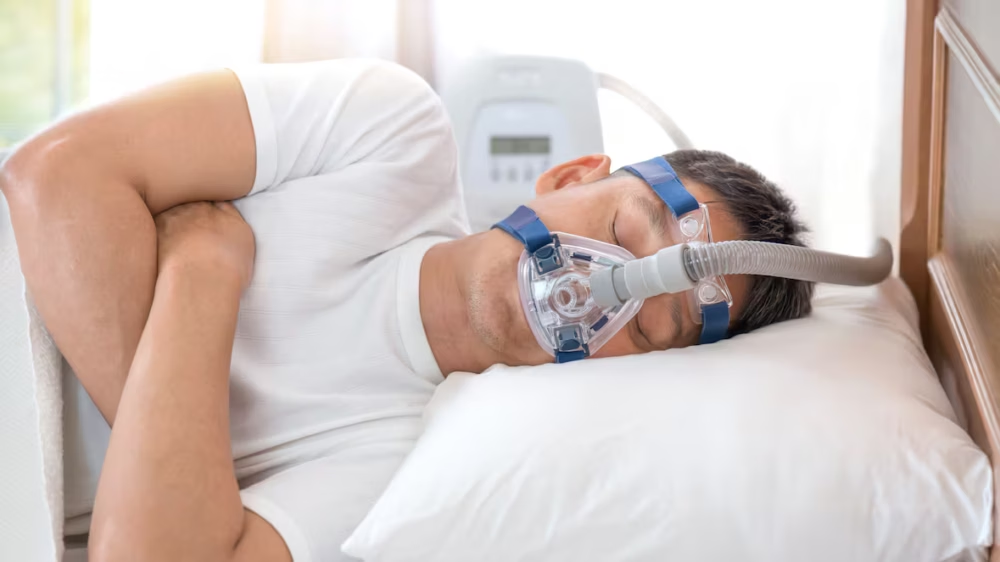
Obstructive sleep apnea occurs when the upper airway becomes blocked during sleep, causing repeated breathing interruptions. The condition often develops when throat muscles relax or excess fatty tissue narrows the airway.
The disorder can cause excessive daytime sleepiness and increase the risk of serious health problems. Additionally, untreated sleep apnea has been linked to high blood pressure, heart attacks and strokes.
Dr. Mandeep Singh, a clinician investigator in sleep science at University Health Network in Toronto, said obesity frequently contributes to obstructive sleep apnea. He noted that weight loss can often improve symptoms and reduce the severity of the condition.
Zepbound contains tirzepatide, a medication that targets both glucagon-like peptide-1 and glucose-dependent insulinotropic polypeptide hormone receptors. The treatment reduces appetite and helps patients lose weight through a once-weekly injection.
Tirzepatide also serves as the active ingredient in Mounjaro, Eli Lilly’s diabetes treatment. Meanwhile, the company competes with Novo Nordisk A/S (NYSE: NVO), which markets the semaglutide-based drugs Ozempic and Wegovy.
Health Canada spokesperson Marie-Pier Burelle said adults with a body-mass index of 30 kilograms per square metre or higher can use the medication. However, patients must combine the treatment with a reduced-calorie diet and increased physical activity.
Read more: Breath Diagnostics advances pre-op pneumonia screening with FDA breakthrough designation
Read more: Prestigious medtech intelligence firm recognizes Breath Diagnostics for innovation
Authorization follows Phase 3 clinical trials
Burelle also emphasized that Zepbound does not replace continuous positive airway pressure therapy. CPAP remains the primary treatment for moderate to severe obstructive sleep apnea.
She said patients should continue using their CPAP machines unless a physician advises otherwise. Consequently, the new approval is expected to complement existing treatment approaches rather than replace them.
The authorization follows Phase 3 clinical trials involving patients with both obesity and obstructive sleep apnea.
Researchers found that patients who did not use CPAP experienced 25 fewer breathing interruptions per hour after taking tirzepatide. By comparison, participants receiving a placebo recorded five fewer interruptions per hour.
The results were even stronger among patients already using CPAP therapy. Additionally, researchers observed 29 fewer breathing interruptions per hour in patients taking tirzepatide, compared with six fewer among placebo recipients.
Singh explained that doctors classify sleep apnea severity according to the number of breathing interruptions recorded each hour. Patients with mild sleep apnea typically experience five to 14 interruptions per hour, while moderate cases involve 15 to 30 interruptions. Severe cases exceed 30 interruptions per hour.
He said reductions of 25 to 29 events per hour could represent a meaningful clinical improvement. Furthermore, such changes could move some patients from a severe category into a lower severity classification, depending on their starting point.
Singh said physicians have observed potential sleep apnea improvements among patients taking other GLP-1 medications. However, researchers have not yet produced sufficient evidence to confirm the same effect scientifically.
He added that future studies could help determine whether tirzepatide improves sleep apnea strictly through weight loss or through direct effects on the airway itself.
.