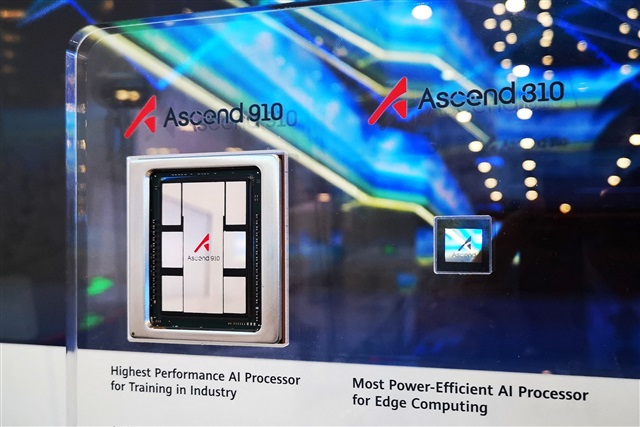

Chinese researchers have reportedly completed full-parameter post-training of DeepSeek’s V4-Pro artificial intelligence model using more than 1,000 Huawei Ascend 910C chips, marking a potential milestone for China’s domestic AI hardware ambitions.
The project involved Huawei Technologies and three Shenzhen-based research institutions, according to the Shenzhen municipal government. Additionally, the report appeared on Tuesday in the South China Morning Post and described the effort as a successful full-parameter post-training run on Chinese-made processors.
The research team included Huawei, the Shenzhen Loop Area Institute, the Shenzhen campus of Harbin Institute of Technology and the Shenzhen Research Institute of Big Data.
The development suggests Chinese accelerators can now support at least some training-class AI workloads without relying on Nvidia hardware. Furthermore, training capability has remained one of the most difficult areas for Chinese firms to localize under United States export restrictions.
Huawei’s Ascend 910C serves as the company’s flagship AI accelerator. The dual-die processor previously delivered about 60 per cent of an Nvidia H100’s inference performance during earlier DeepSeek testing.
Inference occurs when a completed model answers user prompts. However, training requires repeated recalculation of a model’s internal weights across massive datasets.
The researchers said they completed full-parameter post-training rather than applying a smaller adapter layer. Consequently, the process updated every weight within the model.
DeepSeek’s V4-Pro contains approximately 1.6 trillion parameters. Meanwhile, the company’s technical documentation states that pre-training relied on a dataset exceeding 32 trillion tokens.
Pre-training creates a model’s core capabilities by processing enormous amounts of text. Subsequently, post-training refines behaviour through instruction-following, safety controls and specialized task data.
Read more: Thailand sees rapid workplace AI adoption rise in Q1
Read more: Microsoft teams up with Mayo Clinic to create healthcare specialist AI model
DeepSeek returned to Nvidia processors for training
The reported achievement represents progress for Huawei’s AI platform. However, it does not show that Ascend chips can pre-train a frontier model entirely from scratch.
That distinction remains important because pre-training demands far more computing power, time and cost than post-training.
Questions also remain about Ascend’s broader training performance.
In August, reports indicated that DeepSeek struggled to complete a successful training run for its R2 model using Ascend hardware. Additionally, reports cited unstable performance, slow chip-to-chip communication and shortcomings in Huawei’s CANN software ecosystem.
CANN serves as Huawei’s alternative to Nvidia’s CUDA software platform. DeepSeek reportedly returned to Nvidia processors for training while continuing to use Ascend chips for inference workloads.
DeepSeek released V4-Pro in April as its first model designed around Ascend hardware from the beginning.
The Shenzhen announcement provided few technical details. Furthermore, officials did not disclose training duration, hardware utilization rates or comparisons with Nvidia-based systems.
The report also included no independent benchmark results. Meanwhile, DeepSeek has not publicly commented on the reported achievement.
DeepSeek drew global attention in early 2025 after releasing artificial intelligence models that appeared to rival leading Western systems at a fraction of the expected cost.
The Chinese startup quickly became a major topic across the technology industry. Additionally, its claims raised questions about whether advanced AI development required the enormous budgets associated with companies such as Nvidia and OpenAI.
DeepSeek said it developed its models using fewer resources than many competitors. Furthermore, the company reported training costs that appeared significantly lower than those typically associated with frontier AI systems.
Read more: Solidion’s AI data centre battery tech reveal sends stock into space
Read more: XOS skyrockets on launch of AI data centre energy storage systems
DeepSeek made waves when it arrived on the scene
The announcement triggered a sharp reaction in financial markets. Consequently, investors reassessed assumptions about future demand for expensive AI infrastructure.
Technology stocks experienced heightened volatility following the release. Meanwhile, analysts debated whether DeepSeek had discovered a more efficient path toward advanced AI development.
The company also attracted attention because it operated under United States export restrictions that limited China’s access to the most advanced AI chips. However, DeepSeek demonstrated that Chinese firms could still produce highly capable models despite those limitations.
Researchers and industry observers quickly began examining the company’s technical papers. Additionally, many focused on methods that emphasized efficiency, optimization and selective activation of model components.
Some experts praised the achievement as evidence that AI development costs could fall faster than expected. Conversely, others questioned whether public disclosures captured the full amount of computing power used during development.
The release also intensified competition across the global AI sector. Subsequently, developers accelerated efforts to improve performance while reducing training and operating costs.
DeepSeek’s emergence marked a turning point in the industry’s discussion about scale. Rather than focusing solely on larger computing clusters, companies increasingly examined ways to achieve comparable results with greater efficiency.
The debut transformed DeepSeek from a little-known Chinese startup into one of the most closely watched names in artificial intelligence.
.











ppsspp gold
July 15, 2026 at 9:13 am
This is a fascinating development! It’s impressive to see DeepSeek achieve such significant milestones without relying on Nvidia chips. This could open up new avenues for AI development and create more competition in the market. Looking forward to seeing how this impacts the landscape!
bdg Win
August 2, 2026 at 5:57 am
It’s fascinating to see DeepSeek pushing the boundaries of AI training without relying on Nvidia chips. This could potentially shake up the industry and open new doors for competitive hardware alternatives. Looking forward to seeing how this impacts future advancements in AI technology!