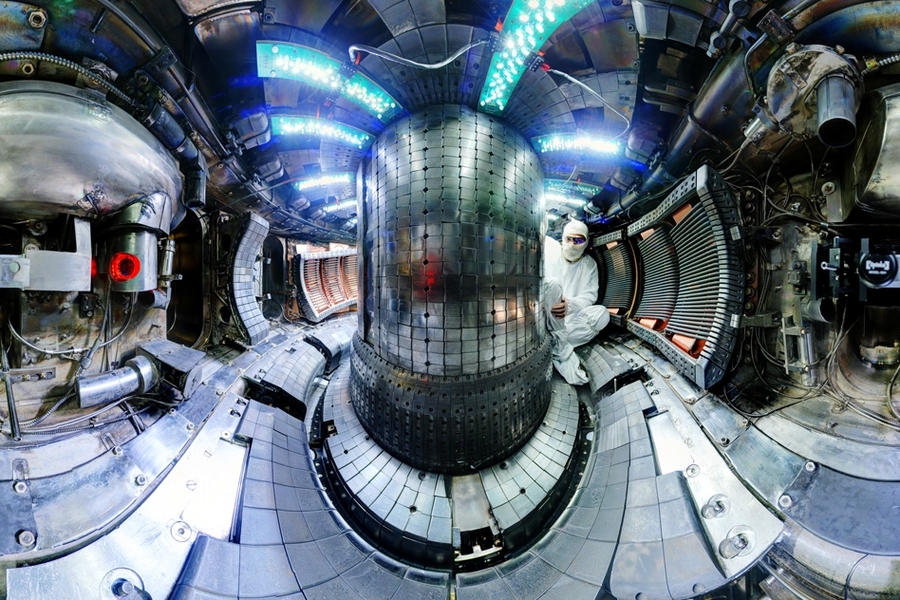

Scientists have identified a potential security risk tied to future nuclear fusion power plants and proposed a way to detect any attempt to secretly produce nuclear weapons materials.
Researchers from Virginia Tech and Princeton University found that deuterium-tritium fusion reactors could, in theory, generate significant quantities of plutonium or uranium-233 if operators modified them for covert weapons production. Additionally, the team said existing particle detection technology could help regulators identify such activity.
The findings were published Tuesday in the journal Physical Review Applied.
Nuclear fusion has attracted growing attention from governments and private investors seeking a source of virtually limitless carbon-free electricity. Furthermore, recent advances in fusion experiments have increased optimism that commercial reactors could eventually become practical.
However, physicists Patrick Huber of Virginia Tech, Robert Goldston of Princeton Plasma Physics Laboratory and Alexander Glaser of Princeton University examined a less-discussed challenge.
They focused on deuterium-tritium, or DT, fusion systems. These reactors generate energy by fusing hydrogen isotopes into helium. The process also releases large numbers of high-energy neutrons.
According to the researchers, those neutron emissions could create an opportunity for weapons proliferation.
The team calculated that a gigawatt-scale DT fusion reactor could potentially produce tens of kilograms of plutonium or uranium-233 each week if operators deliberately altered the system. Additionally, such production could occur inside a reactor’s breeding blanket, a component designed to help generate tritium fuel.
Breeding blankets play an important role in many proposed fusion reactor designs. They surround the fusion chamber and absorb energetic neutrons released during operation.
Read more: 5 Junior Miners positioned to benefit from rising defence spending: A Mugglehead roundup
Read more: Cameco increases Cigar Lake ownership as nuclear demand grows
The solution could be antineutrino detectors
In some concepts, the blanket contains lithium compounds that convert neutron energy into additional tritium fuel. However, researchers noted that operators could theoretically insert uranium-238 into the blanket and expose it to neutron bombardment.
That process would gradually convert uranium into plutonium-239, one of the primary materials used in nuclear weapons.
To address the issue, the team proposed using antineutrino detectors.
Antineutrinos are extremely small particles produced during nuclear reactions. They rarely interact with matter and pass through most materials almost undisturbed.
Scientists have monitored antineutrinos for decades. Additionally, researchers have used specialized detectors to study nuclear reactors and investigate fundamental physics questions.
The new study suggests that the same technology could support future non-proliferation efforts.
The researchers modeled a hypothetical 1,500-megawatt DT fusion reactor that secretly produced plutonium-239. They also modeled a standard reactor operating without any illicit activity.
To perform the analysis, the team used radiation simulation software originally developed at Los Alamos National Laboratory.
The simulations tracked the number and energy levels of antineutrinos emitted under different operating conditions. Furthermore, the researchers examined whether detectors could distinguish normal reactor activity from covert plutonium production.
Their results suggested that a relatively modest detector could identify suspicious operations.
The proposed device would weigh about one metric tonne and could operate roughly 25 metres from the reactor core. Additionally, the system would not require direct access to internal reactor components.
The researchers argued that antineutrinos offer several advantages for monitoring purposes.
Unlike many forms of radiation, antineutrinos cannot be effectively blocked or hidden. Furthermore, operators cannot easily imitate their signatures to conceal unauthorized activities.
Read more: Denison Mines begins early construction at Phoenix uranium project after securing approvals
Read more: AI boom pushes nuclear power back into global energy spotlight
Many unanswered questions remain
Because the particles travel through matter with little interference, inspectors could potentially monitor reactor operations from nearby locations without disrupting power generation.
The study’s authors acknowledged that commercial fusion power remains years away from widespread deployment. However, they argued that regulators should begin considering safeguards before large-scale reactors enter service.
The team also noted that many unanswered questions remain.
Researchers examined only a limited range of breeding blanket designs. Additionally, they focused primarily on plutonium production scenarios involving uranium-238.
Future studies could investigate other reactor configurations and fuel cycles. The authors suggested that covert production involving thorium could present different detection challenges because the resulting signatures may be weaker.
As governments and investors continue pursuing commercial fusion technology, the researchers said security planning should advance alongside reactor development. Additionally, they argued that early monitoring systems could help ensure future fusion facilities remain dedicated to civilian energy production.
.