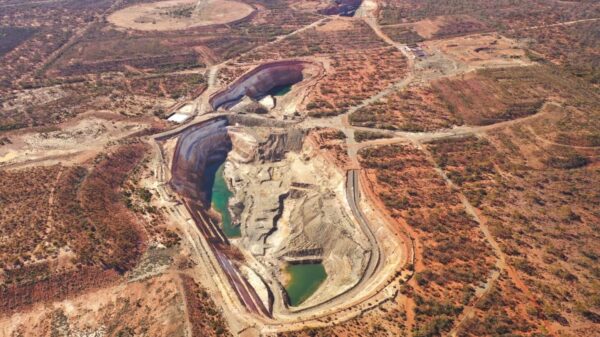

Western governments are increasing defence spending as geopolitical tensions continue to reshape global security priorities. However, modern militaries require far more than tanks, fighter jets and missile systems. Behind every piece of military equipment lies a complex supply chain built on critical minerals and strategic resources.
Many of the materials essential to modern defence systems are produced or processed outside North America and Europe. That reality has prompted growing concern among policymakers seeking to reduce dependence on foreign suppliers and strengthen domestic industrial capacity.
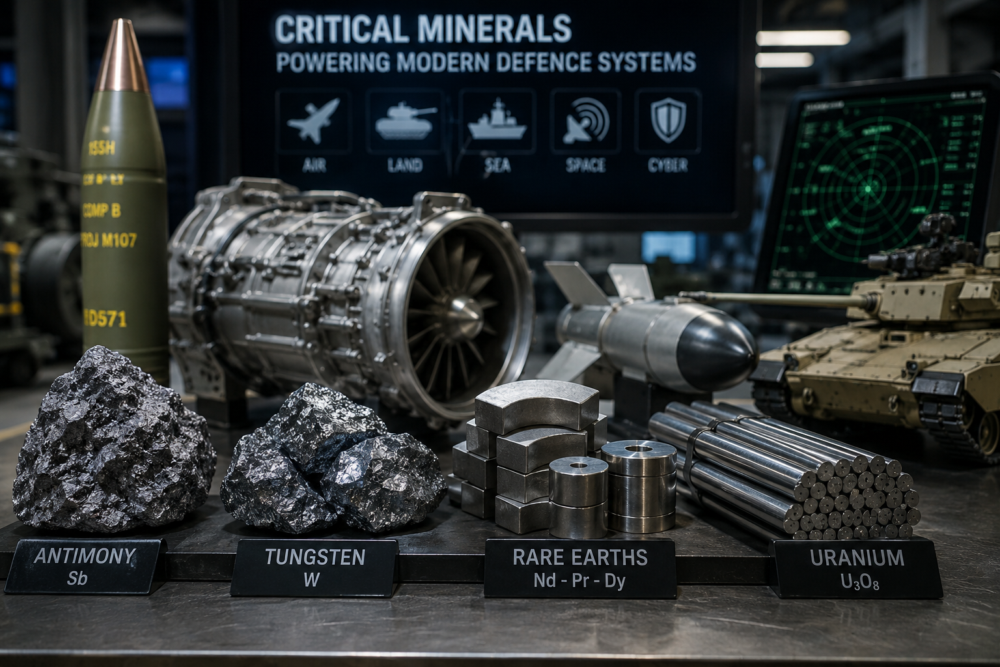
Antimony, tungsten and rare earth elements have emerged as particular areas of focus. These materials are used in everything from ammunition and missile systems to radar equipment, aerospace components and military communications technology. Uranium also plays an important role through its contribution to energy security and nuclear infrastructure.
As governments seek to secure reliable sources of these materials, mining companies are attracting increased attention from investors. Junior miners, in particular, offer exposure to projects that could eventually help support domestic supply chains for critical defence-related commodities.
Many of these companies remain years away from commercial production and face the financing, permitting and development risks common to the mining sector. Nevertheless, the strategic importance of their underlying commodities has created new opportunities as governments and industry seek alternative sources of supply.
The trend reflects a broader shift in how policymakers view national security. Defence planning is no longer focused solely on weapons procurement. Increasingly, it also involves securing the raw materials needed to manufacture military equipment, support industrial production and maintain long-term economic resilience.
The following five junior mining companies provide exposure to commodities that have become increasingly important to defence, energy security and critical infrastructure planning.
NevGold Corp.
NevGold Corp (CVE: NAU) (OTCMKTS: NAUFF) (FRA: 5E50) best represents the intersection of antimony and gold.
The company has emerged as one of the more closely watched antimony exploration stories in North America as governments and industry groups seek new domestic sources of critical minerals. The company’s flagship Limousine Butte project in Nevada contains both gold and antimony mineralization, giving it exposure to two commodities that have attracted growing investor attention.
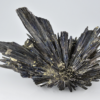
Antimony plays an important role in defence and industrial applications. Manufacturers use the metal in ammunition, explosives, infrared sensors, night-vision systems and flame-retardant materials.
Interest in antimony has increased sharply over the past two years. China dominates global production and processing of the metal and has imposed export restrictions on certain antimony products. As a result, Western governments have been seeking alternative supply sources that could reduce dependence on foreign producers.
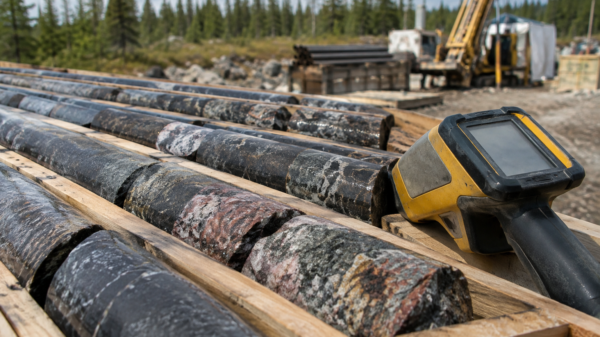
NevGold has spent much of the past year advancing antimony exploration at Limousine Butte. Recent drilling and surface sampling programs have identified multiple zones of antimony mineralization across the property. Several results have demonstrated grades that compare favourably with other North American antimony projects.
The company is now working toward a maiden antimony mineral resource estimate while continuing to evaluate the project’s gold potential. Management believes the combination of antimony and gold could enhance the project’s overall economics compared with a conventional single-commodity deposit.
NevGold remains an early-stage exploration company and faces the risks common to mineral development projects. However, its exposure to antimony comes at a time when the metal has become increasingly important in discussions surrounding supply chain security, domestic manufacturing and defence readiness.
Almonty Industries
Almonty Industries (NASDAQ: ALM) (TSE: ALM) is developing one of the most important tungsten projects outside China through its Sangdong mine in South Korea. The project has drawn growing attention as Western governments look to secure supplies of critical minerals used in defence and advanced manufacturing.
Manufacturers prize tungsten for its hardness, density and resistance to heat. As a result, it is used in armour-piercing ammunition, missile systems, aerospace components and military equipment. The metal also plays a key role in industrial tools, electronics and energy infrastructure.
Interest in tungsten has increased as governments reassess supply chain vulnerabilities. China currently dominates global tungsten production and processing. Consequently, policymakers in the United States and allied countries have been searching for alternative sources of supply.
Almonty’s Sangdong project is expected to become one of the largest tungsten mines outside China once production begins. The mine was historically one of the world’s leading tungsten producers before it closed decades ago. The company is now working to bring the operation back into production at a time when demand for secure supplies is rising.
Furthermore, South Korea offers several advantages as a mining jurisdiction. The country maintains strong relationships with Western allies and sits at the centre of major manufacturing supply chains. That positioning could make Sangdong an attractive source of tungsten for customers seeking to reduce reliance on Chinese suppliers.
Rising defence budgets have also strengthened the investment case for the metal. Governments across North America, Europe and Asia are increasing military spending. In turn, demand for the raw materials used in weapons systems and aerospace applications could continue to grow.
Read more: NevGold Corp. reports antimony grades up to 53.7 per cent at Nevada project
Read more: NevGold launches 20,000-metre drill campaign at Nevada antimony-gold project
Defense Metals Corp.
Defense Metals (CVE: DEFN) (OTCMKTS: DFMTF) is advancing its Wicheeda rare earth project in British Columbia at a time when governments across North America and Europe are seeking secure supplies of critical minerals. The company has positioned itself as part of a broader effort to develop a domestic rare earth supply chain that can support both industrial and defence applications.
Rare earth elements are essential components in a wide range of modern technologies. Companies and governments use critical minerals in precision-guided weapons, radar systems, military communications equipment, electric motors and advanced sensors. Several rare earths power permanent magnets used in fighter aircraft, missile systems, electric vehicles and wind turbines.
Interest in the sector has increased as policymakers examine supply chain vulnerabilities. China currently dominates global rare earth mining, processing and magnet production. Consequently, Western governments have identified rare earths as a strategic priority and have supported efforts to develop alternative sources of supply.
Defense Metals has spent the past several years advancing the Wicheeda project through drilling, engineering studies and metallurgical testing. The company believes the deposit could become an important source of rare earth materials for North American manufacturers.
Furthermore, Defense Metals recently strengthened its international relationships through cooperation agreements with major South Korean industrial groups. Those partnerships reflect growing interest in establishing supply chains that operate outside China’s sphere of influence.
The company remains in the development stage and faces the permitting, financing and construction challenges common to mining projects. However, the strategic importance of rare earths has created a supportive backdrop for companies capable of bringing new supplies to market.
NioCorp Developments Ltd.
NioCorp Developments (NASDAQ: NB) is advancing its Elk Creek critical minerals project in Nebraska, one of the few North American projects focused on producing several specialty metals from a single deposit. As governments seek to secure domestic supplies of strategic materials, the project has attracted attention for its potential role in supporting aerospace, defence and advanced manufacturing industries.
The Elk Creek project contains niobium, and also scandium and titanium. Each of these metals serves important functions in high-performance applications that are difficult to replace with alternative materials.
Niobium is commonly used to strengthen steel alloys while reducing overall weight. Those properties make it valuable in military vehicles, transportation infrastructure, pipelines and aerospace components. Stronger and lighter materials can improve durability while reducing fuel consumption and maintenance requirements.
Scandium is even rarer and has become increasingly important in aerospace manufacturing. When added to aluminum alloys, scandium can improve strength, corrosion resistance and weldability. These characteristics have attracted interest from aircraft manufacturers, defence contractors and companies developing next-generation transportation technologies.
Titanium also remains a critical material for aerospace and military applications because of its combination of strength, low weight and resistance to corrosion. The metal is widely used in aircraft structures, naval vessels and specialized defence equipment.
Interest in Elk Creek has increased because the United States relies heavily on imports for many of these materials. Furthermore, global production is concentrated among a relatively small number of suppliers. That concentration has raised concerns about long-term supply security as geopolitical tensions continue to reshape global trade patterns.
Read more: NevGold pushes toward potential 2027 antimony production at Limousine Butte
Read more: NevGold reports more positive drill results as gold-antimony resource estimate nears
ATHA Energy Corp.
ATHA Energy Corp. (CVE: SASK) (OTCMKTS: SASKF) is one of Canada’s largest uranium exploration companies and has assembled an extensive portfolio of projects across several of the country’s most prospective uranium districts. As governments increasingly view energy security as a component of national security, the company has positioned itself to benefit from growing interest in nuclear power and domestic uranium supply.
Uranium plays a critical role in supplying fuel for nuclear reactors, which provide reliable baseload electricity without direct carbon emissions. Interest in the sector has increased as countries seek to strengthen energy independence while meeting rising electricity demand from manufacturing, electrification and artificial intelligence infrastructure.
Governments in North America and Europe have also placed greater emphasis on securing domestic uranium supply chains. Consequently, exploration and development companies operating in stable mining jurisdictions have attracted increased attention from both investors and policymakers.
ATHA’s flagship Angilak project in Nunavut is among the company’s most advanced assets. The project hosts the Lac 50 deposit, one of Canada’s highest-grade uranium deposits outside Saskatchewan’s Athabasca Basin. Furthermore, recent exploration programs have identified additional zones of mineralization, supporting the company’s goal of expanding the project’s resource potential.
Beyond Angilak, ATHA controls a district-scale land package spanning millions of acres across the Athabasca Basin, the Thelon Basin and other prospective uranium regions. This extensive portfolio provides exposure to multiple exploration targets and discovery opportunities across Canada’s uranium sector.
Uranium is increasingly viewed as a strategic resource tied to energy security and national resilience as artificial intelligence drives growing electricity demand.
NevGold Corp is a sponsor of Mugglehead news coverage
.