
New Brunswick Premier Susan Holt is promoting the province’s mining potential in Toronto this week during one of Canada’s largest industry gatherings. Her visit follows a recent trade mission to India with Prime Minister Mark Carney.
Holt travelled to Toronto for the Prospectors and Developers Association of Canada convention, where global mining executives and investors have gathered. She said she plans to meet New Brunswick companies and discuss development opportunities across the province.
Additionally, Holt intends to meet Andrew Ing, chief executive of Northcliff Resources (TSE: NCF) (OTCMKTS: NCFFF), which is advancing the proposed Sisson tungsten project. The deposit sits in central New Brunswick and has drawn increasing attention from federal policymakers.
Meanwhile, the federal government recently designated the Sisson project as a potential nation-building initiative. Ottawa has referred it to the prime minister’s major projects office for further evaluation.
Holt has repeatedly described Sisson as one of the largest known tungsten deposits in the world. Tungsten is a critical mineral used in defense systems, electronics and advanced manufacturing.
Furthermore, Northcliff said earlier this month that a site investigation program should wrap up by the end of February. The company also expects to complete an updated feasibility study by mid-2026.
Consequently, the project could move closer to development if economic and regulatory conditions remain favourable. Governments increasingly view tungsten supply as strategically important.
Holt’s appearance at the Toronto convention also coincided with the launch of New Brunswick’s new provincial minerals strategy. The document outlines dozens of areas that could support future exploration.
In addition, officials identified 77 known mineral sites across the province.
Read more: NevGold’s stock growth secures junior spot on 2026 TSX Venture 50 list
Read more: NevGold Corp. advances toward gold-antimony resource with expanded Nevada drilling
New Brunswick could improve competitiveness
The strategy states that mining activity has declined in recent years. However, the report argues the province still holds strong geological potential.
Furthermore, officials say New Brunswick maintains a skilled workforce and technical expertise that could support industry expansion. Policymakers want to translate those strengths into new economic activity.
Consequently, the strategy proposes several measures aimed at accelerating project development and attracting investment capital. The province believes streamlined regulations could improve its competitiveness.
Additionally, the plan calls for more efficient permitting procedures. Officials say lengthy regulatory timelines often discourage investors from pursuing projects.
The strategy also stresses stronger Indigenous participation in mining development. Provincial leaders say partnerships with First Nations will remain essential for future projects.
Furthermore, the document emphasizes building a stronger financial environment for investors considering New Brunswick exploration. Governments hope that clearer rules will encourage new capital.
Meanwhile, officials say local communities should receive tangible economic benefits from nearby mining operations. The strategy proposes mechanisms to prioritize regional employment and development.
Holt said the goal involves accelerating the economic impact that mining could generate for the province. She argued that responsible development can help drive long-term growth.
However, New Brunswick faces mounting financial pressure as policymakers search for new economic drivers. The province recently reported a projected deficit of CAD$1.3 billion. Further, Holt has warned that the upcoming 2026-27 provincial budget will present difficult choices. Fiscal constraints have intensified debate about how to boost economic activity.
Read more: NevGold expands high grade antimony discovery at Nevada’s Limousine Butte Project
Read more: NevGold expands Bullet Zone discovery as drilling confirms oxide gold-antimony system
Sectors with global demand set to profit
Former premier Frank McKenna also addressed the issue during a recent event at the University of New Brunswick. He spoke while announcing a new cyber-training initiative tied to the McKenna Institute.
McKenna said governments cannot rely only on spending reductions to manage deficits. He argued that economic expansion must play a central role in restoring fiscal balance. He also said New Brunswick must invest in industries capable of significant growth.
According to McKenna, sectors with global demand could generate substantial economic returns. he pointed to cybertechnology as one example of an industry where the province could expand its role. The sector continues to grow rapidly worldwide. He also said governments must remain focused on economic development during uncertain times. He argued that growth ultimately generates the revenue needed for public services.
Meanwhile, he declined to offer direct advice to Holt about policy decisions. However, he repeated that economic growth should remain the central priority.
He said governments must concentrate on expanding economic activity rather than focusing solely on restraint. Consequently, stronger growth could help fund the services citizens expect.
Canada’s push to accelerate mining projects also reflects a wider geopolitical scramble for critical minerals, as Western governments try to loosen China’s dominance over key supply chains.
China currently controls large portions of global processing capacity for many critical minerals used in electronics, defense systems and energy technologies. The country dominates refining for rare earths and plays a major role in processing lithium, tungsten and antimony. Consequently, governments in North America, Europe and Australia have begun treating mineral supply as a strategic security issue.
Read more: NevGold’s latest discovery represents near term antimony production potential
Read more: NevGold surges after closing C$10M financing deal
Trump uses Fast-41 permitting framework
The United States has taken several steps to reduce that dependency. Washington has expanded its official critical minerals list to include resources such as lithium and antimony, which are essential for batteries, defense equipment and semiconductor manufacturing. Additionally, policymakers have begun using regulatory reforms to accelerate mine approvals.
One of the most significant tools has been the FAST-41 permitting framework. The program places major resource projects into a coordinated federal review system designed to reduce delays. Furthermore, FAST-41 establishes firm timelines for environmental reviews and allows agencies to run parallel evaluations rather than sequential ones.
Consequently, several proposed mines have moved through the federal permitting system faster than under traditional review processes. Industry groups argue the program helps reduce regulatory uncertainty while still maintaining environmental oversight.
Meanwhile, the U.S. government has also explored direct financial involvement in strategic mineral development. Federal agencies have supported projects through grants, loan programs and strategic partnerships. In addition, policymakers have discussed the possibility of taking equity stakes in companies developing critical mineral deposits.
Supporters say those investments could help secure domestic supply chains for minerals currently sourced from geopolitical rivals. However, critics warn that government ownership in mining ventures could distort markets if implemented too aggressively.
Australia has pursued a similar strategy by promoting domestic processing and funding exploration programs. Additionally, Canberra has partnered with the United States to develop alternative supply chains outside China’s influence.
Consequently, junior mining companies across North America have begun repositioning projects to align with the expanding critical minerals agenda. Several firms now emphasize metals tied to defense or energy security.
Read more: NevGold expands high grade antimony discovery at Nevada’s Limousine Butte Project
Read more: NevGold targets U.S. critical mineral supply chain with new antimony gold find
Explorers highlighting rare earths valued by US government
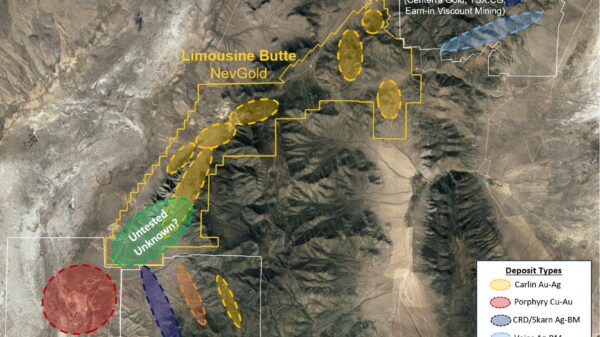
For example, NevGold Corp (CVE: NAU) (OTCMKTS: NAUFF) (FRA: 5E50) represents one significant example. The company has promoted antimony potential alongside its gold resources at the Limousine Butte project in Nevada. The company says the site hosts antimony mineralization that could complement its existing precious metals exploration program.
Meanwhile, other explorers have begun highlighting lithium, tungsten and rare earth elements within previously overlooked deposits. As governments continue to revise critical minerals lists, companies increasingly market these metals as strategic assets rather than niche commodities.
NevGold Corp is a sponsor of Mugglehead news coverage
.