
Contemporary Amperex Technology Co. Ltd. (CATL) (SZSE: 300750) has cleared a major safety test for its high-density aviation battery system.
The Chinese battery giant said on Monday that its system successfully prevented fire from spreading during a thermal runaway verification test. The result could move electric vertical takeoff and landing aircraft closer to carrying passengers commercially.
CATL developed what it calls the world’s first prismatic-cell aviation battery with an energy density of 350 watt-hours per kilogram. That figure sits roughly 50 per cent above the energy density found in standard electric vehicle batteries.
Higher energy density allows manufacturers to store more power without adding equivalent battery weight. Consequently, aircraft can potentially travel farther while carrying passengers and maintaining strict weight limits.
However, packing more energy into batteries also makes controlling fires particularly important for aviation. Thermal runaway starts when a failing battery cell generates enough heat to ignite nearby cells.
The process can subsequently spread through a battery pack and create a rapidly escalating fire. Aircraft designers cannot simply add heavy protective structures because additional weight reduces range and payload capacity.
CATL tested its system by deliberately forcing two neighbouring cells into thermal runaway simultaneously. Furthermore, engineers triggered failures at several locations, including the pack’s dense central area and outer corners.
The battery system contained the resulting heat and stopped the failure from spreading to surrounding cells. Representatives from the Civil Aviation Administration of China supervised the production, inspection and testing process.
That involvement could also help CATL and aircraft manufacturers navigate China’s commercial airworthiness certification process. CATL said its aviation battery system is ready for mass production.
Read more: CATL introduces aviation-grade battery tech as EV race shifts to cost and scale
Read more: Rivian deploys second-life EV battery system to cut factory energy costs
Floating concept combines aircraft landing areas
Additionally, the company operates highly automated production lines with thousands of quality-control checkpoints. CATL said automation reaches about 95 per cent across those production operations.
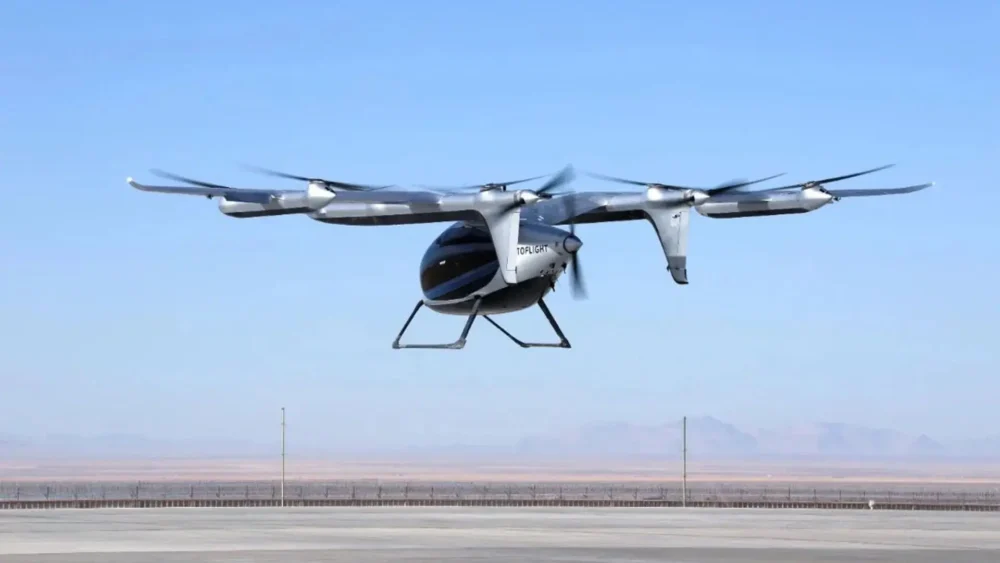
The battery will first appear in passenger aircraft produced by Shanghai-based AutoFlight. CATL has invested in AutoFlight as part of its push beyond conventional electric vehicles.
The companies have also worked together on a floating vertiport designed to connect sea and air transportation. A vertiport provides dedicated infrastructure where electric vertical takeoff and landing aircraft can arrive and depart.
In addition, their floating concept combines aircraft landing areas with solar power and energy storage systems. CATL said it plans to continue working with partners and research institutions to improve aviation battery technology.
Meanwhile, China has promoted commercial aviation below 1,000 metres through its growing low-altitude economy. CCID Consulting expects seven major manufacturers to begin delivering products before the end of 2026.
CATL already holds a dominant position in the global electric vehicle battery business. The company held 39.9 per cent of that market during the first half of 2026.
Manufacturers installed 242.7 gigawatt-hours of CATL batteries during the period. Furthermore, aviation gives CATL another market as battery-powered transportation expands from roads into marine and aerial applications.
.