Sony AI's ping-pong robot 'Ace' is putting professionals to shame
First it was video creation, mathematics and writing, now it's table tennis
 Rowan Dunne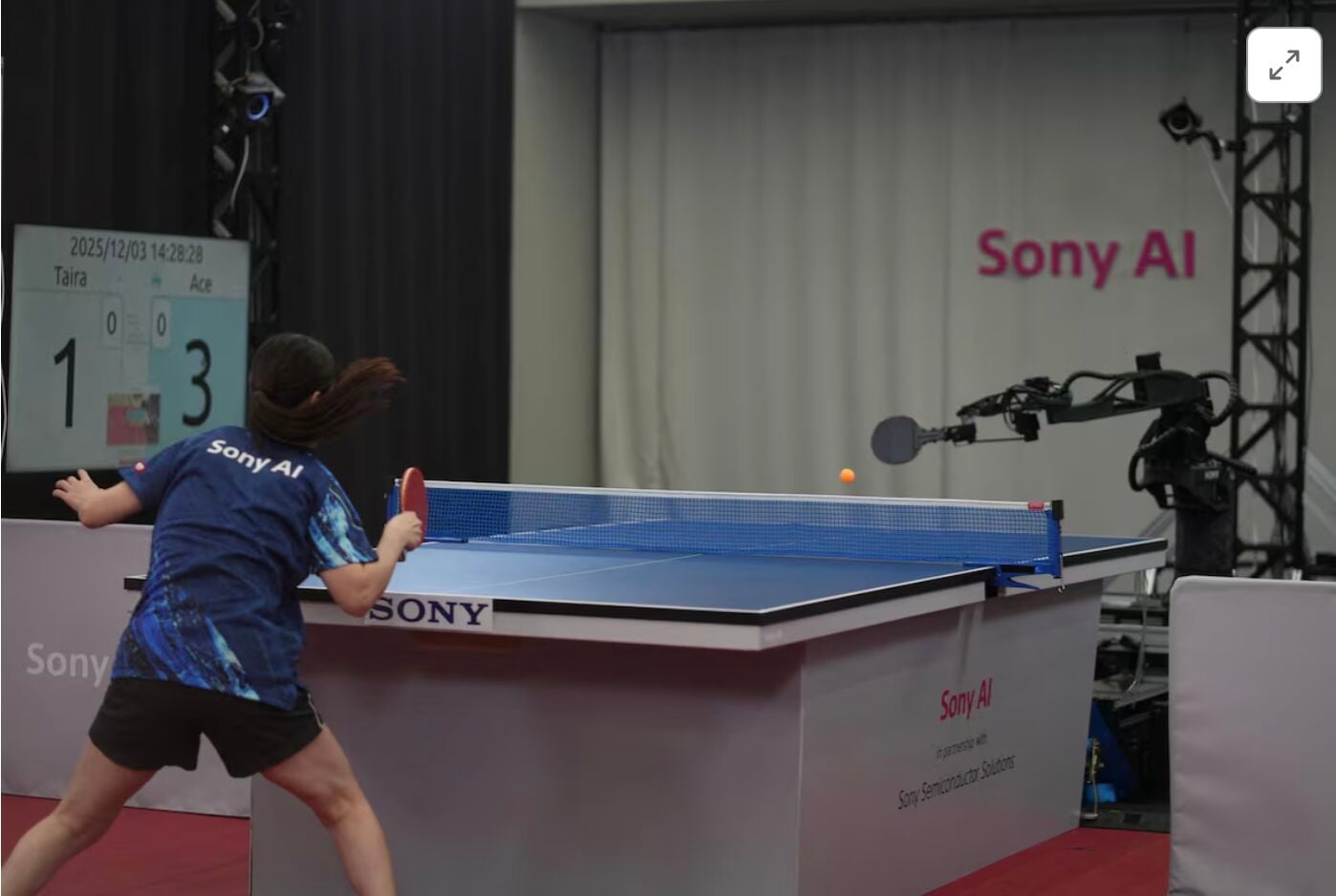
Researchers from the artificial intelligence division of Sony Group Corp NYSESONY OTCMKTSSNEJF revealed a major breakthrough this month by introducing Ace, an advanced table tennis robot that can defeat elite human players.
The team unveiled the achievement in Tokyo through competitive matches and a detailed study published in the journal Nature. Engineers equipped Ace with high-speed cameras and vision sensors that track the ping-pong ball’s position and spin accurately with minimal delay.
Reinforcement learning in detailed simulations taught the robot to adapt its movements during live rallies and the team transferred those skills into precision robotic hardware.
“This research breakthrough highlights the potential of physical AI agents to perform real-time interactive tasks,” said Sony AI Director Peter Dürr in a news release, “and represents a significant step toward creating robots with broader applications in fast, precise and real-time human interactions.”
This development builds on decades of earlier table tennis robot efforts that typically used predictable ball launchers, covered limited areas or avoided complex spin and full competitive rules.
Sony’s engineers created a fully autonomous system that serves, rallies and returns shots under official International Table Tennis Federation conditions. In testing, the robot won three out of five matches against elite players with more than 10 years of training and performed competitively against professionals.
Frank Vrancken Peters, CEO of Springer Nature (publisher of Nature), tried his luck in a game with Ace last week and had a difficult time keeping up with its advanced skills.
“The findings show just how far AI and robotics have come,” he said.


$SONY AI says its autonomous ping pong robot, Ace, became the first robot to reach expert-level performance in a physical sport, beating elite and some professional players under official table tennis rules.
Read more: Yet another scare: AI teaches scientists how to make bioweapons
AI continues to outperform us in sports, other fields
Most recently, Honor engineers created an AI-integrated humanoid robot named Lightning that won the Beijing E-Town humanoid robot half-marathon. This occurred on Apr. 19.
The significance here is that Lightning finished the 21-kilometre course in 50 minutes and 26 seconds. This time beat the human world record by several minutes and left thousands of human runners far behind. Its efficient motors, specialized leg design and autonomous navigation enabled sustained high speeds. Additionally, robots don’t face the physiological limitations that humans do.
Outside of the sports realm, AI systems have also been excelling humans in the field of medicine. A Harvard-led study published on Apr. 30 showed that advanced models such as OpenAI’s o1 outperform physicians in emergency room triage and diagnostic tasks. The AI identified correct or near-correct diagnoses more frequently and recommended appropriate next steps with higher accuracy under pressure. Further validation is required nonetheless.
In creativity assessments, generative AI recently surpassed average human performance. Researchers compared AI outputs to those from more than 100,000 people on standardized tests and found the systems generating more original ideas on well-defined tasks, although the most imaginative humans still stand out. This research was completed by the University of Montreal in January.
This array of occurrences highlights the rapidly evolving nature of AI technology and its ability to surpass human capabilities. What once seemed like science fiction is now today’s reality, suggesting that the true test ahead is not whether machines can keep improving but how humanity chooses to evolve with them.
Read more: Humanoid robot beats human half-marathon record in Beijing race
Follow Rowan Dunne on LinkedIn
rowan@mugglehead.com