OpenAI Navier-Stokes breakthrough sparks data privacy controversy
The Navier-Stokes problem is one of six remaining Millennium Prize Problems
 Joseph Morton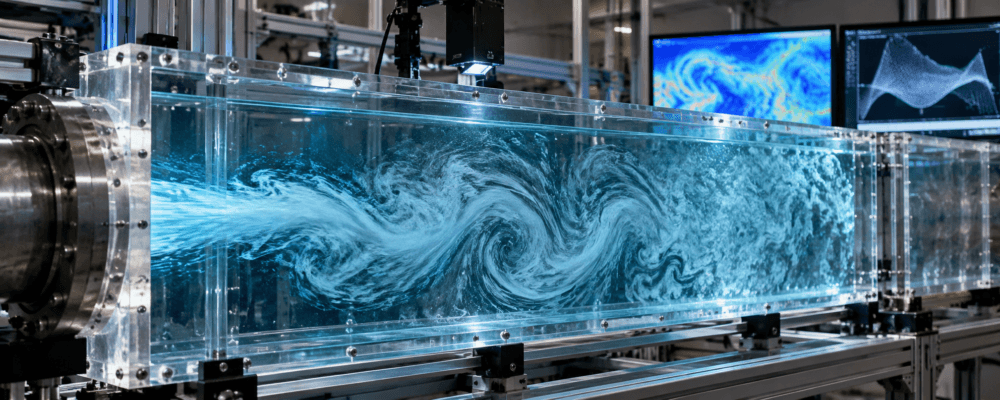
OpenAI is facing questions about research ethics and data privacy after its new artificial intelligence model reportedly solved a famous mathematical problem using an approach similar to two researchers’ unpublished work.
The company announced Tuesday that its internal model had produced a proof for the Navier-Stokes existence and smoothness problem. OpenAI said 10,000 AI agents completed the work in about 88 hours. However, mathematicians Tristan Buckmaster and Levent Alpöge had spent roughly a year pursuing a closely related and unusually specific approach.
The Navier-Stokes problem is one of six remaining Millennium Prize Problems, a group of difficult mathematical challenges spanning several disciplines. A successful solution carries a USD$1 million prize.
Navier-Stokes equations describe how fluids move and have applications ranging from aircraft aerodynamics to blood flow. Engineers routinely calculate approximate solutions for practical applications. However, mathematicians still do not know whether fluids governed by the equations always behave smoothly under every possible condition.
Buckmaster, a mathematician at New York University, had been working with Alpöge, an employee of OpenAI competitor Anthropic. The pair used an idea derived from work by Diego Córdoba and Luis Martínez Zoroa. Additionally, they employed several AI models while extending the approach to the Euler equations.
The Euler work represented an important step toward solving the Navier-Stokes problem. Buckmaster described the approach as highly unusual and said almost nobody he knew was pursuing it. He also argued that researchers would not likely discover that direction within days simply by presenting an AI model with the problem.
Read more: USC researchers use quantum AI to improve cancer imaging
Read more: Galaxy launches USD$5M Bitcoin quantum readiness initiative
OpenAI tested its new model against prize problems
Buckmaster said the pair made substantial progress on Aug. 15 and verified their result by Aug. 22. Subsequently, they began working to understand the proof and prepare it for publication.
OpenAI said it began training a new internal model on Aug. 28. The company reported that the model demonstrated unprecedented performance on its internal benchmarks, including mathematics.
Meanwhile, rumours began circulating that researchers had solved two Millennium Prize Problems. OpenAI said it heard those rumours on Sept. 1. Consequently, the company tested its new model against every remaining Millennium Prize Problem and several other major mathematical challenges.
Buckmaster and Alpöge also heard the rumours. Buckmaster said Alpöge received information suggesting details about their progress had reached OpenAI. He contacted someone at the company on Sept. 3.
Three days later, Buckmaster spoke twice with OpenAI mathematician Sebastien Bubeck and another unnamed company researcher. During those conversations, Buckmaster asked whether OpenAI’s model had accessed or trained on their Codex sessions containing project drafts.
Buckmaster said he was told the model did not look up user data. However, he said he received no answer when he specifically asked about training.
Buckmaster said OpenAI then proposed coordinating publication of the research. One option involved the pair publishing their Euler result before OpenAI released its Navier-Stokes work while crediting them. Another involved Buckmaster writing a paper presenting OpenAI’s Navier-Stokes result and acknowledging the company’s model.
Under the second proposal, Alpöge would not participate because he worked for Anthropic. Buckmaster rejected both options and said he would publicly discuss the situation if OpenAI proceeded.
Read more: Quantinuum secures USD$100M CHIPS award for quantum computer manufacturing
Read more: Snowflake jumps up 22% on latest earnings and boosted guidance
Sam Altman said company did not rush to publication
Additionally, Buckmaster alleged someone on the call asked why he would risk ruining his career by going public. He said another response suggested the speaker did not need to remain nice. Buckmaster nevertheless stopped short of accusing OpenAI of plagiarism or improperly using their data.
Bubeck subsequently rejected what he called false and inflammatory allegations. He said he wanted to coordinate the releases and approached the discussions with good intentions.
Bubeck also denied asking for Alpöge’s removal from authorship of his own research. Instead, he said he suggested Buckmaster lead a rewrite of OpenAI’s proof. He considered having an Anthropic employee author OpenAI’s work inappropriate.
Meanwhile, Bubeck apologized for his remark about Buckmaster risking his career. He said he meant to encourage cooperation rather than threaten the mathematician and retracted the comment during their conversation.
Bubeck said OpenAI did not see Buckmaster and Alpöge’s work before its public release. Furthermore, he said the proofs differ substantially and even address different precise results involving the Euler equations.
OpenAI chief executive Sam Altman also defended the company. He said he would have preferred coordination between the researchers and OpenAI. Additionally, Altman said the company did not rush its publication despite receiving what he described as unfounded plagiarism accusations.
OpenAI said none of its researchers or AI agents saw the pair’s data before public release. The company also said it did not access specific user data to solve the problem.
However, OpenAI acknowledged it cannot completely exclude an indirect connection. The company said de-identified information derived from researchers’ use of its products could have helped improve its models, although it considered that possibility unlikely.
Read more: Palo Alto CEO sees USD$1 trillion cybersecurity overhaul driven by AI
Read more: Oklahoma data center leak drains 3 million gallons, closes schools
Situation raises questions about privacy and trust
The dispute has generated concern among mathematicians about how AI companies handle unpublished research. University of Sydney mathematician Zsuzsanna Dancso said scientific norms require researchers to acknowledge both sources and collaborators.
Meanwhile, Monash University mathematician Melissa Lee said the situation raises questions about privacy and trust. Researchers increasingly use AI systems while developing unpublished ideas, creating uncertainty about how companies may process that information.
Many education and enterprise AI services claim customer data is not used for model training. However, Lee expects researchers to scrutinize those assurances more closely following the dispute.
Scientists using AI during research want confidence that unpublished ideas will remain protected from competing research efforts. In addition, the controversy raises questions about assigning credit when AI systems contribute substantially to scientific discoveries.