Flock Safety calls for compromise as US surveillance backlash grows
Langley argues that policymakers should balance civil liberties with public safety rather than ban the technology outright
 Joseph Morton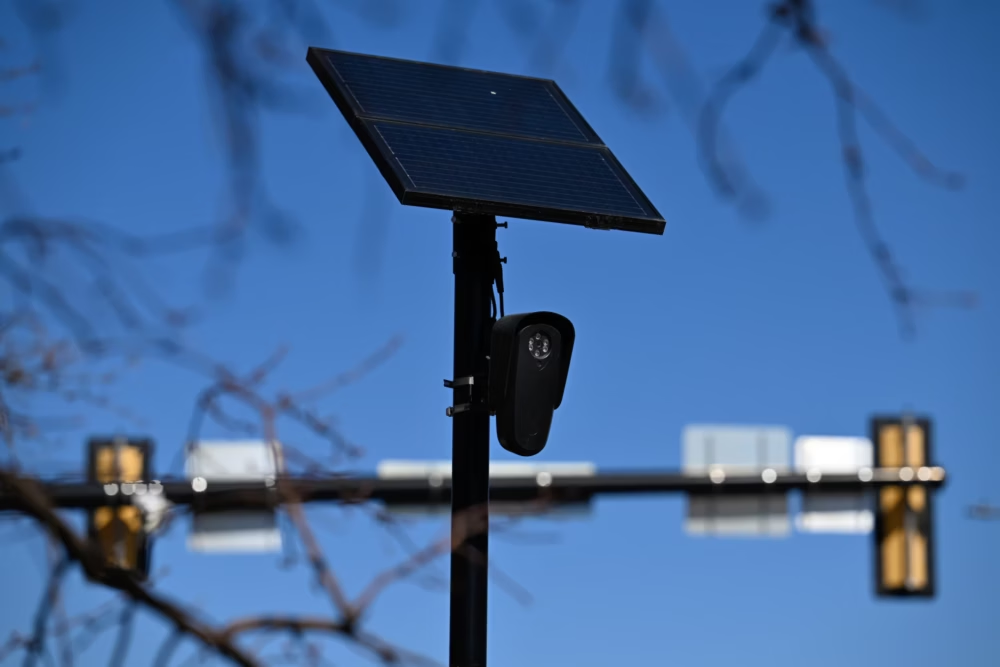
Flock Safety CEO Garrett Langley is calling for compromise on mass surveillance as Americans increasingly push back against automated license plate readers.
The Atlanta-based technology company operates more than 120,000 automated license plate readers and cameras across the United States. Its network collects billions of vehicle-location records each month for more than 5,000 law enforcement agencies.
However, mounting concerns about police misuse and corporate surveillance have triggered opposition from citizens, courts and local governments.
Langley argues that policymakers should balance civil liberties with public safety rather than ban the technology outright. The company has also introduced new safeguards as criticism of its nationwide surveillance network grows.
At least 56 municipalities have deactivated, cancelled or rejected Flock contracts because of privacy and misuse concerns. Los Angeles, Cambridge and Eugene are among the cities that have paused or ended agreements.
Meanwhile, some opponents have taken direct action against the physical camera network.
Vandals have destroyed or obstructed dozens of surveillance camera poles across the country. An Ohio grand jury recently refused to indict a man who was recorded destroying a Flock camera pole.
Additionally, Florida law enforcement deployed 3D-printed decoy cameras to catch people targeting surveillance equipment. Authorities charged one man with three felonies after he allegedly destroyed three decoys.
The backlash follows investigations showing that some police officers used surveillance databases for personal purposes.
A Washington Post investigation identified at least 50 cases involving officers accused or charged with misusing automated surveillance systems. Forty-six of those incidents involved Flock equipment.
More than half involved officers allegedly tracking romantic partners, spouses or former girlfriends.
Read more: Palo Alto Networks, AT&T launch quantum-resistant cybersecurity platform
Read more: Canada launches CAD$900 million defence strategy to advance quantum and AI capabilities
Flock safeguards have failed to prevent inappropriate searches
In addition, a Texas officer used a vast camera network while investigating a woman who had received an abortion. The officer queried a network containing 83,000 cameras while presenting the investigation as a missing-person case.
Privacy advocates have also discovered local camera information reaching federal immigration authorities despite municipal policies restricting that access.
Consequently, critics argue that Flock’s safeguards have failed to prevent unauthorized or inappropriate searches across its expanding network.
Flock has responded by reducing its default footage retention period from 30 days to seven days. Police officers must also provide an active investigation case code before searching the database.
Furthermore, the company expanded an automated auditing system designed to identify unusual activity and suspend suspicious accounts.
Langley argues that Flock’s technology exposes existing police misconduct rather than causing officers to misuse their authority. However, civil liberties groups have criticized the changes as insufficient.
The American Civil Liberties Union argues that shorter retention periods do not address broader concerns surrounding mass location tracking. Critics also note that agencies can preserve information beyond seven days through the platform’s Evidence Mode.
Flock’s nationwide reach creates another challenge for governments attempting to regulate access to vehicle-location information.
Thousands of individual jurisdictions can contribute information to systems capable of following vehicles across municipal and state boundaries. Consequently, oversight can become fragmented even when individual cities adopt stricter privacy rules.
Private surveillance companies can also establish default data policies affecting millions of drivers without lawmakers approving those standards.
Meanwhile, municipalities continue reconsidering whether the crime-fighting benefits justify widespread collection of vehicle-location information.
Read more: BMW and Quantinuum deepen multi year quantum computing alliance
Read more: U.S. to let private companies launch offensive cyber operations
Stronger warrant requirements needed: ACLU
The growing resistance has increasingly shifted attention toward legislation rather than voluntary corporate safeguards. Civil liberties advocates have called for stronger warrant requirements governing police access to automated license plate databases.
Further, critics want lawmakers to establish clearer limits on retention, data sharing and searches unrelated to active criminal investigations.
Flock maintains that its technology can help police solve crimes while preserving reasonable privacy protections. The expanding municipal backlash will continue testing whether governments accept that balance.
Flock’s license plate readers form part of a broader expansion of surveillance technology across U.S. law enforcement.
Police agencies increasingly use facial recognition, drones, cell-site simulators, gunshot detectors and interconnected camera networks to collect and analyze information. Additionally, real-time crime centres can combine several of these technologies into centralized systems that allow police to track events as they unfold.
The Electronic Frontier Foundation’s Atlas of Surveillance has documented more than 15,000 law enforcement deployments of surveillance technologies nationwide.
.