
The Trump administration is backing a major African railway project as Washington seeks greater access to critical minerals and challenges Chinese dominance.
Portugal’s largest construction company, Mota-Engil SGPS SA (ELI: EGL), is expected to take control of the Congolese section of the Lobito Corridor. The Congolese government and Mota-Engil signed an agreement on Wednesday in Kinshasa.
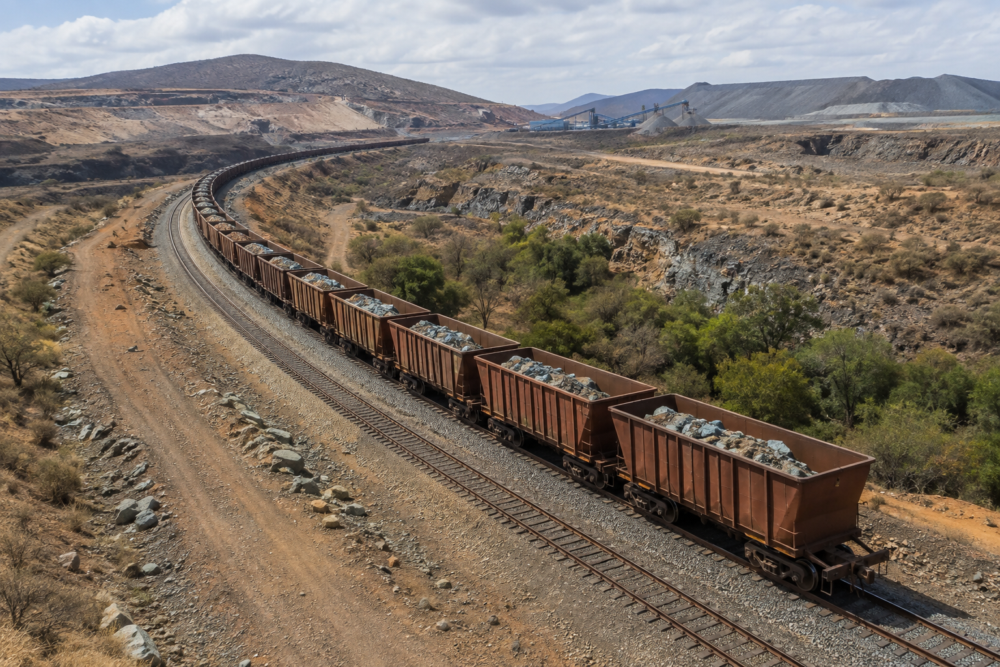
The roughly 1,000-kilometre railway connects major mining centres including Kolwezi, Tenke and Lubumbashi with the broader regional transport network.
It ultimately provides miners with access to Angola’s Atlantic port of Lobito and international markets.
Additionally, the US International Development Finance Corporation signed a letter of interest with Mota-Engil in December.
The agency proposed financing of up to USD$1 billion to support rehabilitation and operation of the Congolese railway.
Mota-Engil already operates part of the Lobito Corridor in Angola through a joint venture with commodities trader Trafigura.
Consequently, the Congolese concession would expand the company’s role across one of Africa’s most strategically important mineral transportation networks.
The project also supports Washington’s effort to build supply chains that rely less heavily on China.
The Democratic Republic of Congo ranks as the world’s second-largest copper producer and its largest source of cobalt.
Both metals play important roles in electric vehicles, renewable energy systems, electronics and other advanced technologies.
However, Chinese companies hold extensive interests across the DRC’s copper and cobalt mining and processing industries.
Washington has responded by pursuing closer economic ties with Kinshasa and supporting infrastructure that can carry minerals toward Western markets.
Meanwhile, the Lobito Corridor offers an alternative export route for Central African producers that traditionally depend on other regional transportation networks.
Read more: NevGold Corp’s Limousine Butte drill program targets first Gold-Antimony resource estimate
Read more: GoldMining chooses to retain its NevGold shares for next 18 months
China is pursuing its own major railway investment
The railway has increasingly been viewed by Washington as a strategic component of its broader African critical-minerals policy.
China is pursuing its own major railway investment on the other side of the continent.
Beijing is advancing a USD$1.4 billion overhaul of the Tanzania-Zambia Railway, commonly known as TAZARA.
Furthermore, that railway connects Zambia’s copper belt with the Indian Ocean port of Dar es Salaam in Tanzania.
The rival projects place transportation infrastructure alongside mines and processing plants in the expanding competition for critical-mineral supply chains.
In addition, control over reliable rail and port infrastructure can influence where African copper and cobalt reach international buyers.
The Lobito investment forms part of a broader US effort to secure critical mineral supplies at home and abroad. Washington has also backed mining and processing projects through loans, grants and direct investments.
Additionally, the Export-Import Bank approved up to USD$10 billion for Project Vault, a strategic critical minerals reserve. The administration has also invoked the Defense Production Act to strengthen domestic supplies and reduce reliance on mineral supply chains controlled by geopolitical rivals.
China’s dominance remains a central concern because it leads global production of dozens of mineral commodities and controls important processing capacity. The US expanded its critical minerals list to 60 commodities in 2025, adding copper, silver and uranium among others.
Washington has also taken the unusual step of buying stakes in mining and processing companies, including MP Materials Corp (NYSE: MP), Lithium Americas Corp. (NYSE: LAC) (TSE: LAC) and Trilogy Metals Inc. (NYSE American: TMQ) (TSE: TMQ)
Additionally, the administration has pushed more domestic mining projects onto the FAST-41 permitting system.
Read more: Antimony recovery results from NevGold’s Limo Butte project exceed expectations
s
Policies represent an increasingly direct government effort
The program provides greater coordination and transparency during federal reviews, potentially helping projects navigate permitting more efficiently.
Together, the policies represent an increasingly direct government effort to build mineral supply chains outside China.
Smaller miners are also positioning US gold-antimony projects as potential alternatives to foreign supply. NevGold Corp (CVE: NAU) (OTCMKTS: NAUFF) (FRA: 5E50) is advancing Limousine Butte in Nevada, including a potential near-term antimony operation using historically mined material.
Meanwhile, Perpetua Resources Corp (TSE: PPTA) (NASDAQ: PPTA) is developing Idaho’s Stibnite gold-antimony project with substantial US government support. The company also opened an antimony processing pilot plant with Idaho National Laboratory in July.
United States Antimony Corp (NYSEAMERICAN: UAMY) is expanding domestic processing capacity and supplying antimony to the Defense Logistics Agency. Additionally, the company received USD$27 million under the Defense Production Act to expand its US operations.
NevGold is a sponsor of Mugglehead news coverage