
New results from Bristol Myers Squibb (NYSE: BMY), BioNTech (NASDAQ: BNTX), Johnson & Johnson (NYSE: JNJ), Pfizer (NYSE: PFE), Kelun and others showed progress across multiple non-small cell lung cancer (NSCLC) subtypes, including patients with RET, EGFR and ALK mutations.
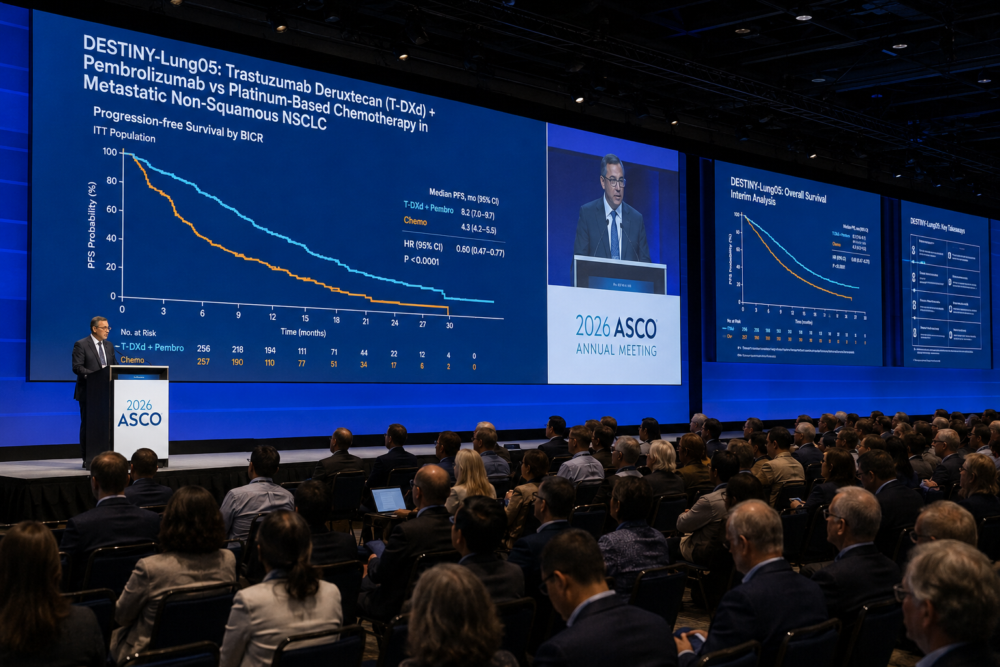
Lung cancer research took centre stage between May 29 to June 2, 2026 at the 2026 American Society of Clinical Oncology congress in Chicago as drug developers unveiled new data for several experimental and approved therapies targeting hard-to-treat forms of the disease.
The findings come as lung cancer remains the world’s deadliest cancer. According to the World Health Organization, it causes more cases and deaths than any other cancer globally.
One of the most closely watched presentations involved Bristol Myers Squibb and BioNTech’s investigational PDL-1/VEGF bispecific antibody pumitamig. Researchers presented interim Phase II data from the ROSETTA Lung-02 study, which is evaluating the therapy alongside chemotherapy in previously untreated NSCLC patients.
Among 40 evaluable patients, the treatment achieved an overall response rate of 70 per cent. Additionally, two patients experienced complete responses while 26 achieved partial responses.
The strongest activity appeared in patients with squamous disease. Nine of 11 patients receiving the 1400-milligram dose achieved a response rate of 81.8 per cent. Researchers also reported Grade 3 or higher adverse events in 44.2 per cent of patients. However, only 18.6 per cent of cases were considered related to pumitamig.
Jefferies analysts said the early data compared favourably with competing PD-1/VEGF therapies. Furthermore, they noted that treatment-related discontinuations appeared numerically lower than rates reported in studies involving Merck’s Keytruda.
Read more: Prestigious medtech intelligence firm recognizes Breath Diagnostics for innovation
Read more: Breath Diagnostics completes install of advanced mass spectrometry system
Pfizer reported encouraging early results
The analysts also suggested efficacy and safety differences between major PD-(L)1xVEGF candidates remain difficult to distinguish. Consequently, they believe future competition may depend on combination strategies involving antibody-drug conjugates.
Meanwhile, Pfizer reported encouraging early results for its own PD-L1/VEGF candidate, PF-08634404.
The therapy produced confirmed overall response rates ranging from 64 per cent to 75 per cent in frontline NSCLC studies conducted in China. Additionally, responses occurred regardless of patients’ PD-L1 status. Kelun attracted attention with data supporting a regulatory filing for its selective RET inhibitor lunbotinib fumarate.
The company presented results from a pivotal Phase II trial involving 163 treatment-naïve and previously treated patients with RET-positive NSCLC. Lunbotinib fumarate achieved confirmed overall response rates of 81.3 per cent among treatment-naïve patients and 87.1 per cent among previously treated patients.
Researchers have not yet reached median progression-free survival among treatment-naïve participants. However, previously treated patients achieved a median progression-free survival of 27.5 months. The therapy also demonstrated activity against brain metastases. Among 40 patients with central nervous system involvement, investigators recorded an intracranial response rate of 30 per cent.
Most treatment-emergent adverse events remained Grades 1 or 2. Additionally, only 1.2 per cent of patients discontinued treatment because of treatment-related side effects. Kelun now plans to seek approval from China’s National Medical Products Administration.
Meanwhile, privately held Ellipses Pharma continues evaluating the therapy in a global Phase II study.
If regulators eventually approve the drug internationally, it would compete with therapies such as Eli Lilly (NYSE: LLY) Retevmo and Roche Holding and Blueprint Medicines, and Gavreto.
Read more: Breath Diagnostics leaders promote their mission at Miami investment conference
Read more: Breath Diagnostics leader speaks at lung cancer education event in Louisville
Earlier outcomes focused on tumour response rates
Johnson & Johnson also presented new data for its Rybrevant and Lazcluze combination in patients with atypical EGFR-mutated NSCLC.
The company released updated findings from the ongoing CHRYSALIS-2 Phase I/Ib study. Researchers are evaluating the combination in patients with uncommon EGFR mutations. While earlier analyses focused on tumour response rates, the latest presentation emphasized long-term survival outcomes.
Investigators reported a median overall survival approaching three and a half years. Additionally, 55 per cent of patients remained alive after three years. A further 46 per cent survived at least four years following treatment.
Researchers also observed consistent activity across different atypical EGFR mutation groups. Many patients remained on therapy for extended periods. Furthermore, 41 per cent continued receiving Rybrevant treatment for at least two years.
Most treatment-emergent adverse events remained Grades 1 or 2.
The results could prove particularly important for patients with atypical EGFR mutations.
These mutations account for roughly 10 per cent to 20 per cent of EGFR-driven lung cancers. However, patients often experience poorer outcomes than those with more common EGFR alterations.
Study investigator Joel Neal of Stanford University said the data suggest the combination may provide longer-lasting disease control than currently available options.
He added that extended follow-up could influence future treatment approaches for this patient population.
Regulators in the United States, Europe and the United Kingdom have already approved the Rybrevant-Lazcluze combination for advanced or metastatic NSCLC with EGFR exon 19 deletions or exon 21 L858R substitution mutations.
Pfizer also used the conference to present seven-year follow-up data for its ALK inhibitor Lorbrena.
Read more: Breath Diagnostics opens Respiratory Innovation Summit with captivating presentation
Read more: Breath Diagnostics now offering a compelling investment opportunity
Therapy options get mixed results
The Phase III CROWN trial compares Lorbrena against Pfizer’s earlier therapy Xalkori in previously untreated ALK-positive advanced or metastatic NSCLC patients.
At seven years, patients receiving Lorbrena maintained a 55 per cent likelihood of remaining alive without disease progression. Conversely, only 3 per cent of patients receiving Xalkori remained progression-free at the same time point. Researchers have not yet reached median progression-free survival among patients treated with Lorbrena.
The therapy also delivered strong protection against brain metastases. Investigators reported a 94 per cent reduction in the risk of intracranial disease progression. However, analysts pointed to central nervous system side effects as a continuing challenge.
Approximately 34 per cent of patients required dose reductions because of these effects. Additionally, 5 per cent discontinued treatment altogether. CROWN principal investigator Tony Mok of the Chinese University of Hong Kong said the long-term findings demonstrate unusually durable disease control.
He also noted that the therapy’s ability to delay progression and limit brain metastases could provide meaningful benefits for patients facing ALK-positive lung cancer. While drug developers continue to improve treatment options for lung cancer patients, many researchers argue that earlier detection could have an even greater impact on survival rates.
Lung cancer often remains undiagnosed until it reaches an advanced stage, when treatment becomes more difficult and outcomes worsen. Consequently, healthcare systems are increasingly seeking faster, less invasive and more accessible diagnostic tools that can identify disease before symptoms appear.
That demand has fuelled growing interest in alternative approaches beyond traditional imaging and tissue biopsies, including blood-based screening tests, breath analysis technologies and artificial intelligence-assisted diagnostic platforms.
Read more: Breath Diagnostics gives the public the chance to join the fight against cancer
Read more: Breath Diagnostics pioneers novel lung cancer breath test
Emerging alternatives challenge standard of care
Low-dose computed tomography, commonly known as low-dose CT, remains the current standard of care for lung cancer screening among high-risk populations. Multiple studies have shown that the technology can detect lung tumours before symptoms develop and reduce lung cancer mortality through earlier intervention. Consequently, healthcare authorities in several countries recommend low-dose CT screening for older adults with significant smoking histories.
Despite those benefits, adoption has remained lower than many public health experts hoped. Access remains a challenge in some regions, particularly in rural communities where specialized imaging equipment may not be readily available. Additionally, screening programs require patients to attend dedicated appointments, creating logistical barriers that can discourage participation.
Low-dose CT scans also generate a significant number of false-positive findings. These results can lead to additional imaging, invasive follow-up procedures and patient anxiety before physicians ultimately determine that no cancer is present. Furthermore, the scans expose patients to small amounts of radiation, which has prompted researchers to investigate complementary screening approaches that could reduce reliance on repeated imaging over time.
As a result, researchers and healthcare companies have intensified efforts to develop less invasive diagnostic technologies. Several emerging approaches aim to identify cancer through biological signals present in blood, breath or other bodily samples.
Among the most closely watched companies in the field are GRAIL, Inc. (NASDAQ: GRAL) which has developed blood-based multi-cancer detection technology, and Owlstone Medical Ltd., which focuses on breath-based biomarker analysis. Meanwhile, Breath Diagnostics Inc. is advancing its own breath-testing platform designed to identify lung cancer through volatile organic compounds found in exhaled breath. Together, these companies represent a broader shift toward faster, more accessible screening tools that could complement existing standards of care and potentially expand early detection efforts.
.