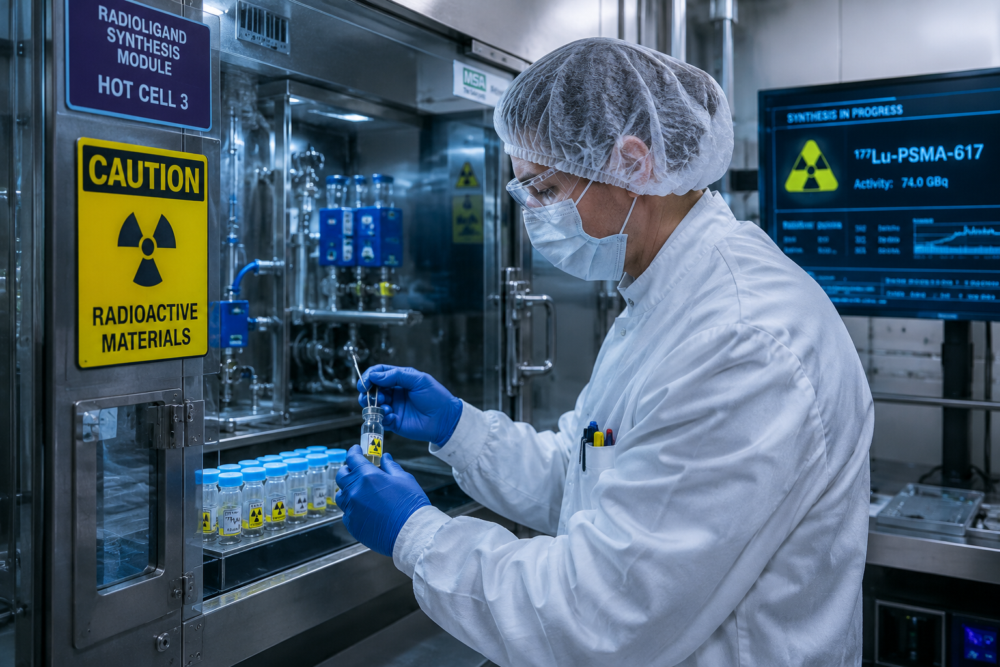

Novartis (SWX: NOVN) reported encouraging early clinical results on Sunday for an experimental prostate cancer treatment that uses the radioactive isotope actinium-225, as the company expands its presence in the growing radiopharmaceutical sector.
Data from a 101-patient study showed the treatment generated anti-tumour activity in several groups of patients. Additionally, 52.5 per cent of participants previously treated with Novartis’ approved prostate cancer drug Pluvicto experienced at least a 50 per cent decline in prostate-specific antigen, or PSA, levels after receiving the experimental therapy.
Doctors commonly use PSA levels to monitor prostate cancer progression and treatment response.
The strongest responses appeared among patients who had not previously received Pluvicto. Furthermore, more than 85 per cent of treatment-naive patients recorded PSA reductions of at least half. Another 58.8 per cent of patients who received chemotherapy before entering the study achieved the same benchmark.
Researchers presented the findings at the annual meeting of the American Society of Clinical Oncology in Chicago.
Analysts from TD Cowen said the data demonstrated clear effectiveness in the early-stage study. However, they noted that side effects could become an important consideration as development progresses. Dry mouth and severe anemia appeared among the more significant adverse events reported in the trial.
Novartis Chief Medical Officer Shreeram Aradhye said larger studies will be necessary to determine how severe those side effects may become and whether patients fully recover from them. Additionally, he indicated that researchers must better understand those risks before moving the therapy into earlier treatment settings.
Read more: Prestigious medtech intelligence firm recognizes Breath Diagnostics for innovation
Read more: Breath Diagnostics completes install of advanced mass spectrometry system
Interest in radiopharmaceutical treatments has accelerated
The Swiss drugmaker continues to increase its investment in radioligand therapies, which deliver radiation directly to cancer cells. Radioligand treatments now account for nearly 40 per cent of Novartis’ oncology research and development spending, according to Aradhye.
Meanwhile, the company has already advanced the experimental therapy into two late-stage clinical trials. Novartis currently markets both Pluvicto and Lutathera, which generated combined revenue of approximately USD$2.8 billion last year.
Interest in radiopharmaceutical treatments has accelerated across the pharmaceutical industry. Consequently, Eli Lilly (NYSE: LLY), Bristol Myers Squibb (NYSE: BMY), Bayer (ETR: BAYN) and AstraZeneca (LSE: AZN) have all acquired developers specializing in radioactive cancer therapies.
Unlike Pluvicto, which uses the beta-emitting isotope lutetium-177, the experimental treatment uses actinium-225, an alpha emitter. Aradhye said alpha-emitting therapies deliver greater energy over much shorter distances, potentially improving cancer-killing effectiveness while limiting damage to nearby tissue.
However, some analysts have warned that global actinium-225 supplies may struggle to meet future demand. In addition, Novartis has already begun securing future isotope supplies. In February, the company signed a long-term actinium supply agreement with U.S.-based isotope producer Niowave.
The radiopharmaceutical market has attracted significant investment as drugmakers seek more precise cancer treatments. According to market research firms, the global radiopharmaceuticals market was worth roughly USD$7 billion to USD$9 billion in 2024 and could exceed USD$20 billion by the early 2030s. Additionally, some industry forecasts project annual growth rates above 10 per cent as new therapies reach commercial use.
Major pharmaceutical companies have moved aggressively into the sector. Consequently, acquisitions involving radiopharmaceutical developers have totalled several billion dollars in recent years. Investors have focused particularly on prostate cancer and neuroendocrine tumour treatments, where targeted radiation therapies have already demonstrated commercial success.
.