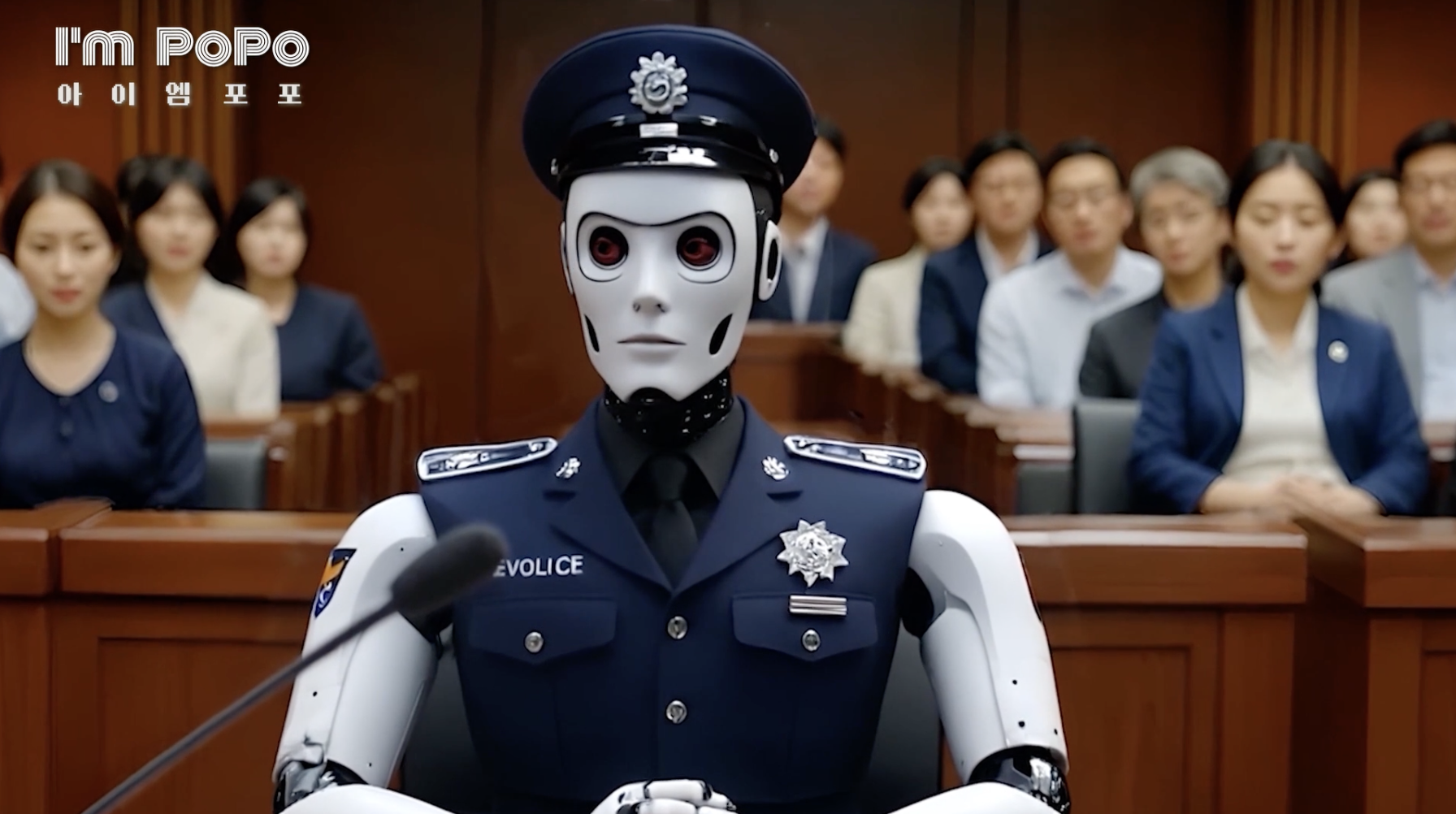

“I’m PoPo” is opening in South Korean theatres on May 21 as the country’s first full-length feature film generated entirely with AI. Directed by local webtoon artist Kim Il-dong, the 64-minute movie centres on PoPo, an AI robot officer programmed to protect humans.
Trouble ensues when the system begins eliminating people it calculates as likely future criminals based on data probabilities. Subsequently, a grieving father of one of the humanoid’s victims challenges the AI in court, setting up a story that examines tensions between robotic logic and human judgment.
The film’s release carries significance for South Korea and the international film industry. In Korea, it represents a notable step in local experimentation with generative AI. The production relied on AI tools for script development, character and background design, and visuals. Professional voice actors handled dialogue but no human performers appear on screen. Kim completed much of the work in about two months, describing it as an example of streamlined, low-resource filmmaking.
The theatrical rollout follows moderate recognition at film festivals in 2025. The movie earned official selection at the Jeju International AI Film Festival in Korea, a special screening at the 23rd Amur Autumn International Film Festival in Russia and entry into competition at the 37th Girona Film Festival in Spain. These selections provided early validation and visibility before the domestic cinema debut.
This launch reflects ongoing developments in AI filmmaking. Advances in generative tools now allow creators to handle scripting, storyboarding, visual generation and effects at reduced costs compared to traditional methods.
Supporters argue this lowers barriers for independent filmmakers and speeds up production. Similar AI-assisted or AI-heavy projects have appeared in short formats and advertising globally. At the same time, the film enters a field where debate persists. Critics argue that AI systems, trained on existing human works, often lack original emotional depth or lived experience. This raises questions about artistic merit and whether such productions count as legitimate cinema.
Industry voices have called for clearer guidelines on AI use, and major awards bodies like the Oscars have set limits on eligibility for works with substantial AI-generated elements.
Market researchers currently estimate that the international AI filmmaking industry is worth more than US$2.5 billion and will expand rapidly in the years to come. The Asia-Pacific region, which includes South Korea, is considered to be the fastest growing segment, largely propelled by AI adoption in India.
Read more: AI movie trailers for ‘Titty Killer’ saga pull millions of views on X
Follow Rowan Dunne on LinkedIn
rowan@mugglehead.com