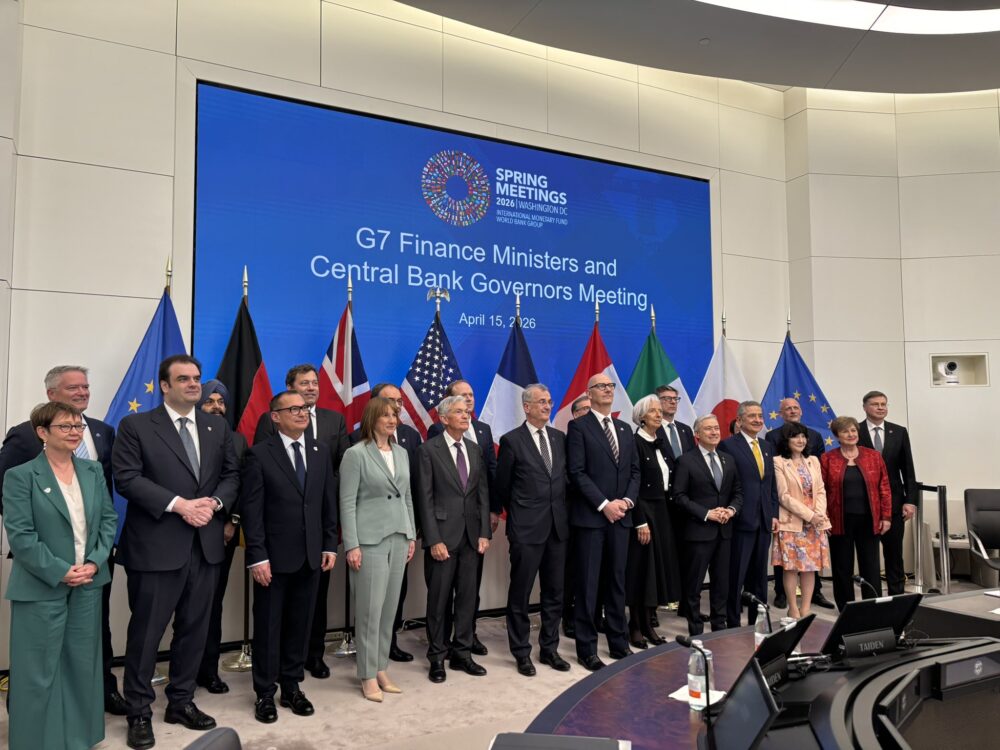

Finance chiefs from the Group of Seven (G7) agreed on April 17 to deepen cooperation on critical minerals and reduce reliance on China, following talks in Washington.
Officials said ministers met with partners from resource-rich nations, including Argentina, Australia, India, Indonesia, South Africa and South Korea. Additionally, leaders from global financial institutions joined the discussions.
Japanese Finance Minister Satsuki Katayama said the group focused on strengthening mineral supply chains across multiple regions. She added that broader sourcing would help stabilize supply while creating economic opportunities for producing countries.
Furthermore, Katayama described the effort as mutually beneficial, with both suppliers and buyers gaining from expanded cooperation. She suggested that resource-rich countries could unlock new business growth through these partnerships.
The meeting, co-chaired by France and Japan, included leaders from the World Bank and the Asian Development Bank. Meanwhile, officials emphasized the role of multilateral lenders in financing mining and processing projects.
A senior Japanese official said France, which holds the 2026 G7 presidency, is pushing a practical approach. Additionally, the plan focuses on developing joint business projects rather than formal trade blocs.
However, the initiative differs from a United States proposal introduced earlier in 2026. That plan aims to create a preferential trade zone for critical minerals among allies.
The US framework would set reference prices within the bloc using adjustable tariffs to manage market volatility. Conversely, the French-backed approach avoids price-setting mechanisms and prioritizes project-level cooperation.
China currently dominates the sector, mining roughly 70 per cent of global rare earths and refining about 90 per cent. Consequently, many countries rely heavily on Chinese supply for materials used in electronics, defence systems and clean energy technologies.
Read more: NevGold targets U.S. critical mineral supply chain with new antimony-gold find
Read more: NevGold expands high-grade antimony discovery at Nevada’s Limousine Butte Project
Multiple countries have taken steps
Officials said reducing that dependence remains a key objective for the G7 and its partners. Additionally, they expect collaboration with development banks to help fund new supply chains outside China.
G7 countries have accelerated efforts to reduce reliance on China for rare earths, combining policy reform, new supply sources and emerging technologies across the sector.
The United States has moved to fast-track domestic mining through initiatives like FAST-41, which streamlines permitting for major infrastructure and resource projects. Additionally, Washington expanded its critical minerals list to include materials such as lithium and antimony, aiming to secure broader supply chains.
Furthermore, US policymakers have supported projects like Perpetua Resources (NASDAQ: PPTA) (TSE: PPTA) Idaho antimony and gold development, positioning it as a domestic source of both defence-critical metals and precious metals. Consequently, the approach ties national security concerns directly to mining approvals.
Japan has taken a more aggressive technological route by pursuing rare earth extraction from the ocean floor. Additionally, Tokyo has advanced deep-sea mining tests near Minamitorishima, targeting mineral-rich mud several kilometres below the surface.
The project reflects a direct effort to build domestic supply after China restricted exports in past disputes. Furthermore, Japan has already reduced its dependence on Chinese rare earth imports significantly through diversification and recycling efforts.
Meanwhile, other G7-aligned efforts focus on processing rather than mining. Companies like UCore Rare Metals (CVE: UCU) (OTCMKTS: UURAF) are developing separation technologies designed to lower costs and simplify refining outside China. Additionally, these innovations aim to weaken Beijing’s dominance in downstream processing, where most rare earths are refined.
Read more: NevGold delivers major growth at Idaho gold project
Read more: Antimony recovery results from NevGold’s Limo Butte project exceed expectations
Policymakers increased funding for strategic projects
Exploration firms have also adjusted their messaging to align with shifting policy priorities. NevGold Corp (CVE: NAU) (OTCMKTS: NAUFF) (FRA: 5E50) has emphasized antimony alongside gold in its disclosures, signalling relevance to Western supply chains. Furthermore, highlighting critical minerals can attract government interest and financing support.
European and Canadian policymakers have also increased funding for strategic projects and partnerships with allied producers. However, these efforts remain fragmented compared to China’s vertically integrated system.
NevGold Corp is a sponsor of Mugglehead news coverage
.