
A mining company has applied for a U.S. deep-sea mining licence, positioning itself within a broader government push to secure critical minerals like lithium and antimony.
Deep Sea Minerals Corp. (FRA: X450) (CNSX: SEAS) said Tuesday that it submitted its application to the National Oceanic and Atmospheric Administration under the Deep Seabed Hard Mineral Resources Act.
Additionally, the move places the firm among early participants in a revived U.S. push into seabed mining. NOAA regulates mineral exploration by qualified U.S. entities in international waters. Furthermore, the agency recently committed to accelerating permit reviews to avoid delays. Officials said they would dedicate resources to ensure applications move through the system efficiently.
The application comes amid broader policy momentum from Washington. Last year, President Donald Trump signed an executive order aimed at strengthening domestic access to key minerals. In addition, the order targeted resources such as nickel, copper and manganese. Officials now view seabed mining as one potential supply solution. Meanwhile, the U.S. government has expanded its list of critical minerals to include lithium and antimony. These materials support batteries, electronics and defence systems.
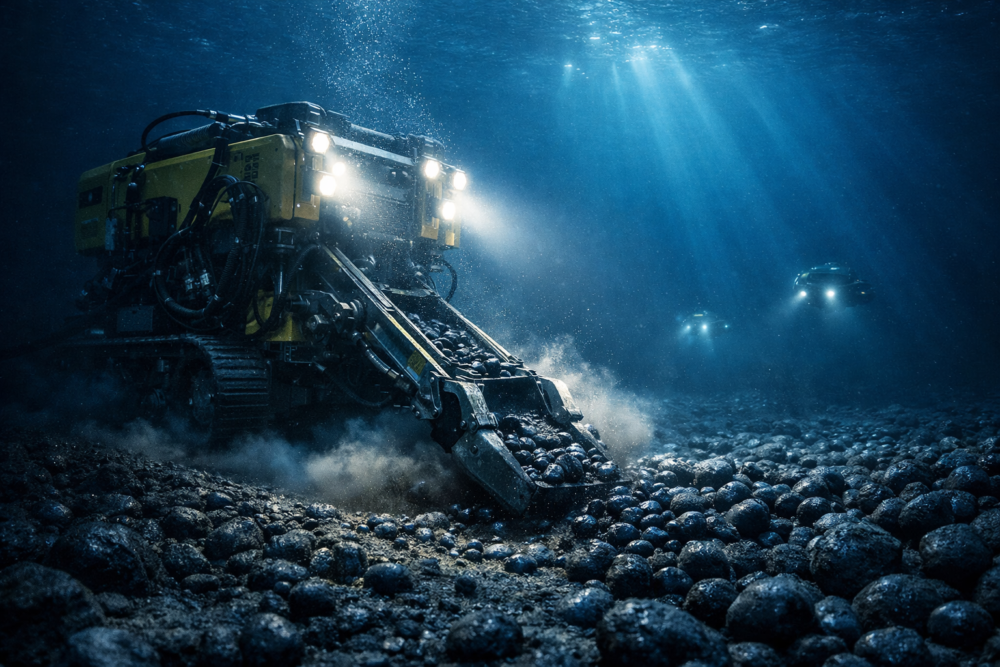
Deep Sea Minerals filed its application through its U.S. subsidiary, American Ocean Minerals Corp. The company seeks an exploration licence for polymetallic nodules in the Clarion-Clipperton Zone of the Pacific Ocean. Additionally, that region contains large deposits of nickel, cobalt and other valuable metals.
The submission includes technical and environmental data required by regulators. Furthermore, it outlines monitoring plans, mitigation measures and proposed exploration activities. The company also detailed expected expenditures tied to the program.
Read more: NevGold delivers major growth at Idaho gold project
Read more: NevGold reports high-grade antimony-gold hits as Limo Butte resource estimate nears
Seabed mining stirs geopolitical concerns
Chief executive James Deckelman said the filing marks an early step in the regulatory process. He indicated the company designed the application to meet NOAA requirements and support a phased exploration approach. Additionally, he said the plan includes ongoing environmental data collection and evaluation.
The Deep Seabed Hard Mineral Resources Act provides the legal basis for the application. Congress passed the law in 1980, and President Jimmy Carter signed it later that year. Consequently, the act created a U.S. framework for exploring and developing mineral resources in international seabed areas.
The legislation allows American companies to operate outside international agreements that remain unsettled. However, it also requires detailed environmental and operational disclosures before licences are granted. Regulators must review baseline data and proposed safeguards before approving exploration.
The renewed focus on seabed mining reflects growing geopolitical concerns. China currently dominates processing and refining for many critical minerals. Consequently, U.S. policymakers have prioritized supply chain independence in recent years.
The inclusion of lithium and antimony signals a shift in priorities. Additionally, antimony has gained attention due to its role in military applications and semiconductor manufacturing. Lithium remains essential for electric vehicle batteries and energy storage systems.
Mining companies have responded by adjusting their messaging. Meanwhile, several firms now emphasize antimony exposure in investor materials. They aim to align with government priorities and attract potential funding or procurement agreements.
This approach mirrors the trajectory of Perpetua Resources (NASDAQ: PPTA) (TSE: PPTA). The company advanced its Idaho-based Stibnite project with support tied to its antimony reserves. Furthermore, federal agencies provided funding and assistance linked to defence supply needs.
Read more: NevGold targets U.S. critical mineral supply chain with new antimony-gold find
Read more: NevGold mobilizes drill on Limo Butte historical pads, eyes 2027 antimony production
Shift reflects practical incentives
Other developers have followed that model. In addition, NevGold Corp. (CVE: NAU) (OTCMKTS: NAUFF) (FRA: 5E50) has drawn attention to antimony potential within its broader gold-focused portfolio. The company has increasingly framed those assets as strategically relevant under evolving U.S. policy priorities.
Additionally, companies with smaller antimony exposure now highlight those holdings alongside primary metals. They present projects as strategic assets that could support national security objectives.
Industry analysts say the shift reflects practical incentives. Government backing can improve project economics and reduce financing risks. Consequently, firms increasingly position themselves as partners in national resource strategies.
The Department of Defense and Department of Energy have expanded engagement with the sector. Additionally, programs now offer grants, loans and procurement pathways for qualifying projects. These initiatives aim to accelerate domestic production and reduce reliance on imports.
However, challenges remain for developers pursuing new projects. U.S. permitting processes can take years to complete. Meanwhile, environmental concerns continue to shape public and regulatory responses.
Deep-sea mining faces additional scrutiny from environmental groups. Furthermore, critics warn about potential ecosystem damage in largely unexplored ocean regions. Regulators must weigh those concerns against strategic resource needs.
Even so, companies continue to move forward with applications. Additionally, early entrants may gain advantages if regulatory approvals accelerate. Firms like Deep Sea Minerals now seek to establish positions within a shifting policy landscape.
.
NevGold Corp is a sponsor of Mugglehead news coverage
.