South Korea's AI bubble bursts, stock market plunges with US$2T lost
Disappointing results from SK Hynix was the primary catalyst for the plunge
 Rowan Dunne
South Koreans who invested heavily in the AI and semiconductor surge now stand in utter disarray, making comments as extreme as “my life’s screwed” after the bubble burst.
The nation’s equity market has tanked spectacularly, wiping out nearly US$2.2 trillion in value across the most recent trading sessions. On Jul. 28, the KOSPI KRXKOSPI plunged nearly 11 per cent, triggering a 30-minute circuit breaker trading halt. The following day it tumbled as much as 12.6 per cent intraday before closing 6 per cent lower, activating another halt. This represents the first consecutive circuit-breaker pair in the index’s history.
From its late-June peak the benchmark has shed almost 40 per cent. SK Hynix Inc KRX000660, the high-bandwidth memory chip specialist, led the carnage, falling 6 per cent on Wednesday and standing 55 per cent below its June high. Its latest financial results were the clearest immediate trigger of the broader slide as the company reported very strong profit growth but numbers that still fell short of high expectations built up around the AI boom. Additionally, Samsung Electronics Co Ltd KRX005930 dropped as much as 15 per cent over the past couple of days and remains 44 per cent lower than its peak last month.
Both had briefly topped US$1 trillion in market capitalisation on AI enthusiasm, but they now sit at about US$704 billion and US$923 billion respectively. Chip equipment maker Hanmi Semiconductor Co Ltd (KRX: 042700) and Jusung Engineering Co Ltd (KOSDAQ: 036930) were also hit hard, with losses exceeding 10 per cent during Tuesday’s session.
Social media has erupted in panic, with users calling it an absolute bloodbath and an AI bubble collapse. About 360,000 investors who borrowed money to buy shares had their holdings automatically sold off by brokers when prices fell.

🚨 BREAKING SOUTH KOREA JUST WIPED OUT A GENERATION OF INVESTORS. KOSPI down 44% in six weeks. Forced selling and liquidations are everywhere. Over 3% of the entire population has lost their whole trading account. Young Koreans couldn't afford homes in Seoul. So they turned Show more


JUST IN: More than $400,000,000,000 has been wiped out across the stock markets of South Korea, Japan, and Taiwan
Read more: Chipmaker CXMT becomes Mainland China’s top stock in explosive IPO
Should overseas investors be afraid?
Investors abroad holding AI-related chip exposure do not necessarily need to panic in lockstep alongside shareholders in Seoul, but caution remains warranted nonetheless. Lingering fear about inflated AI stocks is persistent in the west already. Global chip demand still remains dependent on broader infrastructure spending.
The stage for this slump was set over the past month. From late June the KOSPI flew on AI optimism, retail investors pouring margin loans that hit a record 38.6 trillion won and treating semiconductor funds like the Samsung KODEX SK Hynix Single Stock Leverage ETF (KRX: 0193T0) as long-term wealth vehicles.
Young workers priced out of housing and older savers liquidating insurance policies fuelled a speculative ascent that pushed the index toward 9,000 points, only for the first cracks to appear when Hynix’s latest results failed to live up to the hype.
The explosive Jul. 27 IPO of Chinese DRAM chip maker CXMTCorp (SHA: 688825), which raised US$8.6 billion and saw shares surge more than 460 per cent, further intensified fears of rising Chinese competition and helped accelerate the sell-off in Korean chip stocks.
“I regret failing to fully meet the public’s expectations and take the sharp rise in market volatility very seriously,” said South Korean Financial Services Commission Chairman Lee Eog-weon during a session at the National Assembly. He did not provide specifics about the pending actions.
“Measures will be swiftly implemented to stabilise the market, and additional measures will be reviewed depending on the market situation.”
Korean workers in their 20s and 30s could not afford Seoul apartments so they turned KOSPI into their housing trade (FOMO Case Study) They borrowed on margin at 3x, poured savings into 2x semiconductor ETFs, and treated short term trading tools as long term bets. When prices Show more
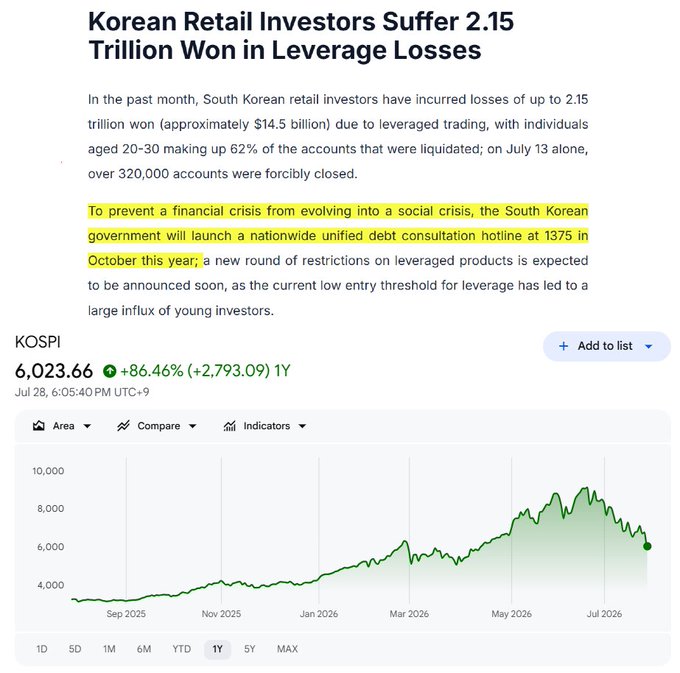

Koreans are surrendering life insurance policies to buy SK hynix, Insurance surrenders at the top 3 life insurers jumped 16% last quarter. Savings bank deposits fell below 100 trillion won for the first time in 4 years. Commercial bank time deposits dropped 12 trillion won

Read more: Artificial Intelligence and the invisible revolution: A Mugglehead roundup
Follow Rowan Dunne on LinkedIn
rowan@mugglehead.com