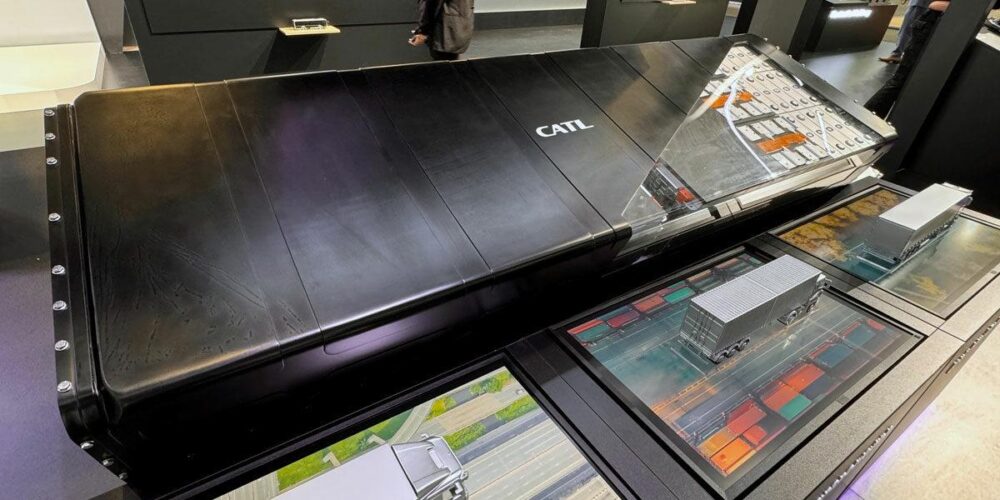

Contemporary Amperex Technology Co., Limited (CATL) (SHE: 300750) unveiled its next-generation TECTRANS II commercial vehicle battery platform at IAA Transportation 2026 in Hanover.
The Chinese battery manufacturer introduced the platform on Monday as a modular system for electric trucks and other commercial vehicles. Additionally, CATL designed TECTRANS II to support different vehicle sizes, payload requirements, charging systems and drivetrain configurations.
The company said commercial vehicles represent an emerging third wave of the global transition toward electric transportation. CATL executive Akin Li said the company intends to work with global partners as commercial vehicle electrification expands.
TECTRANS II uses standardized battery packs that manufacturers can combine in different numbers depending on vehicle requirements. Consequently, customers can adjust battery capacity without developing an entirely different battery system for each commercial vehicle.
The largest configuration can provide up to 1,000 kilometres of driving range, according to CATL. Furthermore, the platform works with both electric axle systems and central-drive architectures.
Operators can also configure TECTRANS II for conventional charging or battery swapping. The latter approach allows operators to replace depleted batteries instead of waiting for vehicles to recharge.
CATL standardized the platform’s external dimensions, electrical connections and communication systems. However, manufacturers can upgrade the underlying battery technology and pack designs as newer technologies become available.
The company said this approach could extend upgrades to existing vehicles without requiring major redesigns. Additionally, CATL claims the modular architecture can cut vehicle development cycles by 50 per cent.
Read more: American Battery Technology’s massive revenue spike fails to boost shares
Read more: US pours USD$500M into domestic critical minerals and battery supply chain
CATL designed truck battery with 12-year service life
It could also reduce research and development costs by between 60 per cent and 70 per cent, according to CATL. Those reductions could help manufacturers introduce new electric commercial vehicles more quickly and lower the costs of adapting existing designs.
TECTRANS II has a gravimetric energy density of 170 watt-hours per kilogram. CATL said that figure sits approximately 13 per cent above the industry average.
The higher density allows vehicles to carry about 0.6 tonnes of additional payload while maintaining the same battery capacity. Meanwhile, the maximum battery configuration can recharge to 80 per cent in 25 minutes using megawatt-level fast charging.
Faster charging could reduce the time long-haul electric trucks spend parked during their working day. In addition, CATL said its full-tab, low-impedance design delivers system round-trip efficiency of 96 per cent.
Round-trip efficiency measures how much stored electricity remains available after energy losses during charging and discharging. Higher efficiency means operators can use more of the electricity they purchase to move vehicles.
CATL has also designed the heavy-duty truck battery for a 12-year service life covering 1.5 million kilometres. The company expects the battery to retain 70 per cent of its original capacity after reaching that point.
Longer battery life could consequently improve the residual value of electric trucks after years of commercial service. Battery replacement costs remain an important consideration for companies deciding whether to electrify large vehicle fleets.
CATL also built several physical protections into the platform for demanding commercial environments. Its hot-formed steel upper cover can withstand a 180-kilogram person repeatedly stepping on it without permanent deformation, the company said.
Read more: CATL aviation battery passes key safety test for passenger eVTOLs
Read more: CATL introduces aviation-grade battery tech as EV race shifts to cost and scale
The platform includes multiple cybersecurity protections
Additionally, CATL tested the cover for 10,000 repetitions under those conditions. The battery’s bottom plate provides 1,000 joules of impact resistance against potential damage from roads and debris.
An extruded-aluminum enclosure with reinforcing ribs provides lateral crush strength of up to 250 kilonewtons. Furthermore, CATL designed the system to resist corrosion for 15 years in coastal and cold environments.
The platform also uses independent battery management controls across multiple branches. Consequently, the system can isolate a failed branch while other branches continue supplying power.
CATL included technology that identifies whether an insulation fault originated inside the battery or elsewhere in the vehicle. The company said this feature should help technicians diagnose problems more quickly.
In addition, the platform uses multiple cybersecurity protections covering its hardware, software and connections with the vehicle. CATL said it developed those protections around international information security standards.
The company has tested TECTRANS II through procedures including complete vehicle torsion and external fire testing. Those tests aim to simulate some of the stresses batteries could encounter during commercial operation.
Meanwhile, CATL announced a memorandum of understanding with DHL AG (ETR: DHL) at the Hanover transportation show.
The agreement expands on a partnership the companies established in September 2024. Additionally, CATL and DHL plan to develop what they call Green Freight Corridors across Europe.
The companies will combine DHL’s logistics network and transport experience with CATL’s battery technology and commercial vehicle electrification systems. They also plan to work with vehicle manufacturers and other partners on electric vehicles designed for specific commercial applications.
The partnership will subsequently launch pilot deployments to test those vehicles under real-world logistics conditions. CATL executive Zhu Lingbo said commercial vehicle electrification will likely unfold over more than a decade.