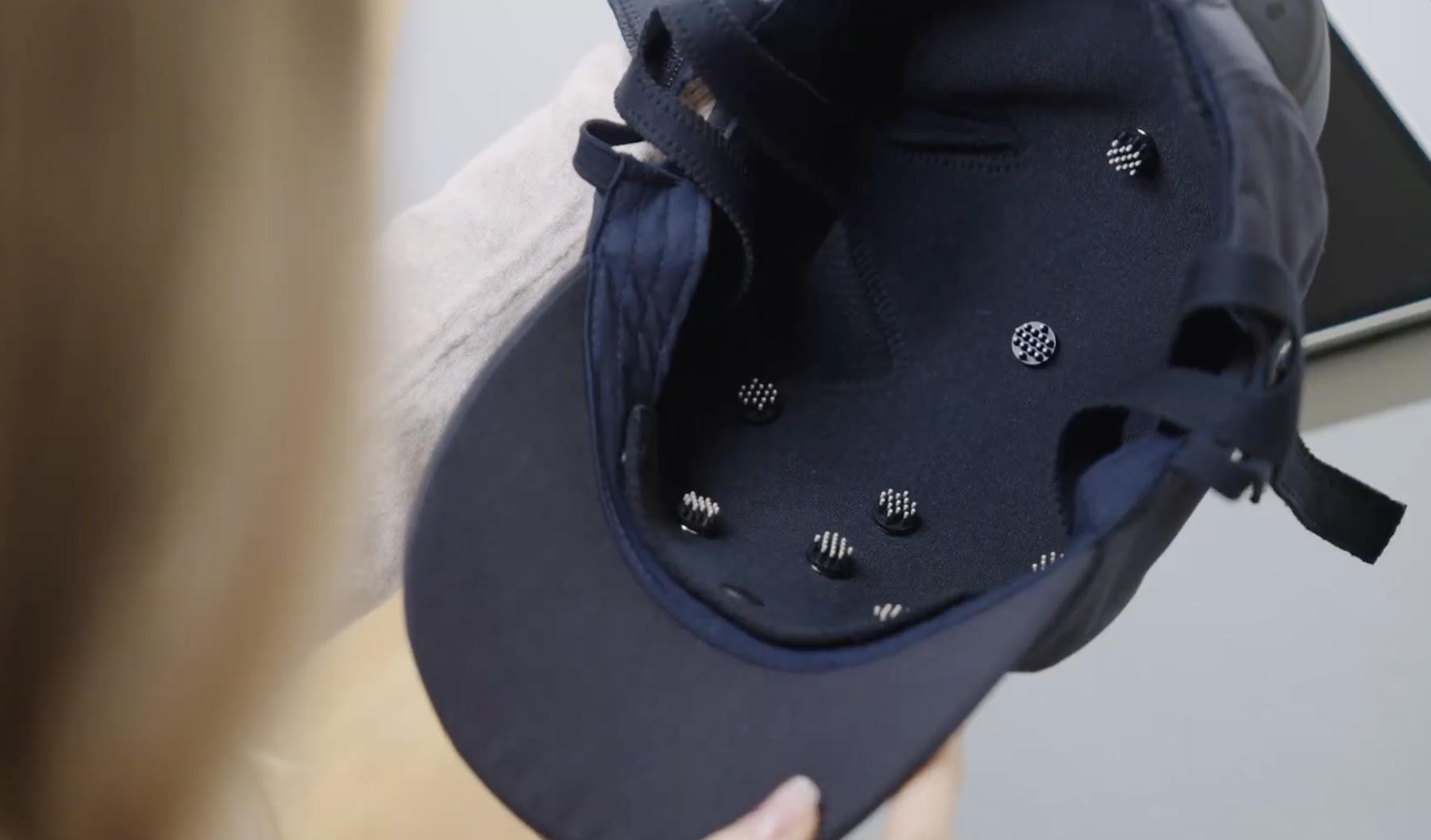

Universal Brain is a medtech firm that has been tackling a stubborn problem in mental health care: traditional brain function tests tend to demand messy gels, specialist technicians and lengthy sessions that leave patients restless and clinics inefficient. It has spent years working to alleviate this issue, turning what once felt like a considerable lab ordeal into merely putting on a baseball cap gadget for a few minutes.
Earlier this month the company secured FDA 510(k) clearance for its Universal Brain Event-Related Potentials (UB ERP) System, also known as the Neurotique platform. This dry-electrode electroencephalography (EEG) wearable now holds official approval for rapid brain-function measurement in psychiatry. Backed by US$7.9 million in seed funding and a recent US$2 million Japanese government grant, the milestone opens the door to routine clinical use and positions Universal Brain to roll out the special hat this summer across roughly 250 interested clinics.
It enables the firm to sell the devices and charge per-test fees while pursuing pharmaceutical partnerships and pilot studies that examine treatment response in depression and mild cognitive impairment. The clearance supplies a tool that supports more personalised decisions, potentially helping to accelerate central nervous system drug development.
In the simplest terms, the tech records the brain’s electrical chatter while a patient completes brief computer tasks that probe attention, reward processing or emotion. Dry electrodes rest on the scalp without any gel. The system records the brain’s signals, averages the responses that follow each stimulus, and identifies special wave patterns. These patterns show how the brain reacts to specific tasks. The entire process, from fitting the cap to generating a report, finishes in about five minutes and needs no specialised laboratory.
Electroencephalography itself began in the late nineteenth century when Liverpool physician Richard Caton first detected electrical currents on animal brains. German psychiatrist Hans Berger recorded the first human EEG in 1924, after which the technique matured into a clinical essential for epilepsy and sleep disorders. Digital systems then started arriving in the 1970s.
Universal Brain’s device sits firmly in the present chapter of this timeline while also pointing towards its future. This platform is built for everyday psychiatric clinics rather than complex research labs, delivering cognitive metrics more efficiently. It shows how EEG technology is evolving.
“We believe this technology will significantly advance neuroscience research and improve the care in neurology and psychiatry,” said chief executive Kazu Okuda.
Although all of this sounds great, it should be noted that “interested clinics” are not quite the same as paying ones and FDA clearance is a thumbs-up for safety, not a guarantee that this hat outshines other setups. The real proof will come when busy psychiatrists actually trust a five-minute readout over their proven procedures.
個人出資先のUniversal Brain、FDAクリアランスを取得👏👏👏👏👏👏👏👏
重要なマイルストン!
代表の奥田くんは元メドレーのインターン生で一緒に働いてくれていました!嬉しい🙌 https://t.co/Q4UyUWMnUG
— まぁてぃ|医療ヘルスケアの未来をつくる (@Fujimoto_Marty) July 14, 2026
Read more: Breath Diagnostics advances pre-op pneumonia screening with FDA breakthrough designation
Follow Rowan Dunne on LinkedIn
rowan@mugglehead.com