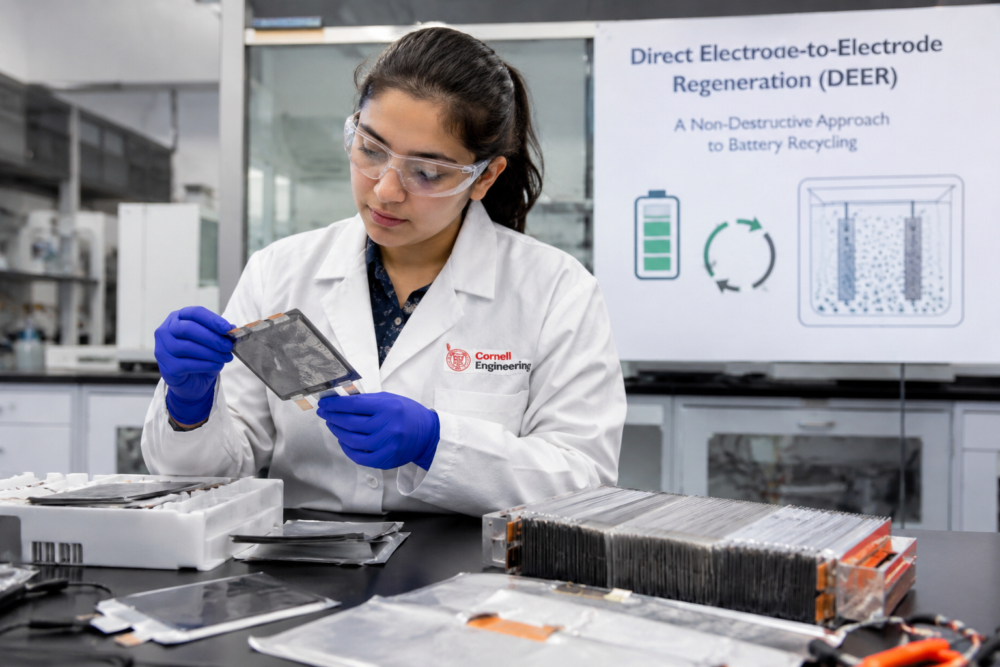

Researchers at Cornell University have developed a new battery recycling technique that restores most of a depleted electric vehicle battery without crushing, melting or chemically dismantling its components.
The method, called Direct Electrode-to-Electrode Regeneration (DEER), uses a specialized chemical bath to clean and rejuvenate battery materials that would otherwise be discarded. According to the research team, the process restores up to 95 per cent of a battery’s original capacity while reducing recycling manufacturing costs by 56 per cent.
The findings were published on June 9 in the journal Energy and Environmental Science.
Current battery recycling methods typically destroy batteries to recover valuable minerals such as nickel and cobalt. Recyclers often shred batteries into a powder known as black mass or process them in high-temperature furnaces before extracting materials through chemical treatment.
However, those approaches require significant energy, water and industrial infrastructure. Additionally, manufacturers must often rebuild battery components from recovered raw materials before reusing them.
The Cornell team sought a different approach.
Rather than breaking apart the battery, researchers focused on repairing the components already inside it. Consequently, the process preserves much of the battery’s original structure.
According to the researchers, lithium-ion batteries usually fail because a layer of insulating material accumulates inside the cell over time. Engineers refer to this buildup as the solid electrolyte interphase.
As the layer thickens, it restricts the movement of energy through the battery. However, many of the underlying materials remain intact and usable.
Standard recycling methods typically destroy these components during processing. Conversely, the DEER technique removes the unwanted buildup while preserving the battery’s internal architecture.
Read more: Rivian deploys second-life EV battery system to cut factory energy costs
Read more: Plug Power delivers electrolyzer system for major European hydrogen project
The approach could shorten battery recycling cycle
To perform the treatment, workers remove the battery’s electrodes and immerse them in a chemical solution known as 1,3-dimethyl-2-imidazolidinone. The solution dissolves the insulating layer and restores electrical performance.
Professor Vibha Kalra of Cornell University’s Duffield College of Engineering said the team repairs battery components directly instead of shredding them into powder before rebuilding them.
Kalra explained that the dissolution process removes the material responsible for capacity loss.
The researchers said the approach could significantly shorten the battery recycling cycle.
The technology arrives as governments and manufacturers seek new ways to secure battery supply chains. Meanwhile, demand for electric vehicle batteries continues to increase worldwide.
The United States possesses limited domestic reserves of several critical battery minerals and relies heavily on international suppliers. Furthermore, the country lacks large-scale infrastructure to refine raw materials and reconstruct battery materials from recycled feedstocks.
“When these lithium-ion batteries came about, nobody was thinking about how these minerals are limited on the Earth’s crust, and you cannot make them forever,” Kalra said.
“In recent years, people are realizing you can’t just keep making batteries, because you don’t have enough material.”
By preserving battery components, the DEER process eliminates several manufacturing steps. Consequently, recyclers could process batteries locally rather than shipping materials through global supply chains for additional treatment.
The researchers also reported that the method reduces air pollution and industrial water consumption compared with conventional recycling approaches.
Currently, the process works on batteries that retain roughly 70 to 80 per cent state of health, which is the level at which many electric vehicle batteries reach retirement.
.