
MARA Holdings Inc. (NASDAQ: MARA) shares dropped more than 5 per cent in after-hours trading Monday after the bitcoin miner posted weaker first-quarter revenue and larger losses tied to its cryptocurrency holdings.
The company reported revenue of USD$174.6 million during the quarter. That marked an 18 per cent decline from USD$213.9 million one year earlier. Meanwhile, net losses widened to roughly USD$1.3 billion as bitcoin prices fluctuated and reduced the paper value of MARA’s holdings.
MARA attributed much of the loss to unrealized declines tied to the 38,689 bitcoins held on its balance sheet. However, management maintained that bitcoin mining still remains central to the company’s long-term business strategy.
Several competitors have recently shifted aggressively toward artificial intelligence infrastructure. Conversely, MARA said it still views bitcoin mining as the operational base supporting future AI and digital infrastructure growth.
Management explained that the company intends to pair new infrastructure projects with existing mining operations. Additionally, executives said that strategy gives MARA flexibility to mine bitcoin today while preserving the ability to redirect power toward AI and high-performance computing workloads later.
The company also repeated previous statements describing itself as a digital infrastructure business rather than solely a bitcoin miner. Furthermore, MARA said it aims to monetize power assets tied to AI, high-performance computing and bitcoin mining operations.
MARA signaled a slowdown in large-scale mining hardware expansion. Instead, the company plans to pursue more selective mining equipment purchases tied to stronger economic returns.
Meanwhile, much of MARA’s AI strategy centers around its partnership with Starwood Capital and its acquisition of Long Ridge Energy & Power in Ohio.
Read more: Lawmakers close in on stablecoin rules amid banking sector resistance
Read more: Cipher Digital pushes deeper into AI hosting as bitcoin revenue declines
MARA mined 2,247 bitcoins this quarter
The site includes a gas-fired power plant and data center campus that MARA believes could eventually support more than 600 megawatts of AI computing demand.
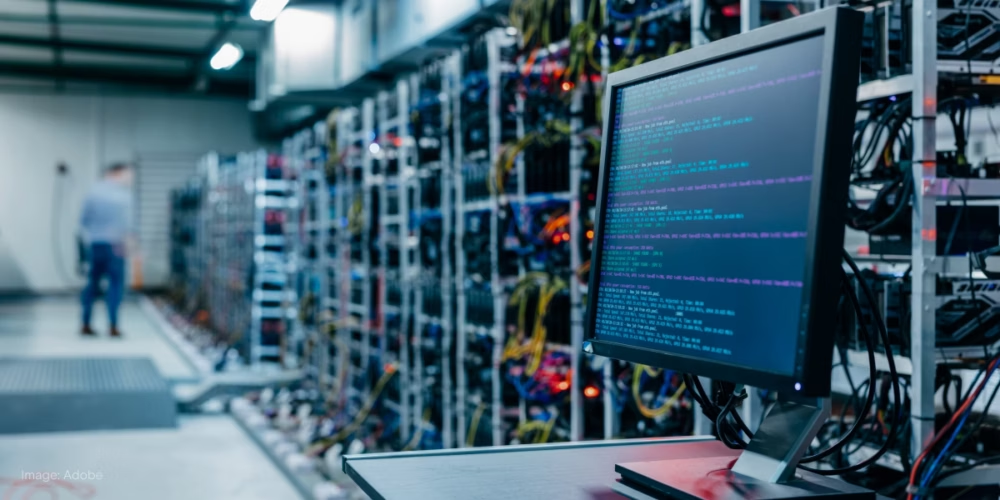
Management said approximately 90 per cent of MARA’s non-hosted mining capacity could eventually support AI and digital infrastructure applications. Additionally, the company increased its energized hashrate by 33 per cent year-over-year to 72.2 EH/s.
MARA mined 2,247 bitcoins during the quarter, up from 2,011 bitcoins in the previous quarter. Subsequently, the company sold roughly USD$1.1 billion worth of bitcoin near quarter-end to retire debt and improve financial flexibility.
That sale reduced MARA’s bitcoin holdings ranking from the second-largest public bitcoin treasury company to the fourth-largest.
Bitcoin has historically moved in a rough four-year cycle tied to its “halving” events, where mining rewards get cut in half approximately every four years. That reduction slows the amount of new bitcoin entering circulation and has repeatedly helped trigger major bull markets. According to Fidelity Investments, bitcoin has followed recognizable boom-and-bust patterns since 2011.
The first major cycle emerged after the 2012 halving. Bitcoin climbed from double digits to more than USD$1,000 in 2013 before collapsing roughly 85 per cent during the following bear market. Subsequently, the next halving in 2016 helped fuel another massive rally that pushed bitcoin close to USD$20,000 during the 2017 crypto boom. That cycle eventually ended with another steep decline in 2018.
Read more: Payward targets U.S. crypto derivatives market with USD$550 million Bitnomial deal
Read more: Canaan scales Ethiopia operations past 5 EH/s as global mining network grows
The latest halving occurred in April 2024
The pattern repeated again after the 2020 halving. Bitcoin surged from below USD$10,000 to nearly USD$69,000 in 2021 as institutional investors, pandemic-era liquidity and corporate treasury buying entered the market. However, rising interest rates and several high-profile crypto failures later drove bitcoin down to roughly USD$15,500 during the 2022 bear market.
Additionally, analysts often describe these cycles as moving through four emotional stages: accumulation, rapid expansion, speculative euphoria and eventual collapse. Investor psychology, liquidity conditions and monetary policy also contribute to the swings alongside the halving itself.
The latest halving occurred in April 2024. Historically, bitcoin tends to peak 12 to 18 months after each halving event. Consequently, many market analysts believe the current cycle remains in either its late bull-market phase or early transition period toward a broader correction.
BitMEX analysts recently argued that the traditional pattern still appears intact despite claims that institutional adoption and exchange-traded funds changed the cycle permanently. “Every time we hear ‘this time is different,’ the cycle proves it isn’t,” the firm wrote in a recent market analysis.
.