
IonQ has published a detailed blueprint for a fault-tolerant quantum computer, outlining a design it says could move the field beyond its current experimental limits and into practical use.
The architecture, described in an arXiv preprint earlier this month by researchers including Felix Tripier and Nicolas Delfosse, lays out a full-stack system capable of running millions of quantum operations on hundreds of logical qubits.
The company argues that its design relies only on hardware techniques already demonstrated in laboratories, positioning it as a near-term engineering challenge rather than a distant theoretical goal. Currently, most quantum computers fall into the category of noisy intermediate-scale quantum (NISQ) devices. These systems can perform thousands of operations, but errors accumulate quickly. Consequently, they struggle to solve problems of industrial or scientific importance.
The IonQ team proposes a different approach. Instead of simply increasing qubit counts, it restructures the entire system architecture. Additionally, it integrates error correction, computation and hardware control into a unified design.
At the core of the issue lies quantum noise. Every operation on a qubit introduces a small chance of error. Over time, these errors compound and degrade results. Fault-tolerant systems address this limitation by encoding information across many physical qubits. In this framework, a single logical qubit spreads its information across multiple physical units. Consequently, the system can detect and correct errors before they cascade.
IonQ’s blueprint uses quantum low-density parity-check codes, or LDPC codes, to achieve this. These codes rely on sparse connections between qubits. As a result, they require fewer physical qubits than older approaches such as surface codes.
Read more: IonQ sparks Italy’s quantum renaissance through Q-Alliance partnership
Read more: IonQ closes Skyloom acquisition to accelerate quantum-secure networking push
Architecture includes processes for distillation
Additionally, the architecture introduces specialized components to manage quantum resources. One of these is the so-called “cat factory.” This unit continuously produces cat states, which are special quantum superpositions. Cat states allow multiple operations to occur simultaneously. Furthermore, they help drive efficient computation across the system’s memory blocks.
Another key component is the “magic factory.” This unit generates magic states, which enable more complex quantum operations. These operations are essential for universal quantum computing, but they are also more prone to errors. Because magic states cannot be created directly through error correction, the system must produce and refine them separately. Consequently, the architecture includes dedicated processes for distillation and quality control.
The overall system connects these components through a modular design. Separate units handle memory, computation and resource generation. Meanwhile, a compiler layer translates quantum programs into executable instructions. These instructions then map onto physical operations involving trapped ions. The design relies on moving charged atoms across a chip rather than sending signals through fixed wires.
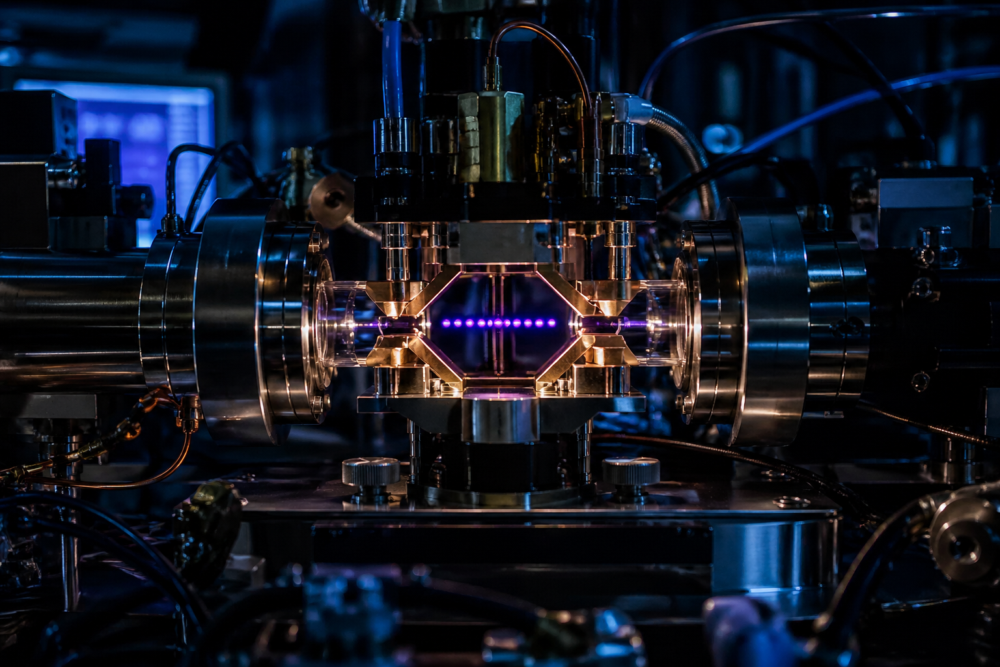
In trapped-ion systems, ions act as qubits. Engineers confine them using electric fields and manipulate them with lasers or microwave pulses. Additionally, they move ions between zones to perform operations. This approach resembles a microscopic assembly line. Ions travel between storage and interaction zones, briefly pairing to execute operations. Subsequently, they return to storage until needed again.
The IonQ team builds its design on a framework known as the quantum charge-coupled device (QCCD). In this system, ions move across a two-dimensional grid. Consequently, they can interact with neighboring ions as required.
Read more: China builds robot training centres to push humanoids into real-world jobs
Read more: New AI model allows farm robots to identify and kill unfamiliar weeds instantly
Technique allows operations to occur without execution on hardware
To simplify the design process, researchers use a “moving-qubit model.” This abstraction represents the system as a grid where qubits move and interact locally. Meanwhile, a lower-level layer translates these interactions into real device instructions. The blueprint outlines three versions of the architecture. Each represents a tradeoff between simplicity, speed and efficiency.
The first version uses a single error-correcting code for both memory and computation. This design is the easiest to build. However, it offers lower computational efficiency. The second version focuses on speed. It uses a newly developed code that encodes multiple logical qubits into a fixed number of physical qubits. Additionally, it employs a method called Clifford frame tracking.
This technique allows certain operations to occur without physically executing them on hardware. Consequently, it reduces the number of required quantum gates and improves performance. Using this configuration, the researchers estimate that a machine with 10,000 physical qubits could simulate a complex quantum system within one month. This includes the repetitions needed to achieve high accuracy. Such a capability would mark a significant milestone. It would suggest that the machine can solve problems beyond the reach of classical computers.
The third version emphasizes density. It uses another new code that packs more logical qubits into each block of physical qubits. Consequently, the system requires fewer total qubits to achieve the same computational power. In this configuration, a machine supporting over 100 logical qubits could operate with just a few thousand physical qubits. It could also execute around one million key operations per day.
Read more: Canada launches CAD$900 million defence strategy to advance quantum and AI capabilities
Read more: Major publisher Hachette pulls horror novel ‘Shy Girl’ over AI allegations
Blueprint performance estimates rely on specific assumptions
These estimates include all system components, from memory to resource factories. As a result, they present a comprehensive view of the machine’s requirements.
Despite these advances, the blueprint remains theoretical. The researchers acknowledge that building such a system will require significant engineering effort. Scaling trapped-ion systems to thousands of qubits presents multiple challenges. Engineers must fabricate precise ion traps and develop scalable control electronics. Additionally, they must manage ion loss and leakage.
Ion loss occurs when a qubit escapes the system. Leakage happens when a qubit enters an unusable state. Both issues can disrupt computation if left unaddressed. The architecture incorporates mechanisms to detect and correct these problems. For example, it includes routines to identify missing ions and reload them. Similarly, it features processes to correct leaked qubits.
These safeguards add complexity to the system. However, the researchers argue they are essential for realistic operation. Performance estimates in the blueprint rely on specific assumptions. These include low error rates for operations and rare occurrences of ion loss. Consequently, real-world results may vary depending on hardware performance.
The team emphasizes that all required operations have already been demonstrated at small scales. Two-qubit gates and ion transport have both been validated experimentally. Therefore, the design does not depend on speculative breakthroughs. However, integrating these components into a large-scale system remains a major undertaking. It will require advances in manufacturing, control systems and system integration.
The researchers suggest that future work could improve the design at every level. This includes better error-correcting codes and more efficient compilers. Additionally, co-optimization between system layers could enhance performance.
Read more: Quantum sensors guide UK train in GPS-free navigation test
Read more: Solana tests quantum-resistant crypto as early trials show major speed tradeoffs
IonQ’s work arrives as industry searches for practical pathways
They also note that many potential applications of quantum computing remain unexplored. A machine capable of sustained, large-scale operations could open new areas of research.
These might include complex simulations in physics, chemistry and materials science. Consequently, fault-tolerant quantum computing could expand the boundaries of scientific discovery. The blueprint represents an attempt to bridge the gap between theory and engineering. It provides a detailed roadmap from high-level software to physical hardware operations.
The paper appears on arXiv, a preprint server that allows rapid dissemination of research. However, it has not yet undergone peer review, which remains a key step in scientific validation. IonQ’s work arrives as the quantum computing industry searches for practical pathways forward. Companies and researchers continue to explore architectures that can overcome current limitations.
Meanwhile, the transition from NISQ devices to fault-tolerant systems remains one of the field’s central challenges. The IonQ blueprint offers one possible route toward that goal.
.