bioAffinity Technologies, Inc. (NASDAQ: BIAF) (NASDAQ: BIAFW) has launched a large longitudinal clinical study to evaluate its CyPath Lung test for early cancer detection.
The biotechnology firm plans to enroll about 2,000 patients to measure the diagnostic performance of its noninvasive lung cancer screening technology. The test analyzes sputum samples using flow cytometry to identify cancer-related cellular changes in patients with suspicious lung nodules.
Researchers designed the study to focus on high-risk individuals whose lung nodules measure between six and less than 30 millimetres. Physicians frequently monitor nodules of that size because they may signal early lung cancer or other pulmonary conditions.
Additionally, the study aims to determine whether CyPath Lung can improve risk assessment for patients already identified through screening programs. Doctors currently face difficult decisions when small nodules appear in CT scans.
In many cases, clinicians must choose between monitoring nodules for growth or pursuing invasive biopsies. CyPath Lung offers a potential alternative because it analyzes sputum rather than requiring surgical tissue sampling.
Furthermore, earlier clinical data suggested the test may detect lung cancer with strong accuracy. In a previous trial, the diagnostic demonstrated 92 per cent sensitivity and 87 per cent specificity in patients with small nodules.
The earlier research also reported an overall accuracy rate of 88 per cent when identifying cancer in nodules smaller than 20 millimetres. Several recent patient case studies also suggest the technology may detect cancer at Stage 1A.
Consequently, early identification could allow doctors to treat tumours before they spread and before symptoms become severe. Early-stage lung cancer often remains highly treatable if clinicians detect it quickly.
Read more: Breath Diagnostics advances pre-op pneumonia screening with FDA breakthrough designation
Read more: Breath Diagnostics leaders promote their mission at Miami investment conference
Patient enrollment could take 18 months
Meanwhile, bioAffinity expects up to 20 clinical sites to participate in the new trial across the United States. These locations include approximately twelve Department of Veterans Affairs medical centres and two large military hospitals.
The research will follow patients over time to capture real-world clinical data about the diagnostic tool. Participants will remain in the study for up to 24 months or until physicians confirm cancer or rule it out.
Additionally, patient enrollment could take roughly 18 months as hospitals recruit individuals who meet the study criteria. Researchers will track diagnostic outcomes as physicians monitor the lung nodules.
Pulmonologist Michael J. Morris of Brooke Army Medical Center will serve as the national principal investigator for the trial. His team specializes in pulmonary medicine and critical care for military personnel and veterans.
In addition, the John P. Murtha Cancer Center Research Program will provide support and funding at several federal facilities. The program operates within the Department of Surgery at the Uniformed Services University of the Health Sciences.
Researchers also plan to evaluate the test’s performance across diverse patient populations. Military service members and veterans will represent an important portion of the study participants.
The investigation will use a research version of the technology called FlowPath Lung. However, the experimental name simply distinguishes the study assay from the commercially available CyPath Lung test.
Both versions rely on identical technology and follow the same laboratory procedures for analyzing sputum samples. Consequently, researchers expect the trial results to reflect real-world use of the commercial diagnostic.
Read more: Prestigious medtech intelligence firm recognizes Breath Diagnostics for innovation
Read more: Breath Diagnostics completes install of advanced mass spectrometry system
Test may help physicians with stronger diagnosis
Doctors already order CyPath Lung through Precision Pathology Laboratory Services, a subsidiary laboratory operated by bioAffinity. Physicians typically use the laboratory developed test when evaluating patients with indeterminate lung nodules.
Additionally, clinicians may use the results to guide decisions about follow-up scans, biopsies or surgical procedures. The test may help physicians determine which nodules warrant aggressive investigation.
“As more indeterminate pulmonary nodules are found either incidentally or by routine lung cancer screening, CyPath Lung can fill the diagnostic gap between ‘watchful waiting’ and invasive procedures that carry risk,” said Gordon Downie, MD, PhD, Chief Medical Officer of bioAffinity Technologies.
“As a result, we see growing adoption and use of CyPath Lung by physicians and expect this longitudinal trial to provide additional evidence to support inclusion of our noninvasive test as part of the standard of care for lung cancer screening and diagnosis.”
Company leadership said the longitudinal study represents a major step toward broader clinical adoption. Executives believe long-term data from multiple hospitals could strengthen confidence among physicians and healthcare systems.
Furthermore, the study will examine how clinicians use the diagnostic tool during routine patient care decisions. Researchers hope the results will demonstrate that CyPath Lung supports earlier and more precise lung cancer evaluation.
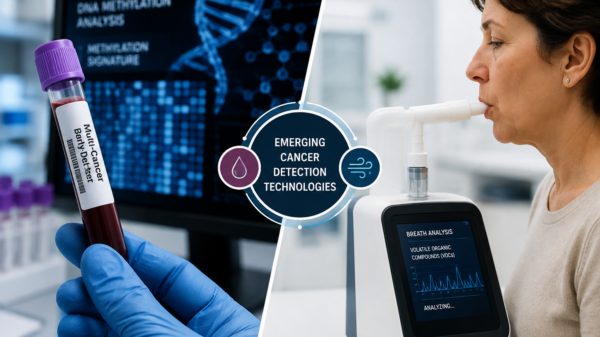
Meanwhile, other biotechnology companies are developing competing early detection tools, including breath-analysis systems from Owlstone Medical and Breath Diagnostics alongside blood-based diagnostics from Guardant Health (NASDAQ: GH).
.