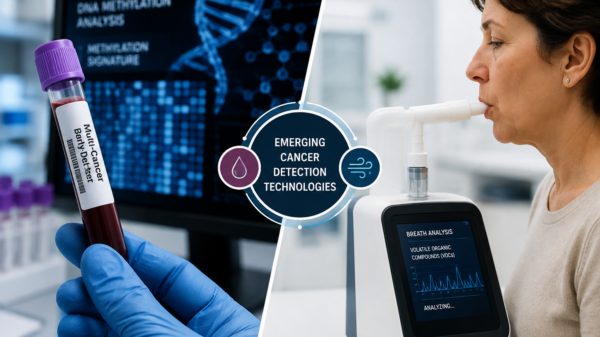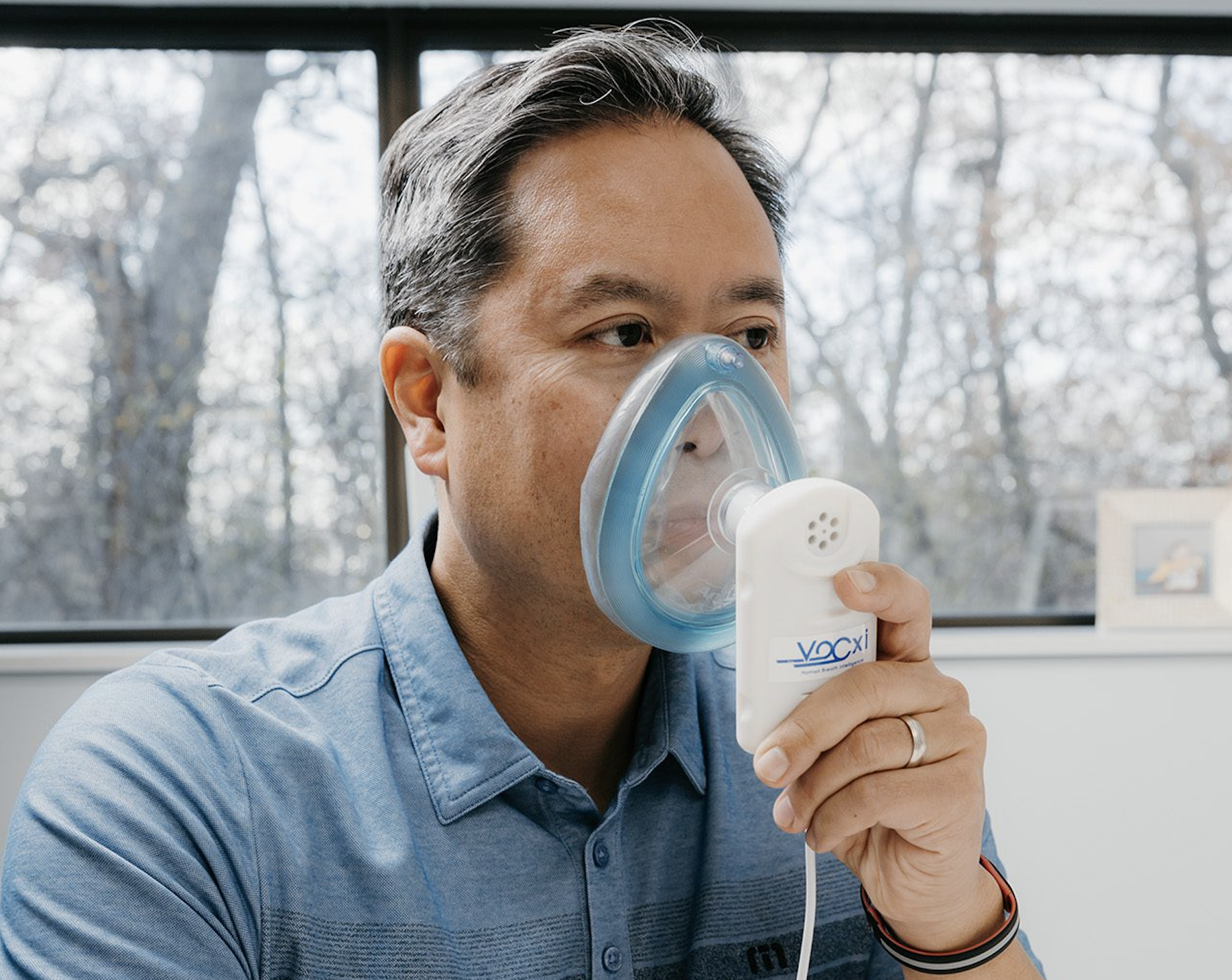

Minnesota-based medtech operators Vocxi Health and Forj Medical have made significant progress with a partnership to advance breath-based diagnostics for lung cancer. They have successfully miniaturized Vocxi’s MyBreathPrint device into a compact handheld tool.
The achievement, announced on Friday, has integrated Forj’s design-for-manufacturability expertise with Vocxi’s nanotechnology, shrinking the original desktop prototype to the size of a deck of cards while maintaining high sensitivity.
Engineers from both companies addressed challenges like electrical noise and humidity interference through custom algorithms and over 1,500 diagnostic tests, yielding three joint patents and an initial production run of 500 units. This alliance, rooted in Minnesota’s Medical Alley think tank and innovation hub, enables affordable, cloud-connected screening that could reach clinics and homes.
“Forj Medical’s engineering ingenuity allowed us to take our vision from a concept on the bench to a manufacturable device ready for clinical deployment,” said Vocxi chief executive Ping Yeh. “Together, we’ve created something that could make early cancer detection accessible to millions.”
The device operates by capturing volatile organic compounds (VOCs) in a patient’s breath during a 60-second exhale. Graphene-based nanosensors, functionalized with specialized chemistries, detect these compounds at parts-per-billion levels, converting breath chemistry into electrical signals via microelectromechanical systems.
Machine learning algorithms then analyze the data in seconds, identifying cancer patterns without needles or radiation. Vocxi Health developed MyBreathPrint over eight years at the University of Minnesota, initially in stealth mode, incorporating technology from an undisclosed major device manufacturer. CEO Ping Yeh joined in 2022 to expand its applications, starting with lung cancer and extending to ovarian cancer studies.
Read more: Breath Diagnostics advances pre-op pneumonia screening with FDA breakthrough designation
Competitive landscape in breath screening
MyBreathPrint stands out for its portability and near-instant results, but competitors offer varied approaches.
Breath Diagnostics’ OneBreath system analyzes a single exhale using a patented microreactor to derivatize VOCs, followed by lab-based ultra-high-performance liquid chromatography-mass spectrometry. It has achieved 94 per cent sensitivity and 85 per cent specificity in clinical studies with over 800 patients. OneBreath recently received FDA Breakthrough Device Designation for pre-operative risk assessment of postoperative pneumonia in elective cardiac surgery patients.
Owlstone Medical’s Breath Biopsy platform collects VOCs via the ReCIVA sampler and uses exogenous probes in clinical trials for lung cancer, focusing on broader biomarker discovery rather than handheld use.
Breathe BioMedical, meanwhile, employs infrared spectroscopy, demonstrating 88.2 per cent accuracy in distinguishing early-stage breast cancer breath signatures. This company’s device has potential lung applications but it is not a primary focus at the moment.
Highly-regarded public schools have taken an interest in breath-based cancer diagnostics as well. The University of Texas at Dallas has been actively studying a lung cancer breath analysis system. The institution’s electrochemical biosensor and AI setup detects eight VOCs in breath. It hit 90 per cent accuracy in a small study of 67 patients, though it remains in early research stages without commercial scalability.
Outlook for breath-based cancer diagnostics sector is positive
Analysts are predicting robust growth in breath-based cancer diagnostics amid rising chronic disease prevalence.
Fortune Business Insights forecasts the global breath analysis market to expand from US$742.9 million in 2025 to US$1.33 billion by 2034 at 6.9 per cent compound annual growth. Non-invasive VOC detection for early cancer screening will be the primary driver.
Moreover, Markets and Markets projects a higher 17.4 per cent compound annual growth rate (CAGR) for related segments through 2025, emphasizing innovations in sensor technologies.
Additionally, The Business Research Company estimates breath biopsy testing to reach US$4.9 billion by 2030 from US$3.43 billion in 2025 at 7.3 per cent CAGR, fuelled by AI integration and portable devices.
These trends reflect increasing adoption for lung and other cancers, supported by regulatory advancements and patient demand for painless, non-invasive and radiation-free testing.
Read more: Prestigious medtech intelligence firm recognizes Breath Diagnostics for innovation
Follow Rowan Dunne on LinkedIn
rowan@mugglehead.com