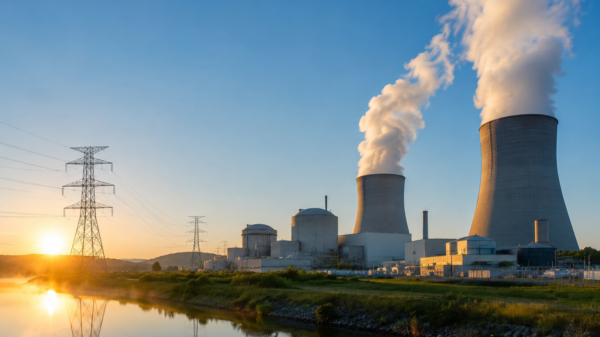

French molten salt reactor developer Stellaria has applied for regulatory approval to build an experimental nuclear reactor, marking a significant step for the country’s emerging advanced reactor sector.
The Paris-based start-up submitted its application for a creation authorisation decree, known as a DAC, on 19 December to the French minister responsible for nuclear safety. Consequently, regulators have begun reviewing the proposal.
Stellaria spun out of the French Alternative Energies & Atomic Energy Commission and Schneider Electric (EPA: SU). The company is positioning itself as a new entrant in France’s fast-neutron nuclear market.
The application covers the siting and construction of a 100-kilowatt experimental reactor called Alvin. Additionally, Stellaria plans to start up the reactor in 2030 to begin a test programme aimed at validating its technology.
Company officials said the submission elevates Stellaria from a research venture to a regulated nuclear operator. Furthermore, they described the move as a defining milestone for both the company and its long-term reactor ambitions.
The DAC filing includes about 15 documents totalling more than 1,000 pages. It lays out the technical, safety, environmental, and financial foundations of the project in detail.
According to the company, the safety case explains how the reactor would operate and remain secure. Additionally, it analyzes possible incidents and severe accident scenarios.
The documents also address external risks such as earthquakes, flooding, and aircraft impacts. Furthermore, they outline radiation protection measures for workers, nearby communities, and the surrounding environment.
The submission includes an environmental impact assessment and a detailed decommissioning plan. Consequently, regulators can evaluate how the facility would be dismantled at the end of its life.
Read more: Saskatchewan moves closer to nuclear future with SMR safety and testing centre
Read more: Texas A&M to host first reactor in Trump’s nuclear pilot initiative
System can operate with wide range of nuclear fuel
Stellaria also provided information on its technical expertise and financial capacity. Additionally, the company submitted extensive engineering documentation describing the installation’s design.
Stellaria said it is the first firm to file such an application in France’s fast-neutron nuclear segment. Meanwhile, it ranks second among eleven French start-ups developing small or advanced modular reactors, following Jimmy Energy. The proposed Stellarium reactor design is highly compact, occupying roughly four cubic metres. Further, the reactor would use molten salt as both fuel and coolant.
Stellaria says the system can operate with a wide range of nuclear fuels. These include uranium, plutonium, mixed-oxide fuel, minor actinides, and potentially thorium. The company claims the design can destroy more long-lived nuclear waste than it produces. However, that assertion will depend on experimental validation.
Molten salt reactors use liquid fluoride salts and operate at low pressure. Consequently, they differ significantly from conventional water-cooled reactors.
Such reactors can run with either fast or epithermal neutron spectrums. Additionally, they attract interest for their potential safety advantages and fuel flexibility. Much of the renewed attention focuses on thorium fuel cycles. Furthermore, thorium systems can theoretically produce fissile uranium-233 from abundant raw material.
However, thorium reactors require an initial fissile source, such as plutonium-239. Conversely, commercial deployment remains technically and regulatorily complex.
Once Alvin completes its test programme, Stellaria plans to construct a 10-megawatt electric prototype called MegAlvin. Subsequently, the company aims to move toward commercial applications.
Stellaria’s leadership said 2025 represented a turning point for the company. Additionally, the firm recently completed a structured fundraising round.
.