
The court-appointed receiver overseeing Victoria Gold assets is preparing a royalty sale as the search for a new mine owner advances.
Meanwhile, Yukon officials said the process marks a more defined phase in efforts to stabilize the Eagle Gold Mine.
The government said the receiver agreed to sell net smelter return royalties for USD$55 million. The royalties would go to Franco-Nevada Corporation (TSE: FNV) (NYSE: FNV) if an Ontario Superior Court of Justice judge approves the deal on March 9.
However, Yukon officials said the royalties involved in the transaction differ from territorial Quartz Mining Act royalties. The government released the update March 3 while the receivership process continues.
PricewaterhouseCoopers, acting as court-appointed receiver, filed its eighth report on Feb. 26 outlining how the sale proceeds would support site operations. Additionally, the report said funds from the royalty transaction would help pay for remediation work ordered by the court.
Officials said the financing will support stabilization and environmental monitoring work underway at the site. Consequently, the funds may also reduce pressure on the government-backed credit facility established to support cleanup and operational costs.
Energy Mines and Resources spokesperson John Thompson confirmed details earlier this year about the loan arrangement. The maximum loan available to the receiver remains capped at USD$220 million through Apr. 1, 2026.
Furthermore, the Yukon government had already provided USD$175 million toward remediation efforts through October 2025. Officials previously said about 60 per cent of those funds came from the mine’s existing security, with territorial funds covering the remainder.
Read more: NevGold’s stock growth secures junior spot on 2026 TSX Venture 50 list
Read more: NevGold discovers transformational oxide gold-antimony structure at Limousine Butte
Heap-leach facility failure triggered Yukon’s significant mining incidents
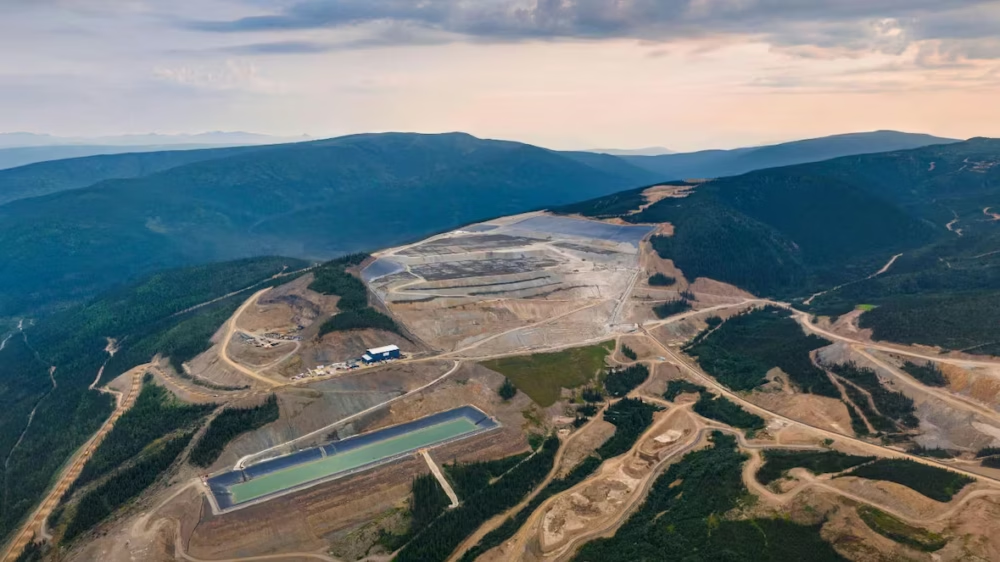
The receiver continues marketing the mine to potential buyers while overseeing technical reviews and site visits. Meanwhile, the Eagle Gold Mine has remained under receivership since 2024 after a heap-leach failure triggered regulatory action and financial intervention.
A major heap-leach facility failure at the Eagle Gold Mine in June 2024 triggered one of Yukon’s most significant recent mining incidents. The collapse occurred when a large section of the heap-leach pad lost structural stability.
Consequently, millions of tonnes of ore treated with cyanide solution slid down the slope toward nearby drainage areas. The failure damaged containment infrastructure and forced an immediate halt to normal mining operations.
Investigators later determined that water accumulation inside the heap played a major role. Additionally, poor drainage conditions within certain ore layers allowed pressure to build inside the pile. As irrigation continued, the internal water table rose and weakened the slope.
Subsequently, the saturated material failed and produced a large debris slide across the valley floor. Contaminated ore and cyanide solution entered nearby Haggart Creek within the South McQuesten River watershed.
However, emergency containment measures began soon after the failure to limit downstream impacts. Crews quickly installed interception wells, pumping systems and additional water storage capacity.
Meanwhile, water treatment systems now capture and process contaminated water before it leaves the site. Additionally, environmental monitoring programs track water quality in surrounding streams and groundwater.
Operators also recover small quantities of gold from contaminated process water stored in treatment ponds. Consequently, the recovery helps offset cleanup costs while breaking down some cyanide during processing.