Europe faces growing pressure to secure critical mineral supply outside China
Soviet engineers originally discovered the deposit during the 1980s
 Joseph Morton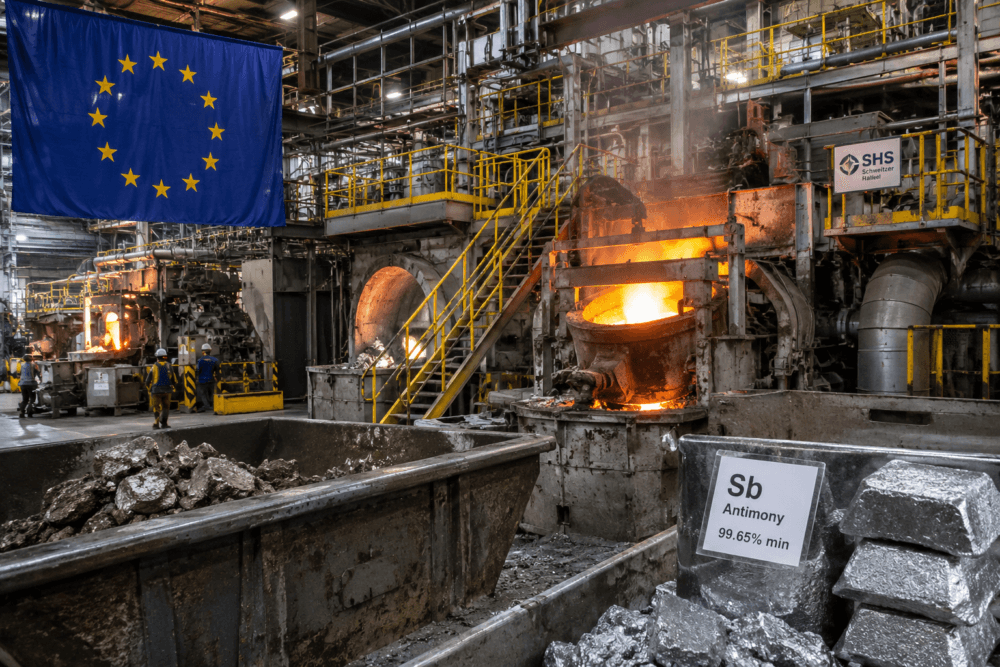
Europe’s struggle to secure critical mineral supplies has turned a dormant Slovakian antimony mine into a growing geopolitical flashpoint as Western governments race to reduce dependence on China.
A Monday report indicates the Trojarova antimony project near Bratislava has emerged as a key test of Europe’s ability to compete with the United States and China in the global scramble for strategic resources. Additionally, the project has drawn attention because antimony remains essential for military systems, renewable energy infrastructure and advanced electronics.
Canada-based Military Metals Corp. CNSXMILI OTCMKTSMILIF controls the Cold War-era property in Slovakia’s Little Carpathian mountain range. The company believes the mine could become one of Europe’s most important domestic antimony sources if governments and industrial partners commit financing.
Soviet engineers originally discovered the deposit during the 1980s. However, operators abandoned the underground mine after the collapse of the Iron Curtain and the Soviet bloc.
Now, Western governments increasingly view antimony as strategically important because the metal supports ammunition, infrared sensors, night vision systems and flame retardants. Additionally, renewable energy technologies and nuclear applications also require the material.
China dominates global antimony processing and controls much of the broader rare earth supply chain. Consequently, Western nations have accelerated efforts to secure alternative supplies after Beijing imposed export controls on several critical minerals last year.
The United States has aggressively pursued overseas mineral partnerships and strategic investments. Meanwhile, European governments have struggled to coordinate funding and industrial policy around critical mineral development.
Read more: NevGold reports more positive drill results as gold-antimony resource estimate nears
Read more: NevGold positions Nevada project for near-term antimony output
Europe aims to extra 10% of annual consumption for key materials
Analysts and policymakers increasingly warn that Europe risks falling behind in the competition for strategic resources. Sabrina Schulz, Germany director at the European Initiative for Energy Security, said financing remains the largest obstacle preventing European mineral projects from advancing.
The European Union introduced the Critical Raw Materials Act in 2023 to strengthen mineral security. Additionally, the legislation established targets for domestic extraction and processing capacity.
Under the plan, Europe aims to extract at least 10 per cent of annual consumption for key materials. Furthermore, the bloc wants to process 40 per cent of strategic mineral demand domestically.
European policymakers initially focused heavily on battery materials such as lithium. However, global competitors increasingly shifted toward military-focused minerals including antimony, gallium and germanium.
Officials familiar with internal discussions said Brussels lacks both the authority and financial flexibility available to Washington. Consequently, many projects owned by smaller mining firms remain stalled while companies search for financing.
Germany itself reportedly continues debating how aggressively it should pursue critical mineral de-risking policies. Additionally, officials from several ministries have yet to align around a unified strategy.
That uncertainty has frustrated many European policymakers and mining executives. Some officials reportedly fear Europe could miss major supply deals while other governments move faster.
The issue has become more pressing ahead of expected summit discussions between US President Donald Trump and Chinese President Xi Jinping. Furthermore, Trump has continued threatening new tariffs targeting Europe during broader trade disputes.
Last month, the European Union and United States reached an agreement to coordinate critical mineral supply chain policies. Military Metals views that cooperation as a potentially positive development for Trojarova.
Read more: NevGold raises up to CAD$25M to fast-track Limo Butte development
Read more: NevGold Corp. advances toward gold-antimony resource with expanded Nevada drilling
Antimony occurs alongside gold deposits
The company hopes joint US-European financing or future offtake agreements could help advance the Slovakian project. However, no major European supply agreement has emerged so far.
German foreign ministry official Frank Hartmann recently argued Europe continues moving too slowly on critical minerals. Additionally, he urged governments to commit long-term funding over the next decade if Europe wants greater independence from foreign suppliers.
Military Metals acquired the Trojarova project nearly two years ago. Since then, the company has promoted the asset as a possible cornerstone of a future European antimony supply chain.
The underground tunnel network extends roughly 1.7 kilometres into the hillside near the Slovakian town of Pezinok. Additionally, company executives believe the mine contains one of Europe’s largest antimony deposits.
Antimony often occurs alongside gold deposits and remains relatively uncommon outside several concentrated regions. China, Russia and Tajikistan currently dominate much of global supply.
Schulz described antimony as a strategically important mineral despite relatively small global production volumes. Furthermore, she noted Europe remains almost entirely dependent on imports.
China controls nearly 80 per cent of antimony processing capacity, according to Schulz. Consequently, Europe faces risks not only from mining shortages but also from refining bottlenecks.
Military Metals chief executive Scott Eldridge said the company wants Trojarova to supply refined antimony directly to European defense customers. Additionally, the company believes refining partnerships in Germany and Sweden could help create a broader regional processing network.
If fully reactivated, Trojarova could potentially supply about one-third of Europe’s annual antimony demand. Company estimates place that output near 6,000 tonnes annually.
Read more: NevGold discovers transformational oxide gold-antimony structure at Limousine Butte
Read more: ***NevGold’s stock growth secures junior spot on 2026 TSX Venture 50 li*******st
American company has approached Military Metals
Executives believe the project could begin operating within two or three years if financing materializes. However, Military Metals remains a relatively small company with a market capitalization below USD$30 million.
That funding gap remains one of the project’s largest obstacles. Additionally, critical mineral markets frequently experience sharp price swings that discourage private investment.
Even lithium projects have stalled recently despite strong long-term demand forecasts. Consequently, many developers increasingly seek government-backed financing and price guarantees.
Germany previously established a €1 billion raw materials investment fund to support strategic projects. However, the program has reportedly backed only two projects while maintaining extensive qualification requirements.
European governments have also signed mineral cooperation agreements with resource-producing nations including Brazil. Meanwhile, US agreements often involve larger funding commitments and faster execution timelines.
Washington has additionally promoted minimum price guarantees for critical mineral producers to counter Chinese competition. European governments have remained hesitant toward similar policies so far.
The United States has continued moving aggressively despite other geopolitical crises competing for attention. Furthermore, American officials have actively searched for strategic mineral projects across multiple regions.
One American company has already approached Military Metals regarding the Trojarova project. Additionally, the US government’s investment arm recently agreed to a USD$5 million deal supporting another dormant antimony mine in North Macedonia.
Military Metals chairman Thomas Hüser said Europe still struggles with fragmented execution despite growing awareness around supply chain risks. He argued policymakers continue operating too slowly compared with industrial realities facing the sector.
Read more: NevGold expands Bullet Zone discovery as drilling confirms oxide gold-antimony system
Read more: NevGold reports over 93 per cent gold recovery after antimony processing at Limousine Butte
Multiple companies pursue critical mineral angle
The United States has already begun accelerating several domestic antimony and critical mineral projects through federal initiatives such as the FAST-41 permitting framework. Additionally, Washington has increasingly tied mineral development to defense readiness and long-term industrial policy.
Perpetua Resources Corp. NASDAQPPTA TSEPPTA, for example, has emerged as one of the most visible examples through its Stibnite gold-antimony project in Idaho. The company has received backing from the US Department of Defense as officials push to restore domestic antimony production capacity. Furthermore, Perpetua has positioned the project as a potential cornerstone of an American antimony supply chain.
Meanwhile, NevGold Corp CVENAU OTCMKTSNAUFF FRA5E50 has continued advancing its Limousine Butte project in Nevada, where the company recently expanded its focus on antimony mineralization alongside gold exploration. NevGold has increasingly promoted the property as part of the broader North American effort to secure strategic mineral supplies outside Chinese control.
Those developments contrast sharply with Europe’s slower and more fragmented approach to financing and permitting critical mineral projects.
NevGold Corp is a sponsor of Mugglehead news coverage
.