
African resource-rich governments are rewriting mining contracts and asserting control over strategic minerals, reshaping global supply chains in the process.
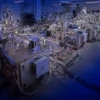
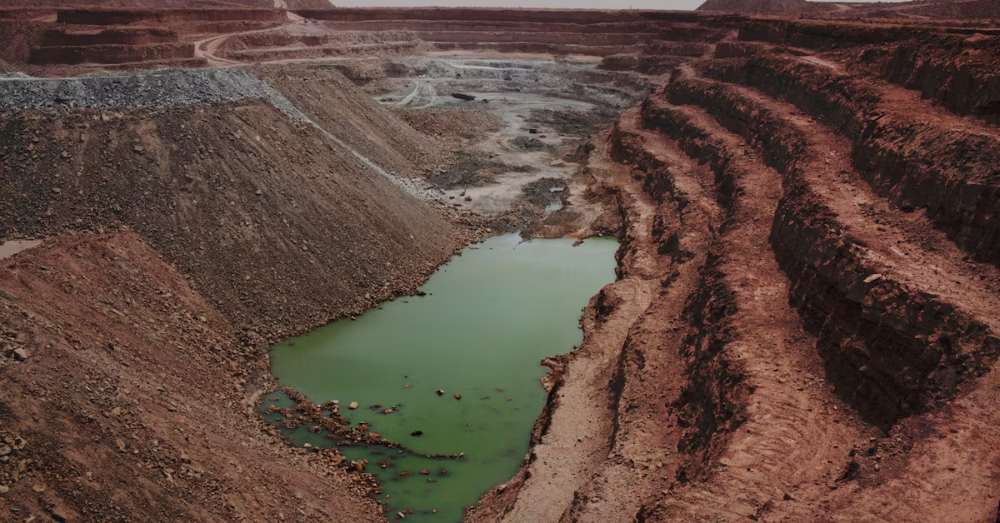
In Niger, a dispute with French nuclear fuel company Orano SA (EPA: ORA) has become a flashpoint in a broader movement that challenges decades-old agreements rooted in the colonial era.
The conflict centres on uranium, a critical fuel for nuclear power plants. However, the implications stretch far beyond one mine in the Sahel. Governments in Mali, Burkina Faso and Niger have all pushed to renegotiate mining deals they say failed to deliver fair economic returns.
These countries argue that earlier agreements favoured foreign operators. Additionally, they say royalty structures did not reflect rising commodity prices. Leaders now frame resource control as both an economic and political imperative.
The uranium market amplifies the tension. Nuclear energy has regained global support as countries pursue climate targets and energy security. Consequently, demand for uranium has climbed while supply remains concentrated. Kazakhstan, Canada and Australia dominate global production. However, African producers hold meaningful reserves that utilities rely on. This concentration creates vulnerabilities when governments intervene in established contracts.
Between January 2021 and late 2025, uranium spot prices surged from under USD$66,000 per ton to above USD$180,000 per ton. That 173 per cent increase reflects renewed demand and supply disruptions. Additionally, it signals how quickly geopolitical tensions can move commodity markets. Niger moved to assert state control over uranium operations following its July 2023 political transition. The government argues that a 1968 concession granted operational rights, not permanent ownership of subsoil resources. Consequently, officials say the state retains ultimate authority over the mineral wealth.
Read more: NextEra explores nuclear growth as AI drives record U.S. electricity demand
Read more: Texas A&M to host first reactor in Trump’s nuclear pilot initiative
Over 80,000 tons produced between 1971 and 2024
The Arlit concession covers roughly 360 square kilometres. Niger’s leadership maintains that constitutional sovereignty supersedes contractual commitments. However, Orano disputes that interpretation and has pursued international arbitration.
The dispute now includes a 156-ton uranium stockpile. Niger has proposed allocating 63.4 per cent of that material to Orano, matching the company’s historical equity stake. Additionally, the government says it will cover transport costs for the foreign share.
Officials argue that production after the state assumed control belongs entirely to Niger. They estimate that about 2,000 tons have been extracted under national management. Consequently, they reject proportional ownership for that output.
Government data shows more than 80,000 tons were produced between 1971 and 2024. Leaders claim sales volumes exceeded what foreign equity percentages justified. However, Orano maintains that it operated under valid legal agreements.
Niger’s position reflects a broader legal shift across Africa. Governments increasingly challenge investor-state arbitration frameworks that protect foreign capital. Additionally, they question whether colonial-era contracts can bind modern sovereign states indefinitely.
International tribunals such as the World Bank’s arbitration body may take years to resolve such disputes. Meanwhile, uranium operations require constant investment and technical management. Consequently, ownership debates intertwine with practical operational demands.
The economic stakes remain significant. Uranium fuels nuclear reactors that require long-term supply stability. Utilities often secure contracts years in advance to manage risk. However, political disruptions complicate those arrangements.
European countries, especially France, rely heavily on African uranium. France generates most of its electricity from nuclear power. Additionally, several EU states plan reactor expansions to reduce fossil fuel use.
Read more: Stellaria applies to build 100-kW molten salt reactor as France backs advanced nuclear
Read more: Saskatchewan moves closer to nuclear future with SMR safety and testing centre
Resource nationalism reshapes regional politics
China, India and South Korea have also announced new nuclear projects. These buildouts could lift uranium demand by 25 to 35 per cent by 2035. Consequently, supply disruptions in West Africa reverberate across global markets.
Utilities typically maintain six to 24 months of forward inventory. However, stockpile levels remain commercially sensitive. Rising prices above USD$180,000 per ton suggest that traders see tightening supply.
Resource nationalism also reshapes regional politics. Mali, Burkina Faso and Niger have coordinated rhetoric around sovereignty and economic justice. Additionally, military-led governments use mineral policy to bolster domestic legitimacy.
Post-coup authorities face pressure to demonstrate tangible gains. Control over uranium offers revenue potential and nationalist appeal. Consequently, leaders frame mining disputes as reclaiming wealth from foreign domination. Niger invested tens of billions of CFA francs to maintain operations after July 2023. Those funds tie the government financially to continued production. Additionally, they strengthen the state’s claim to output generated under its management.
Alternative partnerships have emerged. Russia and China have expanded engagement in African mining sectors. Consequently, Western companies face competition not only in markets but also in political relationships. Eastern-backed projects often promise infrastructure development and technology transfer. However, they also introduce new geopolitical considerations. Governments weigh equity stakes, expertise and long-term autonomy.
Currency issues add another layer. Many royalties were denominated in CFA francs. Depreciation eroded the real value of payments over time. Additionally, fixed-rate structures did not capture windfall gains during price surges. Uranium disputes differ from oil or gold conflicts. Nuclear fuel cycles span decades, from mining to enrichment and fabrication. Consequently, disruptions cascade through multiple stages of production.
Read more: Bushehr expansion and new reactor sites mark Iran nuclear ambitions
Read more: U.S. Army launches Janus Program to deploy nuclear microreactors by 2028
Reactors require steady fuel supplies
Unlike financial assets, uranium stockpiles require secure storage and transport. Environmental and safety concerns complicate transfers. Additionally, accusations of radioactive pollution have surfaced in the Niger dispute.
Arbitration timelines often stretch three to seven years. Enforcement depends on state compliance or diplomatic pressure. Meanwhile, production continues under contested ownership claims. Investors watch closely. Uranium equities have rallied alongside rising prices. However, political risk premiums have increased for projects in the Sahel.
Niger’s actions signal a shift in bargaining power. Governments increasingly coordinate policies to avoid isolation. Additionally, they point to historical grievances to justify new frameworks. For global nuclear markets, the stakes extend beyond one country. Reactors require steady fuel supplies to operate safely and economically. Consequently, consuming nations reassess diversification strategies.
Some countries have already reduced reliance on Russian uranium. That shift tightens Western supply channels. Additionally, it increases the importance of African producers. Strategic stockpiles may cushion short-term shocks. However, sustained disruptions could strain expansion plans. Utilities must balance cost, security and political exposure.
The Niger-Orano dispute encapsulates these pressures. It blends legal interpretation, historical grievance and modern energy policy. Additionally, it tests whether multinational mining models can adapt to a new sovereignty-focused era. As negotiations and arbitration proceed, uranium continues to move through global markets. Prices fluctuate with each political development. Consequently, the world’s nuclear ambitions remain closely tied to decisions made in the deserts of West Africa.