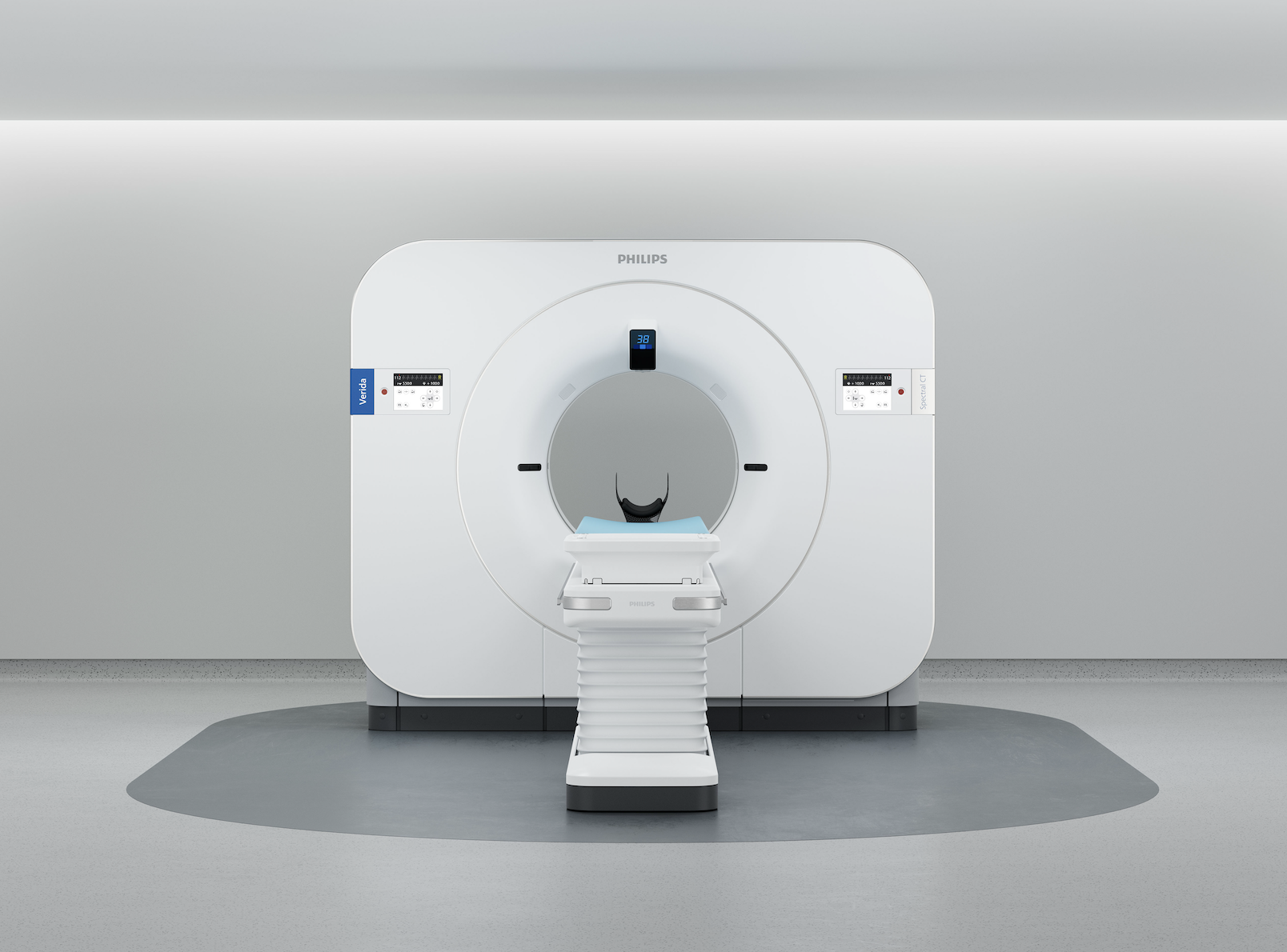

Koninklijke Philips NV (NYSE: PHG) (ETR: PHI1) has secured FDA 510(k) clearance for Verida — its new computed tomography (CT) system that pairs a dual-layer detector with AI to deliver spectral imaging without separate scans or added radiation dose. The company announced the milestone on Apr. 16.
The technology works by capturing high and low-energy data in a single rotation. It then applies deep-learning reconstruction to cut noise and sharpen detail, producing up to 145 images per second.
Full exams finish in less than 30 seconds, supporting as many as 270 studies in a standard shift. Clinicians gain simultaneous access to conventional and spectral results, improving tissue characterization and material differentiation across radiology, cardiology, interventional procedures and oncology. This includes low-dose lung cancer screening.
The clearance makes the system commercially available in the United States and positions detector-based spectral CT as a practical tool for routine practice rather than a specialized add-on in healthcare settings.
“AI isn’t a feature. It’s the engine,” said Philips’ CT Business Leader Dan Xu in a recent social media post. “At the heart of Verida is Spectral Precise Image — an AI-powered reconstruction engine that enhances image clarity, preserves anatomical detail and supports up to 80 per cent lower-dose scans.”
Read more: Breath Diagnostics advances pre-op pneumonia screening with FDA breakthrough designation
Industry-wide push in advanced CT systems
This milestone arrives amid a burst of FDA activity in computed tomography, signalling steady progress toward higher-resolution, lower-dose and more efficient scanners.
Just weeks earlier, GE HealthCare Technologies Inc (NASDAQ: GEHC) (FRA: L0T) received clearance for its Photonova Spectra photon-counting CT platform. The system uses a wide detector with eight-bin energy resolution and accelerated computing to extract richer spectral information from a single scan while freezing motion and preserving spatial detail, essentially.
On Apr. 2, the agency also cleared GE’s True Definition DL software, a deep-learning algorithm that enhances spatial resolution and supports high-definition chest, musculoskeletal and inner-ear imaging without increasing scan time or radiation.
A couple of months earlier in February, New Zealand medtech company MARS Bioimaging gained approval for a compact, mobile photon-counting CT scanner intended for upper-extremity imaging. The portable unit produces high-resolution 3D images that clearly separate bone, soft tissue, vessels and metal implants. It is ideal for fracture assessment, surgical planning and follow-up in clinics or sports-medicine facilities.
Systems like these will help reduce repeat scans, support earlier diagnoses and expand CT’s role across care environments.
Read more: Prestigious medtech intelligence firm recognizes Breath Diagnostics for innovation
Follow Rowan Dunne on LinkedIn
rowan@mugglehead.com