
China is rapidly shifting humanoid robots from staged demonstrations into real-world work as it builds a nationwide network of robot training centres.
The push follows a high-profile showcase at the Spring Festival gala earlier this year. Provinces including Anhui, Zhejiang and Shandong are now opening training hubs in quick succession. These centres aim to speed up commercialization of next-generation robotics.
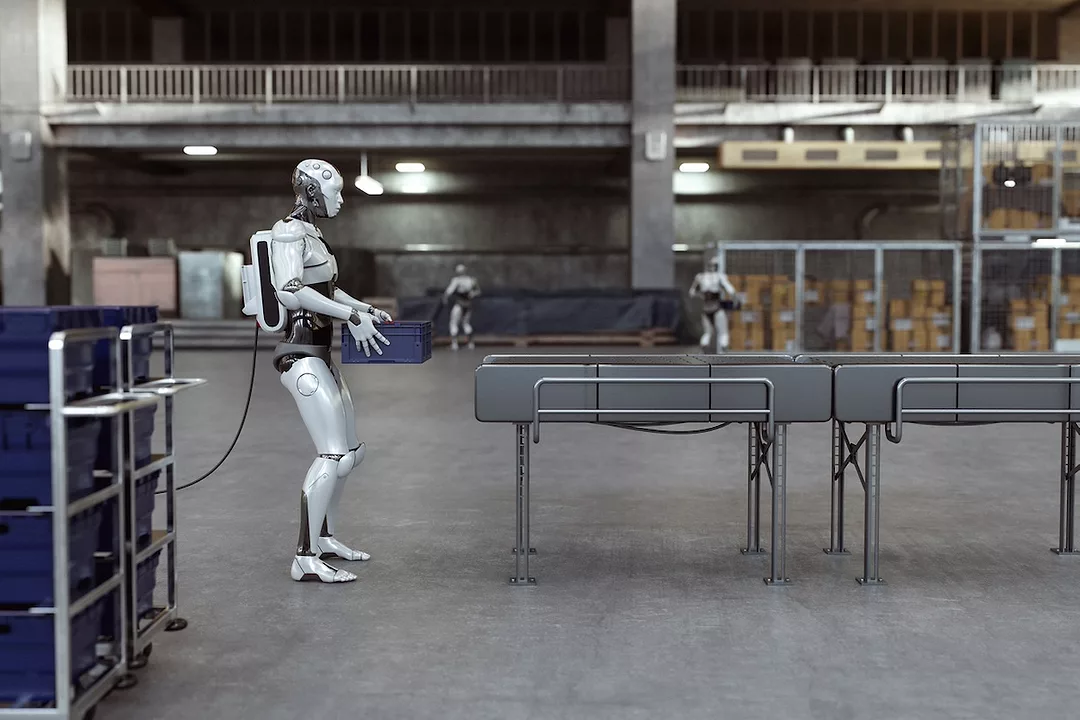
In Shandong, engineers train dozens of humanoids on basic physical tasks. Robots carry trays, fold clothes and retrieve items from shelves. Meanwhile, operators repeat the same actions to generate detailed motion data.
Training humanoid robots requires far more complex inputs than typical AI systems. Unlike text or image datasets, this data cannot come from the internet. Instead, engineers must collect it through direct interaction with machines.
The datasets include joint movement, speed and rotation metrics. Additionally, they capture visual input, touch, pressure and force feedback. This level of detail allows robots to operate safely in physical environments.
China has built more than 40 state-backed robot data centres to support the effort. So far, 24 facilities are already running. These sites often span thousands of square metres and house dozens of machines.
Workers perform repetitive tasks alongside robots to record precise action data. Consequently, companies can train systems faster and refine performance in real-world scenarios.
Leju, a humanoid robotics firm, operates one such centre in Hebei. It built simulated environments including assembly lines, smart homes and eldercare settings. Furthermore, the site runs 16 separate training programs for humanoid systems.
Read more: New AI model allows farm robots to identify and kill unfamiliar weeds instantly
Read more: Boston Dynamics turns to AI to make humanoid robots safer around people
Real world training remains essential for progress
Some robots use virtual reality and motion capture to complete assigned tasks. They sort materials, return empty boxes and package goods. The centre produces roughly 6 million data entries each year.
Engineers report that these robots now perform more than 20 functions. Additionally, task success rates have reached about 95 per cent in controlled settings.
Another facility in Hubei uses about 100 humanoids for continuous training cycles. Robots repeatedly fold clothes, iron fabric and clean surfaces. Meanwhile, the repetition helps systems learn consistency and precision.
Industry leaders say real-world training remains essential for progress. Li Chao, a robotics executive, said companies must test robots in practical environments to improve results. He added that supportive government policies allow faster deployment and experimentation.
The training network is already generating revenue for robotics firms. Data centres in Jiangxi, Guangxi and Sichuan have driven significant sales growth. Consequently, one major robotics company reported sales of 566 million yuan from humanoid systems.
China expects early adoption in manufacturing and logistics sectors. These industries rely on repetitive tasks that robots can learn quickly. Furthermore, companies see automation as a way to address labour shortages and improve efficiency.
.