
Silver has ascended to a historic high exceeding US$63 per ounce amid supply deficits, heightened industrial demand and safe haven-focused purchases. Economic uncertainty, persistent inflation, and rising geopolitical tensions have also fueled the commodity’s recent upswing.
The precious metal has surpassed the previous 1980 peak in unadjusted United States dollar terms. Many analysts believe it may be on its way to achieving an equivalent or higher value than it had 45 years ago. Silver was the worth a sum equal to approximately US$170 per ounce in today’s dollars in early 1980, on an adjusted basis.
On Dec. 9, The Silver Institute released a report forecasting that silver demand would continue rising across industrial sectors, thereby driving this anticipated rally. Titled, “Silver, The Next Generation Metal,” the assessment covers three key industries that are expected to propel the silver market. They are solar photovoltaics, electric vehicle manufacturing and artificial intelligence.
Oxford Economics, a leading independent economic advisory firm, helped the institute craft its report.
“Falling solar costs, increasing EV adoption, and rapid data-centre expansion are set to reinforce silver’s role as a critical industrial metal,” said Oxford Economics Associate Director, Amid Sharda.
Read more: NevGold expands high-grade antimony discovery at Nevada’s Limousine Butte Project
Green ambitions bring heightened solar demand
Demand for silver in the solar photovoltaics industry has increased immensely over the past decade. Between 2014 to 2024 the total percentage consumed in this clean tech sector globally rose by 18 per cent to 29 per cent.
According the report, China has been the primary leader in the industry, accounting for 51 per cent of this growth. Behind Beijing is Europe, accounting for 15 per cent, and the U.S., which is responsible for 9 per cent. China is largely responsible for declining solar costs due to the country’s investments in enhancing its manufacturing capabilities.
The International Energy Agency expects solar photovoltaics to become the world’s leading renewable energy source by the end of the decade.
“With experts believing that solar costs will continue to fall, solar power is increasingly become cost competitive independent of government support,” the report specified.
Importantly, solar is expected to drive the largest share of silver demand among the three industrial segments. Silver is the world’s most conductive metal, and its ability to enhance energy conversion in solar panels is essential for their functionality.
Report co-author Oxford Economics has estimated that solar electric power generation in the U.S. will see compound annual growth of 14 per cent until 2030.
Read more: Silver and copper now considered critical minerals in U.S.
Post-pandemic era EV demand brings silver with it
For the electric vehicle segment, The Silver Institute anticipates a modest compound annual growth rate of 3.4 per cent for automotive industry silver demand between now and 2031. The organization highlighted that their rate of production has been increasing since the pandemic.
Additionally, EVs consume approximately 72 per cent more silver than vehicles with internal combustion engines. Their growing popularity is driving precious metal spending in the industry. The average electric vehicle requires 25 to 30 grams of silver in its components.
Silver is used to ensure efficient power transmission throughout the vehicle’s electrical systems, such as the battery packs, charging modules and inverters.

JinkoSolar Holding Co., Ltd (NYSE: JKS) (FRA: ZJS1) is one of China’s top solar manufacturers. Here you can see one of the company’s installations at a paper mill in Pakistan. Photo credit: Jinko Solar
Read more: NevGold surges after closing C$10M financing deal
AI revolution & data centre multiplication requires silver stockpiles
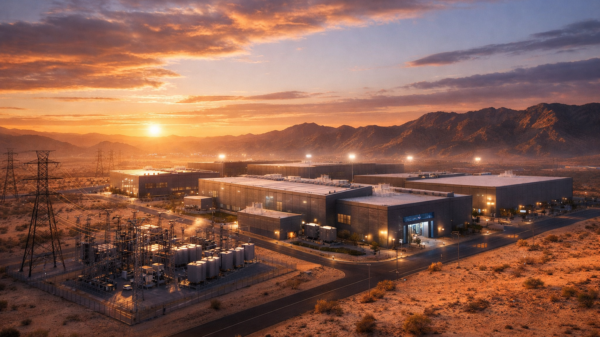
Like the solar and EV industries, demand for silver in the artificial intelligence sector is increasing because the metal’s excellent conductive properties make it essential for high-performance electronic applications. Data centres house thousands of powerful servers, graphics processing units, and high-performance chips that rely on silver in their components.
As AI adoption increases globally the demand for silver-intensive hardware is rising with it. This positions silver as an essential material in the rapidly evolving technology sector.
“AI applications increasingly rely on specialized hardware such as graphics processing units GPUs, tensor processing units [TPUs], and neural processing units [NPUs],” The Silver Institute explained, “all of which depend on high-performance semiconductors that use silver in their internal connections and packaging.”
The Silver Institute is a non-profit comprised of silver mining companies, refiners, bullion suppliers, manufacturers and wholesalers. It intends to serve as an international voice for the silver industry.
The @SilverInstitute's new outlook reinforces what we’re seeing across the industry: silver demand is accelerating, especially in clean energy, electronics, and other high-tech sectors.
From my perspective, this isn’t just a market trend,it’s a clear signal of #silver’s growing…
— Dan Dickson (@DanDickson_) December 12, 2025
Read more: NevGold edges closer to gold-antimony resource with latest Limousine Butte results
Follow Rowan Dunne on LinkedIn
rowan@mugglehead.com