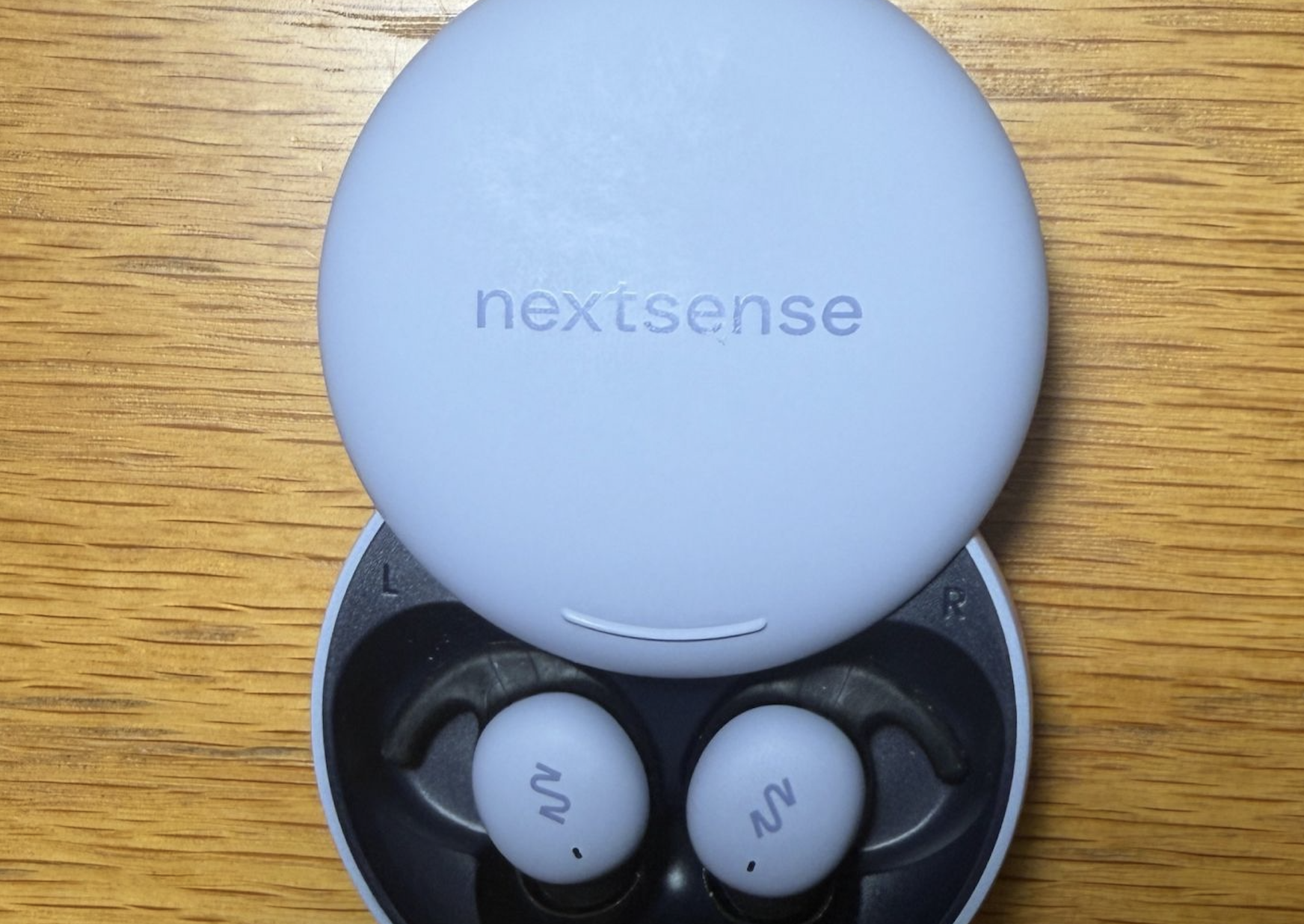

California-based sleep technology and wellness company NextSense has officially unleashed its groundbreaking SmartBuds, a novel addition in the wearable tech industry. Shipping commenced on Feb. 9.
These wireless earbuds integrate six clinical-grade EEG sensors to monitor brain activity in real-time. They can detect a user’s sleep stages with considerable precision.
Unlike past tracking devices on the market, SmartBuds deliver precisely timed audio frequencies to amplify slow-wave/deep sleep. This is said to boost recovery, help to consolidate memory and make the wearer more alert during the day.
“This real-time brain sensing uses audio to improve the depth of your sleep through a mechanism called slow-wave enhancement,” said Head of Product and Content, Caitlin Shure, in an interview.
They harness an AI algorithm to learn an individual’s unique neural patterns and then use that information to provide personalized insights through an app. The application tracks metrics like drift-off time and waking duration intervals throughout the night.
Meanwhile, during the day, users can listen to tunes or podcasts with up to 13 hours of battery life between the headphones and charging case they go inside of. Priced at an early-bird US$249 (regular US$399), they require a US$14.99 monthly Fit Kit subscription after three free months.
Controlled beta testing on the product over 106 nights with an unspecified number of participants revealed favourable results. About half of those involved subjectively reported significantly improved sleep and a boost of morning energy.
Separately, by pooling data from various early testing groups, the company says it has gathered over 1,000 nights of everyday real-world use. NextSense touts this as proof the brain-sensing tech works reliably outside of a lab setting and one of the biggest consumer EEG sleep datasets available. These numbers are self-reported and not peer-reviewed or backed by large-scale randomized studies.
The gadget does stand out from competitors though. Ozlo Sleepbuds, for instance, rely on passive noise masking and biometric detection via sensors. They have less battery life at 10 hours and do not utilize the same brain-level intervention that the Smartbuds boast, but they do have a lower regular price range between US$274 to US$349.
Soundcore’s Sleep A30 headphones, meanwhile, have active noise cancellation and snore masking tech but also lack the EEG-driven modulation of the SmartBuds. These only cost about US$200.
NextSense’s novel gadget is pioneering active neuromodulation and elevating brain health accessibility, but you can only use the futuristic ear plugs if you have an iPhone 12 model or higher running iOS 17 or above.
This sleep technology company was spun out as an independent entity from Alphabet’s X (the Moonshot Factory). Founder and CEO Jonathan Berent, a former director there, came up with the SmartBuds idea as an exploratory probe into in-ear brain-sensing tech.
Read more: Aston Martin racing team starts using Eight Sleep Pod for competitive edge
Follow Rowan Dunne on LinkedIn
rowan@mugglehead.com