
What counts as weeds have always depended on a farmer’s judgment, however Carbon Robotics is shifting that decision toward real-time artificial intelligence.
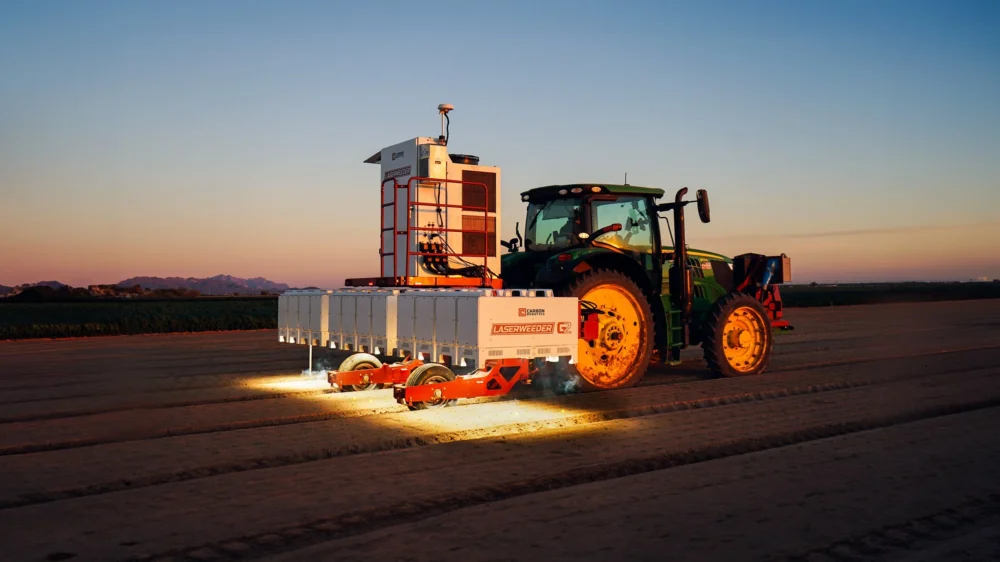
Seattle-based Carbon Robotics has unveiled a new AI system called the Large Plant Model, designed to instantly recognize plant species in the field. The model now runs inside the company’s LaserWeeder robots, which use precision lasers to destroy unwanted plants without chemicals.
Previously, farmers had to wait for engineers to retrain the machines whenever unfamiliar weeds appeared in new soil conditions. That retraining process typically took about a day, consequently slowing response during fast-changing growing seasons.
The new model instead allows farmers to flag a plant immediately and instruct the robot to eliminate it. According to the company, the system can identify plants it has never encountered before by analyzing structure and relationships.
Additionally, farmers can choose which plants to protect or destroy directly through the robot’s interface. The Large Plant Model draws on more than 150 million labeled plant images collected from operating machines worldwide.
Those images come from over 100 farms across 15 countries where the LaserWeeder is already deployed. Furthermore, each robot continuously adds new data as it moves through fields, expanding the system’s knowledge base.
Carbon Robotics founder and chief executive Paul Mikesell said the model recognizes plants at a deeper biological level. He explained the system no longer depends on narrow visual matches tied to specific lighting or soil conditions.
Instead, it evaluates shape, growth patterns, and plant relationships to make rapid decisions. Meanwhile, Carbon Robotics began developing the model shortly after shipping its first commercial machines in 2022.
Read more: Fusemachines stock soars on AI collaboration with IBM partner modulAIre
Read more: Google Research discovers that repeating LLM prompts twice gives superior answers
Farmers will not need new hardware
Mikesell previously worked on neural networks at Uber and on virtual reality hardware at Meta’s Oculus division. That background influenced the company’s push toward large-scale models similar to those used in consumer AI tools.
Additionally, the Large Plant Model will roll out to existing customers through a software update. Farmers will not need new hardware to access the improved capabilities, according to the company.
Carbon Robotics has raised more than USD$185 million from investors including Nvidia (NASDAQ: NVDA) NVentures, Bond, and Anthos Capital. The company plans to keep refining the model as more field data flows in.
Consequently, the robots should become better at distinguishing crops from weeds across diverse climates and geographies. Mikesell said the company now believes it can identify nearly any plant image using its existing dataset.
He added that the volume of training data allows accurate classification without prior exposure to specific species.
.