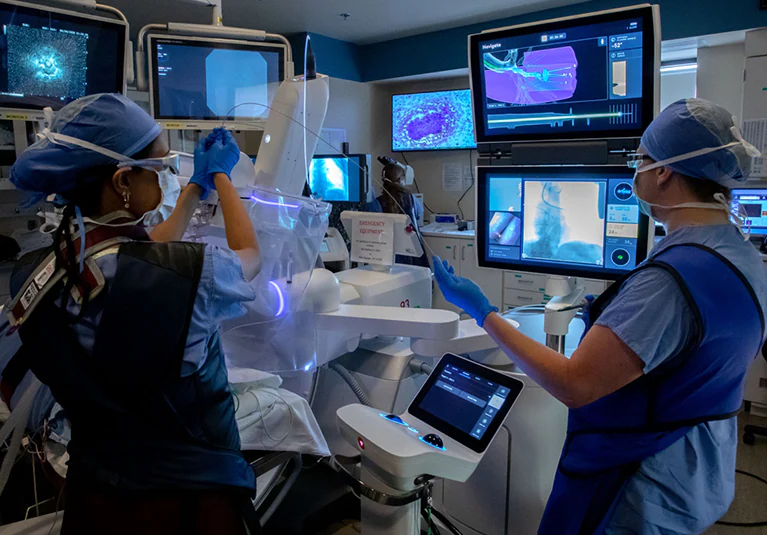

A new robotic system is helping doctors spot and treat lung cancer earlier, potentially improving survival for patients.
Researchers from the Mayo Clinic said in the April 2026 issue of the journal Mayo Clinic Proceedings that the technology can quickly distinguish dangerous lung nodules from harmless ones. Consequently, doctors can act sooner and reduce uncertainty for patients undergoing screening.
Lung cancer often begins as a small nodule detected during a CT scan. However, most nodules are benign, which makes diagnosis difficult and sometimes slow.
The new approach uses shape-sensing robotic-assisted bronchoscopy, first cleared by regulators in 2019. This system allows physicians to navigate deep into the lungs with precision.
Doctors can collect multiple tissue samples in a single procedure using the robotic system. Additionally, this reduces the need for repeated invasive procedures.
The system also integrates endobronchial ultrasound to examine nearby lymph nodes. Furthermore, physicians can assess whether cancer has spread during the same session.
Advanced 3D imaging improves targeting accuracy during biopsies. As a result, clinicians can sample suspicious areas with greater confidence.
Lead researcher Dr. Sebastian Fernandez-Bussy said earlier detection remains critical for survival. He explained that better tools allow doctors to diagnose and even treat disease sooner with fewer complications.
The study reviewed 2,115 lung lesions across 1,904 patients at Mayo Clinic sites. Meanwhile, researchers tracked outcomes before and after adopting the robotic system.
Early-stage lung cancer diagnoses increased significantly following adoption of the technology. Specifically, rates rose from 46 per cent in 2019 to nearly 69 per cent by mid-2024. Late-stage diagnoses declined during the same period. In contrast, those cases dropped from 54 per cent to 31 per cent.
Read more: Prestigious medtech intelligence firm recognizes Breath Diagnostics for innovation
Read more: Breath Diagnostics completes install of advanced mass spectrometry system
Early detection plays a major role in survival outcomes
Doctors are also beginning to treat some patients during the same procedure. For example, they can combine diagnosis with pulsed electric field ablation to destroy suspicious tissue.
This approach can benefit patients who cannot undergo surgery or radiation. Additionally, it reduces the number of hospital visits required.
Dr. Janani Reisenauer described the method as a single-anesthetic pathway. She noted that patients spend less time in recovery.
Early detection plays a major role in survival outcomes. According to the researchers, patients with small, localized tumors have a five-year survival rate of 67 per cent.
However, survival drops sharply once cancer spreads. In those cases, the five-year survival rate falls to about 12 per cent.
The findings suggest that combining robotics, imaging and ultrasound can reshape how physicians manage lung cancer. Consequently, more patients may receive timely diagnoses and immediate care during a single procedure.
Researchers are also exploring alternative diagnostic tools that rely on artificial intelligence to detect cancer earlier. For instance, machine learning models can analyze imaging scans to identify subtle patterns that human eyes might miss.
Additionally, AI systems are being trained on large datasets of lung scans to improve accuracy over time. These tools can flag high-risk nodules quickly and help prioritize patients for follow-up care.
Breath-based diagnostics are also gaining attention as a non-invasive option. Breath Diagnostics Inc is developing technology that analyzes exhaled breath for chemical markers linked to cancer.
This method relies on detecting volatile organic compounds associated with tumor activity. Furthermore, AI algorithms help interpret complex chemical signatures to distinguish benign conditions from malignancies.
Liquid biopsies represent another emerging approach. These tests analyze blood samples for circulating tumor DNA, offering a less invasive alternative to tissue biopsies.
.