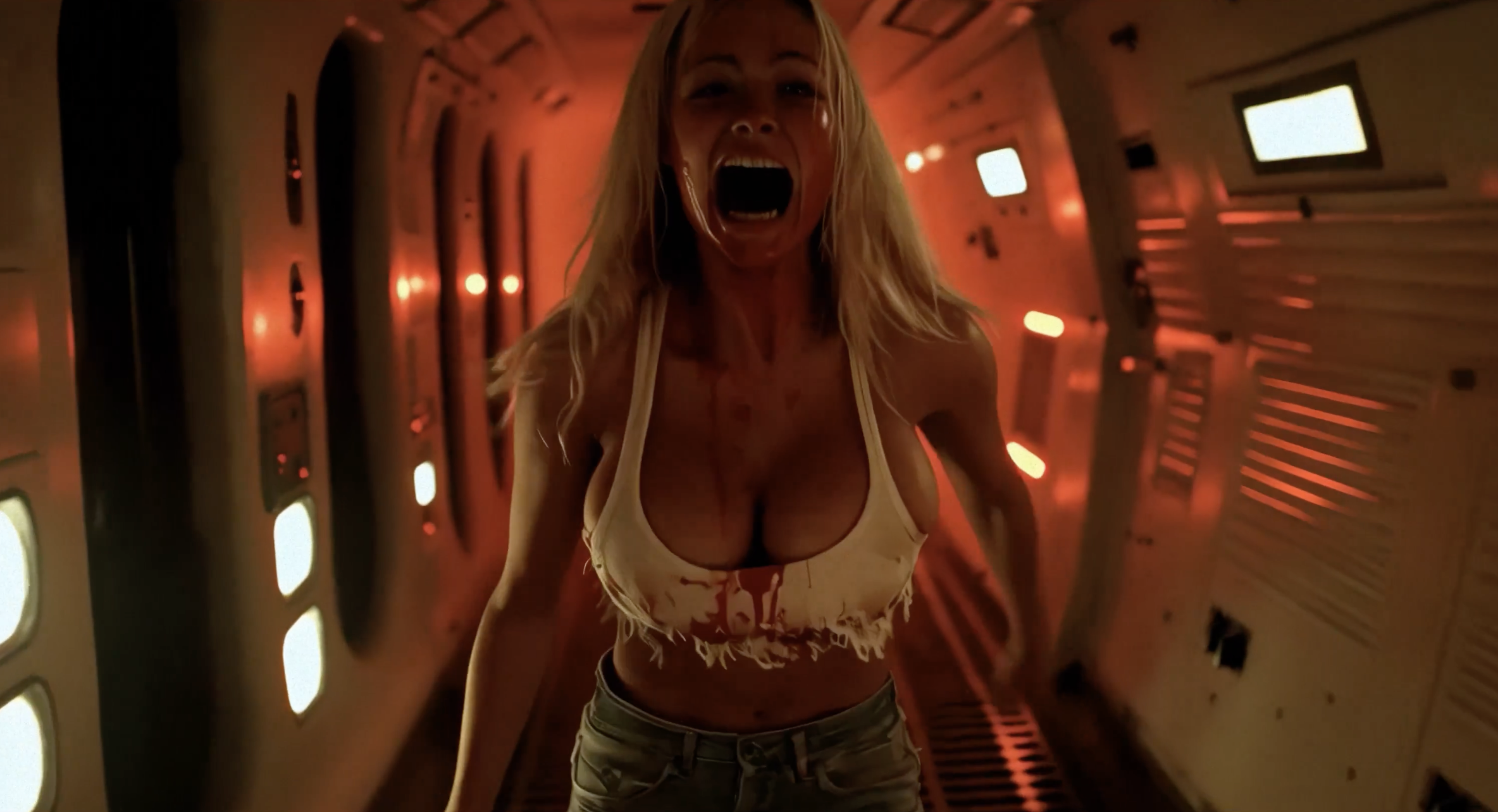

American filmmaker Charles Curran has racked up millions of views on X with his “Titty Killer” trailers. They depict women with large breasts fleeing from a crazed, mysterious murderer.
These short, AI-generated parodies are complete with dripping-blood title cards and over-the-top narration. The latest two, “Titty Killer 6: Tits of Mars” and Titty Killer 5: Zero G, are interstellar-themed. Sorority girls float in zero gravity inside of a space station while the killer strikes amid flashing alarms, girly screams and blood-spattered white T-shirts covering double D knockers.
These clips even caught Elon Musk’s attention, prompting the tech magnate to leave a laughing and fire emoji side-by-side. In addition, famous American commentator Tim Pool shared Titty Killer 5 on the social media platform, saying that the “future looks bright.”
“This is like the plot of a movie written by a 12-year-old boy,” said one of the characters in the teaser.
Read more: Netflix takes over Ben Affleck’s AI film startup InterPositive
The visionary director
Charles or Charlie Curran brings real filmmaking expertise to these latest viral and controversial artistic creations. He directed the acclaimed 2018 documentary See Know Evil, which chronicles fashion photographer Davide Sorrenti’s life and earned spots on “best fashion films” lists from publications like Russh Magazine.
Curran has also shot campaigns for major names such as Nike Inc (NYSE: NKE) (ETR: NKE), Google, Marc Jacobs and Tommy Hilfiger. He currently runs Menace Studio and experiments boldly with AI, including by creating a memorable Miss Piggy version of Melania Trump’s movie trailer.
At the moment, Curran has been treating the Titty Killer series as proof-of-concept art. “If you think AI film can’t be art then explain this,” he says to the haters who want to label it as more AI slop.
He writes the premise, feeds precise prompts into the software and edits the results into tight trailers that feel directed rather than generated. Curran builds the clips primarily with Seedance 2.0 from ByteDance and Kling AI. These tools generate consistent characters, realistic motion, and extended sequences that once demanded full crews and VFX houses.
AI transforms filmmaking
In 2026, AI video tools have been reshaping the industry at lightning speed. Seedance 2.0’s February release in particular triggered an explosion of hyper-realistic clips that racked up millions of views overnight. They included celebrity fight scenes, alternate TV endings and full short films.
Creators now use tools like Runway, Kling, Google’s Veo and Higgsfield to produce cinematic footage without budgets, crews, or studios. Trailers and shorts that once cost hundreds of thousands now emerge in mere hours.
Hollywood has reacted with outrage over copyright and job losses, yet indie filmmakers continue to seize the moment with disregard for those that disapprove.
“Independent filmmakers will soon face zero constraints as a result of AI,” commented a popular independent publisher. “Budget will no longer be a factor — every artist will be unleashed.”
If you think AI film can’t be art then explain this. pic.twitter.com/mD4KVtW6Bh
— Charles Curran (@charliebcurran) April 3, 2026
Read more: Wonder Studios raises US$12M in seed for AI film production
Follow Rowan Dunne on LinkedIn
rowan@mugglehead.com