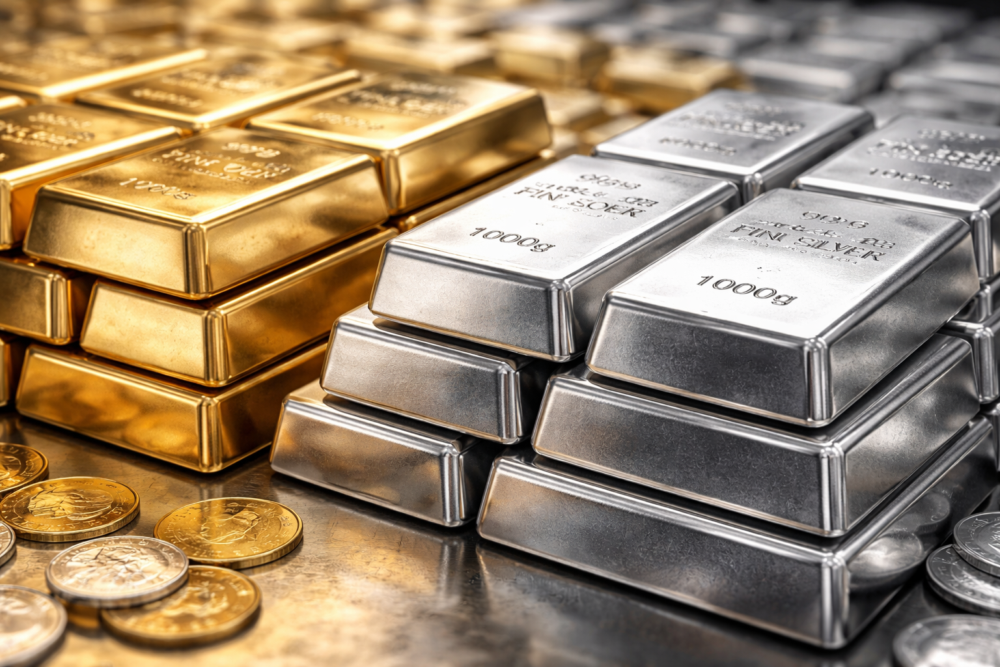

Gold prices eased slightly in early U.S. trading on Tuesday while silver pushed higher, as investors positioned ahead of a closely watched U.S. inflation report and weighed fresh political and market risks.
Risk aversion remained elevated amid geopolitical tension, policy uncertainty, and sharp moves across commodity markets. February gold futures were last down USD$25.80 at USD$4,589.10, while March silver rose USD$0.474 to USD$85.58.
Meanwhile, attention was firmly fixed on the upcoming U.S. consumer price index data. Economists broadly expect the annual inflation rate to hold steady at 2.7 per cent in December. Core inflation, which strips out food and energy, is forecast to edge up to 2.7 per cent from 2.6 per cent in November, marking a potential pause in recent disinflation trends.
On a month-over-month basis, headline CPI is expected to rise 0.3 per cent. Core prices are also seen climbing 0.3 per cent, driven largely by higher goods costs. However, the inflation outlook remains clouded by data quality concerns tied to the recent U.S. government shutdown.
November’s month-over-month figures were not published because the Bureau of Labor Statistics could not collect sufficient data during the shutdown. Consequently, some analysts warn that distortions may still be affecting December’s report. However, markets are bracing for signs that downward inflation pressure could be reversing.
Meanwhile, CME Group (NASDAQ: CME) is changing how it sets margins for gold, silver, platinum, and palladium futures after a surge in prices and heightened volatility. The exchange said margins will now be based on a percentage of a contract’s notional value rather than fixed dollar amounts.
Read more: NevGold’s latest discovery represents near-term antimony production potential
Read more: NevGold surges after closing C$10M financing deal
Gold and silver both set records on Monday
Previously, the exchange adjusted margin requirements using fixed dollar thresholds. However, the new framework reacts more smoothly to price swings, allowing margin levels to shift in step with market volatility. The change takes effect from Tuesday’s close, following what the exchange described as a routine review of market volatility.
According to market participants, the percentage-based system should reduce the need for frequent margin changes during fast markets. However, CME indicated that it may still raise margin percentages if volatility exceeds historical norms or unexpected events emerge.
Gold and silver both set fresh records on Monday as investors piled into safe-haven assets. Spot gold climbed as much as 2.6 per cent to an all-time high of USD$4,625.34 per ounce, clearing the USD$4,600 level for the first time. Silver surged 7.2 per cent to a record USD$85.73 per ounce.
Growing unease over the U.S. Federal Reserve and doubts about its independence have driven the rally. Repeated public attacks on the central bank by Donald Trump have unsettled markets and pushed investors toward assets viewed as long-term stores of value.
Investors worry that political pressure could weaken the Fed’s ability to control inflation. Such interference would likely hurt the U.S. dollar and Treasury bonds. Consequently, gold’s appeal has strengthened as protection against policy risk.
Additionally, falling U.S. interest rates expectations and rising geopolitical tensions have provided further support for precious metals. Several money managers told Bloomberg they have resisted locking in profits, citing confidence in gold’s longer-term prospects.
One macro strategist said the rally reflects overlapping political, monetary, and geopolitical risks that continue to reinforce haven demand.
Read more: NevGold targets U.S. critical mineral supply chain with new antimony-gold find
Read more: NevGold Expands Gold-Antimony Potential at Limousine Butte in Nevada
Silver’s rally supported by tight physical supply
Gold closed 2025 up 65 per cent, marking its strongest annual gain since 1979. Silver outperformed even that move, posting a 140 per cent gain. That momentum has carried into 2026 as political uncertainty deepens.
Meanwhile, the Trump administration has escalated its confrontation with the Fed. Chair Jerome Powell now faces the threat of criminal indictment after receiving a grand jury subpoena from the U.S. Justice Department. Markets have reacted sharply to the headline risk.
Analysts at Julius Baer Group described increased interference with the Fed as a key bullish wildcard for precious metals in 2026. Silver, they noted, tends to react more aggressively than gold due to its smaller market size and sensitivity to rates and the dollar.
In addition, strategists say the possible indictment serves as a reminder of how many risks markets are juggling at once. These include geopolitics, debates over growth and interest rates, and renewed concerns about institutional stability.
Tight physical supply supports silver’s rally. Fears of potential U.S. tariffs on silver have drained warehouse inventories, echoing conditions seen during the London silver squeeze in October.
Furthermore, analysts at BMI, a unit of Fitch Solutions, expect the silver market deficit to persist through 2026. They attribute the imbalance primarily to rising investment demand. Industrial consumption has also tightened supply to historically strained levels.
Meanwhile, speculative activity in China has added fuel to the broader commodities surge. Traders and large funds have poured money into metals in recent weeks, driving prices higher across the complex.
Read more: NevGold expands high-grade antimony discovery at Nevada’s Limousine Butte Project
Read more: NevGold expands Limo Butte footprint by staking 90 promising antimony-gold claims
Trump threatened new tariffs on countries trading with Iran
Notably, China’s only pure-play silver fund temporarily halted new subscriptions after premiums surged well above the value of its underlying assets. Managers cited concerns over investor risk during the rapid price spike.
Geopolitical tensions have also intensified. President Trump on Monday threatened new tariffs on countries that trade with Iran. The move risks undermining a one-year trade truce between the U.S. and China, the world’s largest buyer of Iranian oil.
Such developments have reinforced demand for defensive assets. However, currency markets showed limited reaction early Tuesday. The U.S. dollar index edged slightly higher, tempering some upward pressure on metals.
Meanwhile, crude oil prices advanced, trading near USD$60.75 per barrel. Rising energy prices could feed back into inflation expectations, adding another variable ahead of the CPI release.
Additionally, the benchmark 10-year U.S. Treasury yield hovered around 4.19 per cent. Bond markets remain sensitive to both inflation data and shifting perceptions of Fed independence.
Consequently, investors across commodities, currencies, and rates markets remain cautious as the inflation report approaches. Positioning reflects a market bracing for volatility rather than confidence in a single outcome.
However, precious metals continue to attract steady inflows as political risk, supply constraints, and policy uncertainty converge. The interplay between inflation data, central bank credibility, and global trade tensions remains the dominant force shaping price action.