Foremost Clean Energy reports 1.3% uranium oxide over 1m at Tuning Fork
Eight holes outlined mineralization across 200 metres of strike at Hatchet Lake South, with follow-up targets to the north and south.
 Mara Quinlan
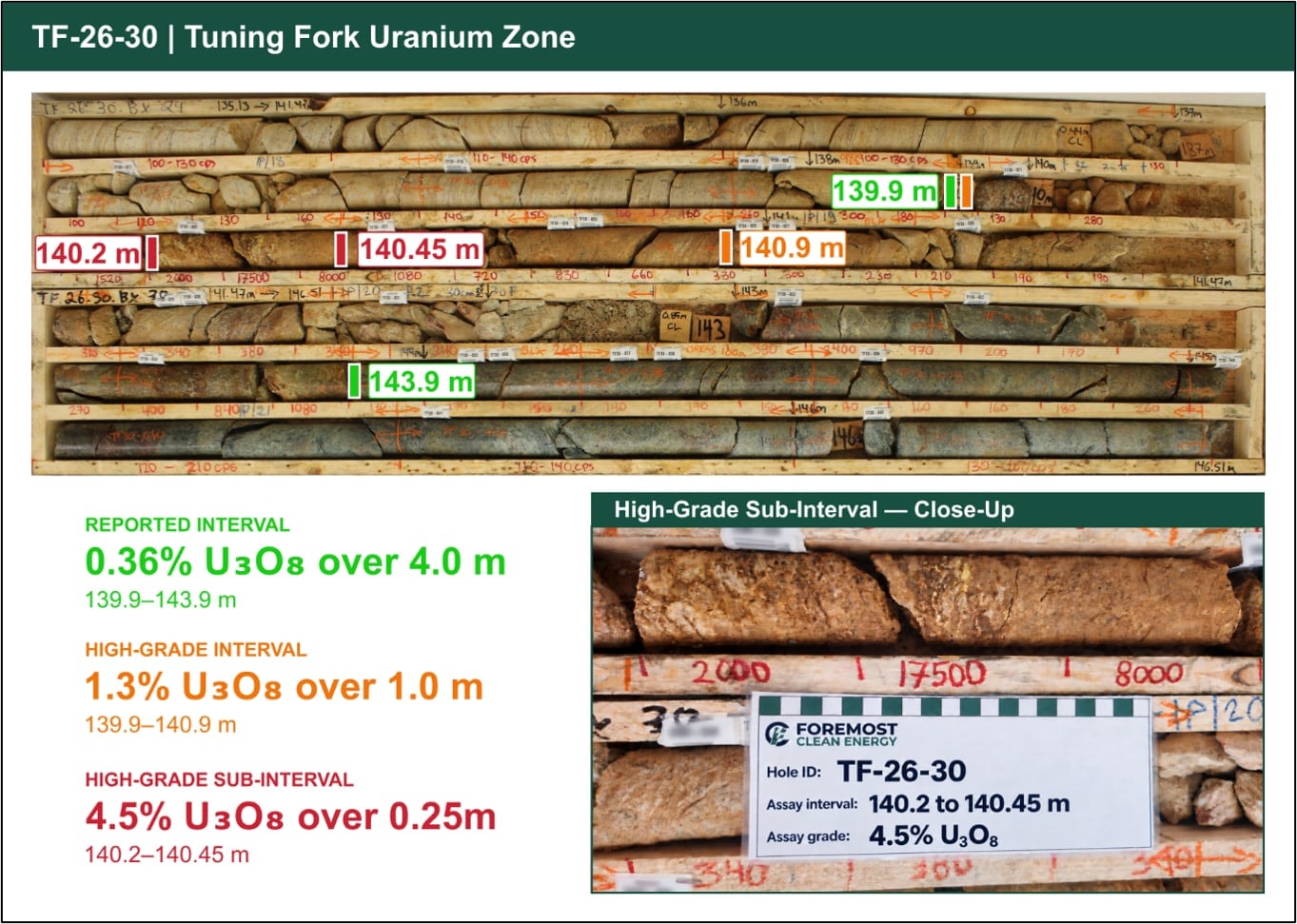
Foremost Clean Energy Ltd. CNSXFAT NASDAQFMST reported on Tuesday that hole TF-26-30 returned 1.3 per cent uranium oxide over 1.0 metre at its Tuning Fork zone in northern Saskatchewan. The assays confirm mineralization in eight holes across 200 metres of strike, giving the Hatchet Lake South exploration project targets for follow-up drilling.
Shares were unchanged at C$0.73 at the Oct. 26 close on the Canadian Securities Exchange, timestamped 4:00 p.m. EDT CNSXFAT. That close preceded Tuesday's announcement.
The strongest interval began at a downhole depth of 139.9 metres, according to the company's Oct. 27 release. It included 4.5 per cent uranium oxide over 0.25 metres within a broader composite of 0.36 per cent over 4.0 metres.
Foremost expects further drilling to test extensions in both directions, with particular emphasis on southern targets. The company identified approximately 600 metres of prospective conductive strike to the south and 250 metres to the north that remain inadequately tested.
The completed program comprised 19 diamond drill holes totalling 3,848 metres. Five drill fences, spaced approximately 50 metres apart, tested the trend, with mineralization encountered on four fences.
Foremost used a uranium oxide cut-off of 0.05 per cent to identify the eight mineralized holes. The reported lengths are downhole intervals; the results table does not give true widths.
"Our next step is to understand the geological controls on that mineralization and identify where similar conditions may occur," vice-president of exploration Cameron MacKay said in the release.
The assay table also distinguishes laboratory results from radiometric equivalent grades, which estimate uranium content from radiation measurements. The table places the assays beside radiometric results previously released on April 15 and May 13.
The highest-grade subinterval was reported as a chemical assay. The broader composite includes a core-loss section from 142.15 metres to 143.00 metres, so it combines laboratory assays with radiometric estimates.
The compositing rules allow up to 2.0 metres of internal dilution within an interval. Two holes used a lower cut-off of 0.01 per cent uranium oxide, as noted in the table.
On the northernmost fence, hole TF-26-36 returned 0.19 per cent uranium oxide over 2.8 metres. Foremost said historical drilling farther north was not positioned to evaluate its current targets.
Only three holes have tested the prospective southern area. The company said some of its most promising targets there remain untested, making the south a priority for the next program.
Read more: Myriad Uranium regains full control of 24 Arizona breccia-pipe prospects
Foremost's next step is follow-up drilling at Tuning Fork, with no start date specified in the announced program priorities.