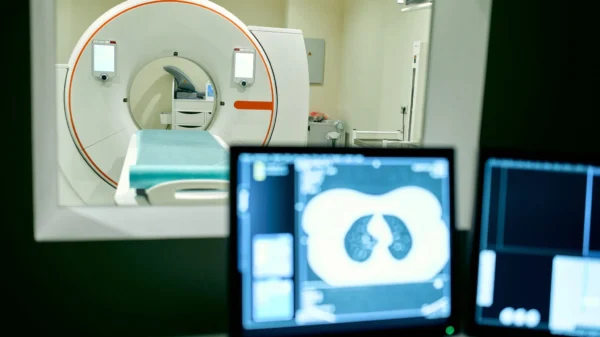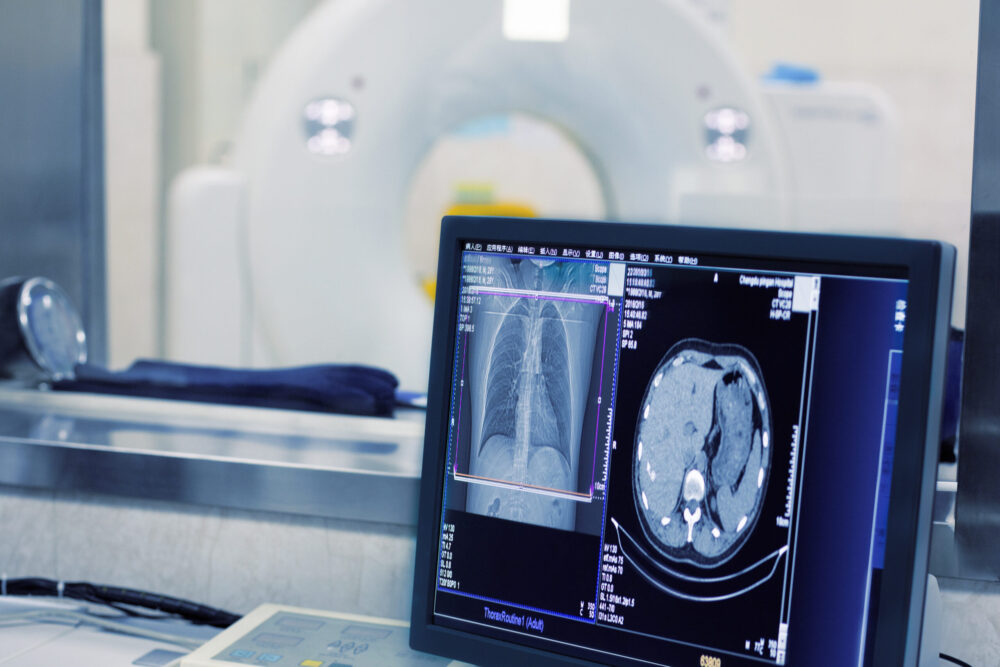

FDA regulators have cleared new lung-nodule assessment software from Median Technologies (EPA: ALMDT) designed to help doctors judge cancer risk on CT scans.
The company said on Monday that the platform, eyonis LCS, analyzes lesions detected during low-dose lung cancer screening.
Additionally, the software estimates how likely a nodule is malignant before clinicians order invasive procedures. Doctors often monitor indeterminate nodules for months because lung biopsies carry meaningful medical risks.
Further, this watch-and-wait approach can leave patients uncertain while clinicians track subtle changes in scans. Median executives say the software provides a probability score that guides the next diagnostic step.
The Median system, however, reported 93.3 per cent sensitivity and 92.4 per cent specificity when identifying malignant lung nodules in validation testing cited by the company. Furthermore, the platform achieved a 99.9 per cent negative predictive value in supporting benign assessments.
Developers built the system using real-world patient outcomes that regulators carefully reviewed during the FDA clearance evaluation process last year overall. Meanwhile, clinicians still rely on CT imaging, nuclear scans, biopsies or ablation depending on individual cases.
Muduroglu said the tool estimates malignancy risk across a wide probability range. Consequently, care teams can choose faster follow-up tests instead of waiting three to nine months.
Radiologists may recommend a diagnostic CT scan or tissue sampling when the risk score signals a higher probability of cancer development. Low-risk scores may support continued monitoring without immediate invasive procedures.
The company designed the software to operate within existing lung cancer screening programs. The software evaluates nodules at the same time radiologists review screening scans.
Read more: Prestigious medtech intelligence firm recognizes Breath Diagnostics for innovation
Read more: Breath Diagnostics completes install of advanced mass spectrometry system
Non-invasive screening tools help with diagnostics
Hospitals increasingly seek tools that reduce unnecessary biopsies while keeping cancer detection accurate. Meanwhile, earlier risk estimates could shorten the period patients spend anxiously waiting for clearer diagnostic answers after initial screening scans arrive.
Kentucky-based Breath Diagnostics Inc., for example, is developing breath-analysis technology designed to detect chemical biomarkers associated with lung cancer.
The approach aims to provide a non-invasive screening tool that could help identify patients who need further imaging or diagnostic testing. Additionally, breath-based analysis could potentially be used alongside existing CT screening programs to refine risk assessments before clinicians recommend invasive procedures.
However, such technologies remain under development and still require broader clinical validation before widespread clinical adoption.
Muduroglu said the goal is to guide personalized care decisions sooner. Consequently, clinicians may move more quickly toward imaging, biopsy or treatment when risk appears high.
.
joseph@mugglehead.com