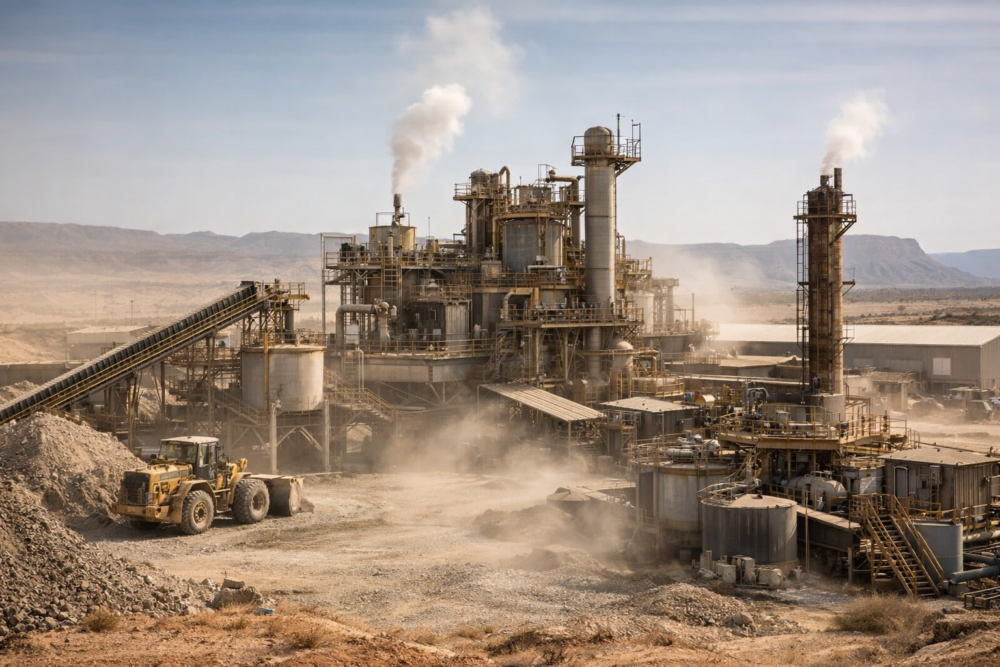

Energy Fuels Inc (NYSE: UUUU) (TSE: EFR) has produced its first kilogram of high-purity terbium oxide at its White Mesa Mill in Utah, marking a key step in rebuilding a domestic rare earth supply chain.
The company said it achieved 99.9 per cent purity using U.S.-sourced monazite ore at pilot scale. Additionally, that level meets specifications required by global magnet manufacturers.
Energy Fuels also recently produced nearly 30 kilograms of dysprosium oxide at the same purity level. Consequently, the company continues to expand its portfolio of heavy rare earth materials.
Executives said the milestone shows the company can economically produce heavy rare earth oxides at scale in the United States. Furthermore, they expect this capability to support domestic supply chains for advanced technologies.
The company believes it is the first U.S. producer in decades to report such production from primary mineral feedstock. Meanwhile, it has already sent samples to manufacturers for validation testing.
Both terbium and dysprosium face export controls from China, which dominates global supply. Consequently, Western governments and companies have pushed to develop alternative sources.
Manufacturers use these elements to improve the performance of permanent magnets in high heat environments. Additionally, they help create smaller and more efficient motors for electric vehicles and robotics.
The White Mesa Mill will continue pilot production at roughly one kilogram of terbium oxide per week. Furthermore, the company plans to begin pilot runs of samarium, europium and gadolinium oxides.
Energy Fuels also aims to expand its processing circuits to support commercial-scale recovery of multiple rare earth elements. In addition, the facility could separate other materials such as yttrium and lutetium if market demand supports it.
Read more: NevGold delivers major growth at Idaho gold project
Read more: Antimony recovery results from NevGold’s Limo Butte project exceed expectations
Energy Fuels plans a second expansion phase
The company expects its expanded commercial circuit could begin operating as early as 2027, pending approvals. Subsequently, it could process about 10,000 tonnes of monazite per year.
That capacity could yield up to 35 tonnes of dysprosium and 12 tonnes of terbium annually. Additionally, it could produce between 850 and 1,000 tonnes of neodymium-praseodymium oxide.
Neodymium-praseodymium, often called NdPr, forms a key component in high-performance permanent magnets. Consequently, it plays a central role in electric vehicle production and clean energy systems.
Energy Fuels also plans a second expansion phase to further increase production capacity later this decade. Meanwhile, the Phase 2 circuit could come online as early as 2029.
That expansion could lift NdPr output to more than 6,000 tonnes per year. Furthermore, it could produce about 80 tonnes of terbium and 288 tonnes of dysprosium annually.
At those levels, the company said it could supply enough material for roughly 7.0 million electric or hybrid vehicles each year. Consequently, it would position itself as a major supplier to global clean energy markets.
The company continues to source monazite from domestic producers and allied countries. Additionally, it identified projects in Australia, Madagascar and Brazil as future supply sources.
These include the Donald Project in Australia, the Vara Mada Project in Madagascar and the Bahia Project in Brazil. Meanwhile, the company described these assets as key to long-term feedstock security.
Energy Fuels also plans to install new circuits to process mixed rare earth concentrates at White Mesa. In addition, these materials represent partially processed intermediate products used in global supply chains.
Read more: NevGold targets U.S. critical mineral supply chain with new antimony-gold find
Read more: NevGold mobilizes drill on Limo Butte historical pads, eyes 2027 antimony production
United States accelerating permitting reforms
Executives said expanding processing capabilities will help the company serve both light and heavy rare earth markets. Furthermore, it aligns with broader efforts to localize critical mineral supply chains.
Industry demand for these materials continues to grow alongside electric vehicles, defence systems and advanced electronics. Consequently, companies that secure reliable supply chains could gain strategic advantages.
The United States has accelerated permitting reforms to support that goal, including the FAST-41 program. Additionally, FAST-41 aims to streamline approvals for major infrastructure and mining projects.
Perpetua Resources (NASDAQ: PPTA) (TSE: PPTA) has become a flagship example under that framework. Furthermore, its Stibnite project in Idaho targets both gold and antimony production.
The project has received federal backing due to its potential to supply antimony domestically. Meanwhile, antimony remains critical for defence applications such as munitions and flame retardants.
The U.S. government has also expanded its official critical minerals list in recent years. In addition, lithium and antimony now feature more prominently due to supply risks and demand growth.
Lithium plays a central role in battery production for electric vehicles and grid storage systems. Consequently, policymakers have prioritized domestic projects to reduce reliance on foreign supply chains.
Federal agencies and private investors have also taken direct stakes in key companies. Additionally, Lithium Americas Corp (TSE: LAC) (NYSE: LAC) (FRA: WUC) has received support tied to its Thacker Pass lithium project in Nevada.
That project aims to become one of the largest lithium sources in North America. Meanwhile, it has drawn attention as a cornerstone asset for U.S. battery independence.
Read more: NevGold discovers transformational oxide gold-antimony structure at Limousine Butte
Read more: NevGold’s stock growth secures junior spot on 2026 TSX Venture 50 list
Junior companies positioned to supply critical minerals
Other junior companies have positioned themselves to supply critical minerals alongside traditional commodities. Furthermore, some explorers now emphasize antimony as a secondary or co-product opportunity.
NevGold Corp (CVE: NAU) (OTCMKTS: NAUFF) (FRA: 5E50) has promoted its Nevada projects as potential domestic antimony sources in addition to gold. Additionally, the company has pointed to historical data suggesting antimony mineralization across its properties.
This dual-commodity approach allows companies to align with both precious metals and strategic minerals demand. Consequently, it can improve project economics while attracting government and investor interest.
Meanwhile, companies across the sector continue to re-evaluate old deposits and tailings for overlooked materials. Furthermore, advances in processing technology have made previously uneconomic resources more viable.
These combined efforts reflect a broader push to rebuild domestic supply chains and reduce dependence on China.
.
NevGold Corp is a sponsor of Mugglehead news coverage
.