Big cyborg cockroaches may be a lifesaver for disaster victims one day
It might not be what they want to see initially, but these insects have good intentions
 Rowan Dunne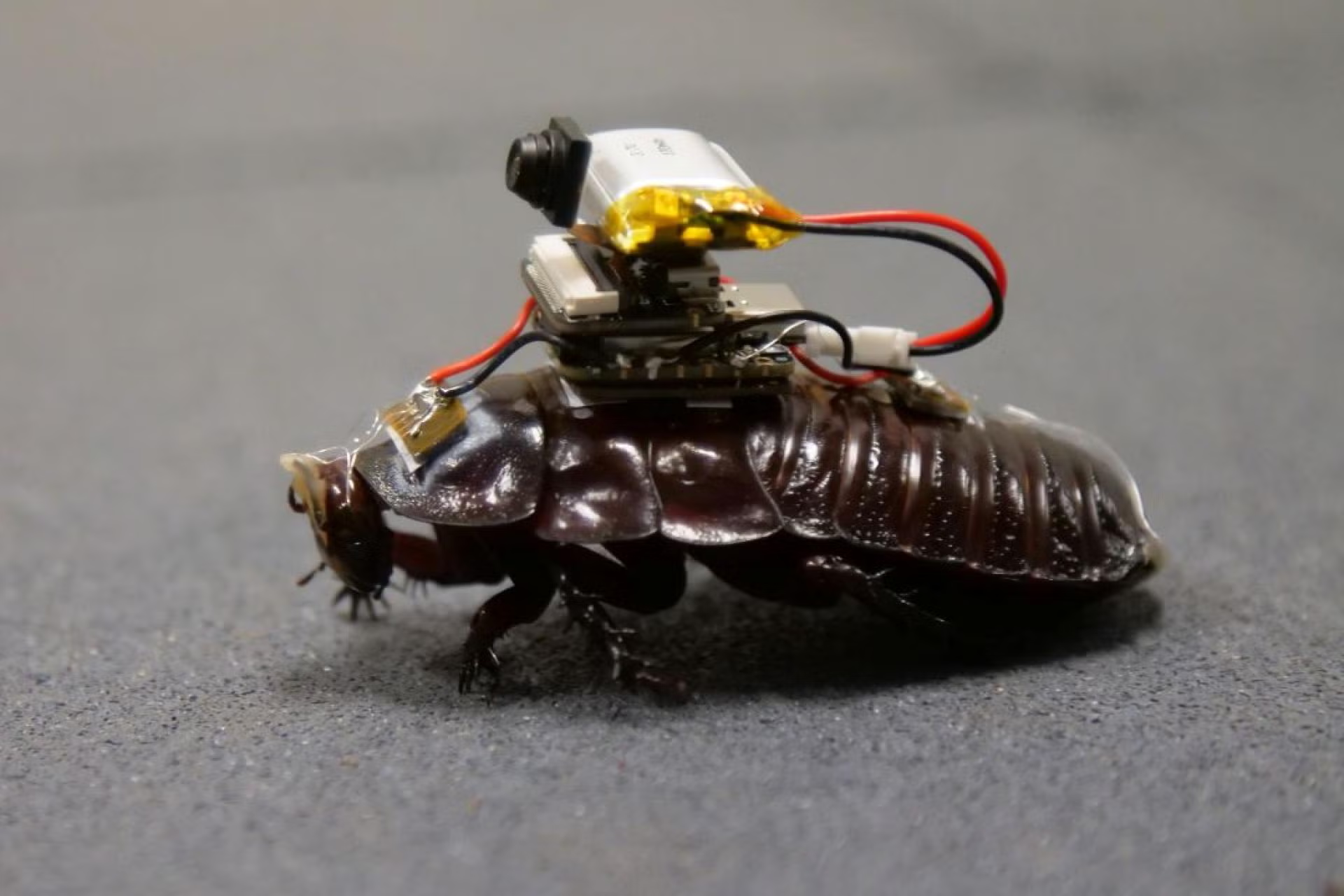
It may be the last thing you want to see if you are trapped underneath a building after a natural disaster or other type of calamity, but giant burrowing cockroaches scurrying in your vicinity could one day be just what you need.
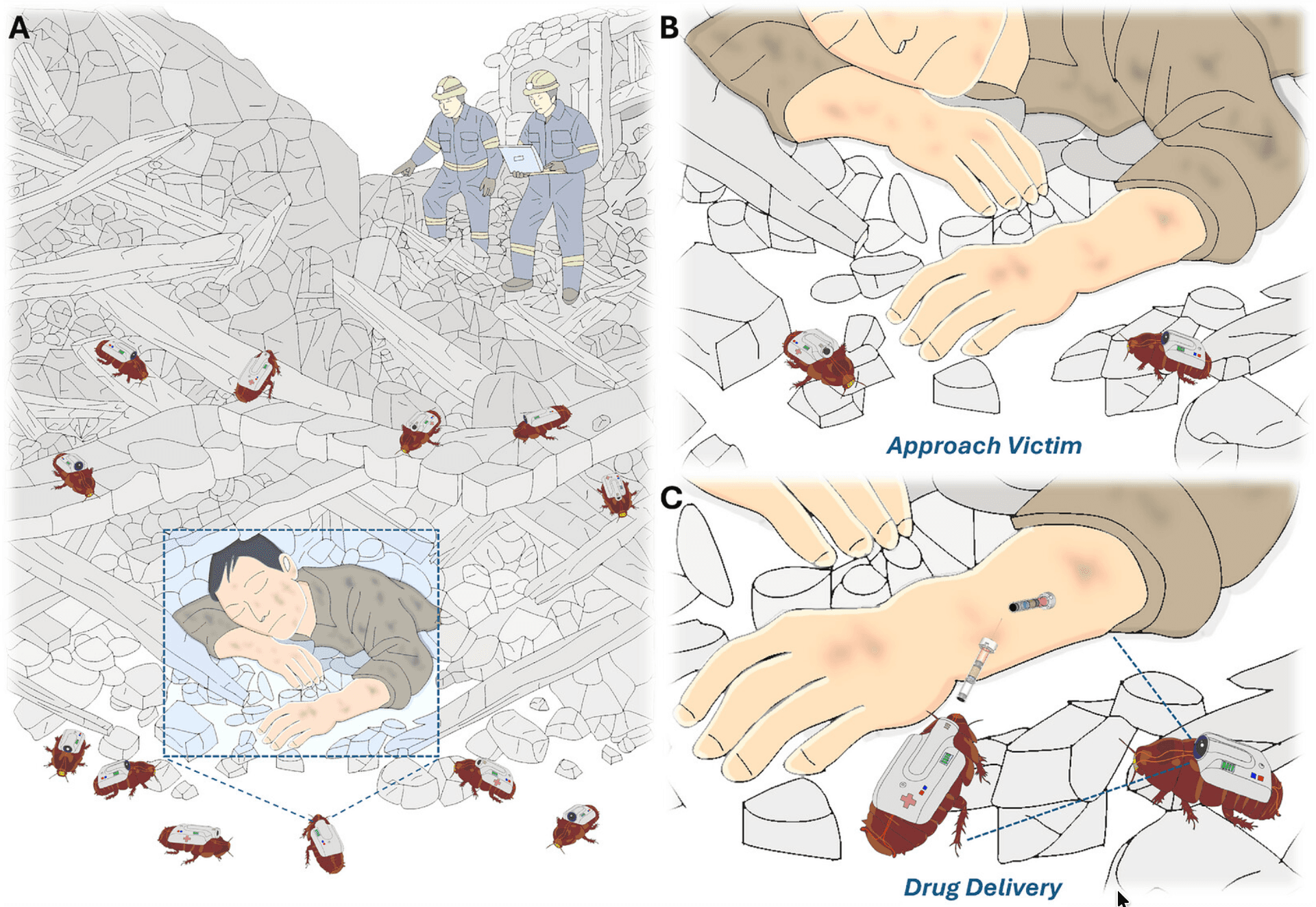
Researchers at the University of Queensland, working with the University of New South Wales, have fitted those large Australian cockroaches with small packs that hold cameras or a remotely fired injector. They call these giant cyborg critters “paraborgs.”
In new lab tests highlighted in the journal Advanced Science on Aug. 5, every insect reached set points on a course. The full job of walking to a set location, lining up and delivering a dose worked in 72 per cent of trials. When the bugs’ injectors fired from within 15 centimetres, success rose to 95 per cent. A person remotely operating still decides when the dose goes in. The tests used fake targets and pig skin in the trials, not actual people in rubble.
Staff steer the insects with a game controller. They first put the insect to sleep with anaesthesia before fitting a small pack with thin wires on its feelers and at its rear. Later, when the insect is awake, a person uses a controller to send a small electric pulse through those wires and steer it. The insect still uses its own legs to climb and squeeze through gaps.
These machine-bug hybrids are not ready for real disasters just yet. Operators still face rough ground, lost signals inside wrecked buildings and the need to prove their jabs are safe. Insect research rules are also not settled. U of Queensland biorobotics engineer Dr. Thang Vo-Doan says teams could reach real emergencies in five to 10 years if funding and field tests go as hoped.
“Substantial advances in hardware integration, autonomous control, system reliability, and field validation will be required before such platforms can be deployed in real-world emergencies,” the authors stated in their discussion.
Read more: Photon Matrix makes mini air defence system for taking out mosquitoes
Reasoning for choosing cockroaches
Looks have nothing to do with it. These insects already push through tight, dusty spaces and need little extra power. Small robots still struggle to do so.
The giant burrowing cockroach is the world’s heaviest of its kind at up to 8.5 centimetres long, so it can easily carry a camera or injector. The species lives in the wild in north Queensland. Researchers used that local kind, kept in the lab on dry gum leaves and apples.
The same Australian lab has also guided darkling beetles up walls with removable packs. Those beetles are meant for search work. They find people and help map a wreck. The giant cockroaches are larger and stronger, so they can do more than just look. The idea is simple — use different insects for different jobs.
Some critics, including PETA, have objected to cyborg insect research on ethical grounds. The authors acknowledge this view but do not share it considering the potential to save human lives.
Several years of research
This study adds to a search idea that labs have chased for about 20 years. In Singapore, engineer Hirotaka Sato’s group has successfully steered Madagascar hissing cockroaches and even made a tiny diving suit so the insects can work in floodwater. Some of those insects were used after the 2025 earthquake in Myanmar to help search for people under the rubble, but they did not find any.
In 2022, Japan’s RIKEN institute added a small solar cell so a cockroach pack could keep running for weeks. Ten years earlier, North Carolina State University showed remote-steered cockroaches that could carry a beacon and a tiny microphone into rubble.
The first sight of one would shock most people, particularly when they are in life-threatening condition. The bet is that in a space no rescuer can safely enter, a swarm that could look, map and give a supervised dose might keep someone alive until help arrives.
“This study presents the first comprehensive proof-of-concept demonstration of the paramedic cyborg insects (Paraborgs), capable of providing medical assistance in emergency scenarios,” the researchers said, “specifically, in situ drug-delivery for trapped victims in complex terrains and confined, unknown environments.”

Cockroaches have finally found a proper job Australian scientists have created cyborg cockroaches to rescue people trapped under rubble. A camera or a miniature syringe containing medicine is attached to a giant cockroach, after which an operator can remotely guide it toward a Show more
Read more: Bird Buddy spreads its wings with new insect observation tech
Follow Rowan Dunne on LinkedIn
rowan@mugglehead.com