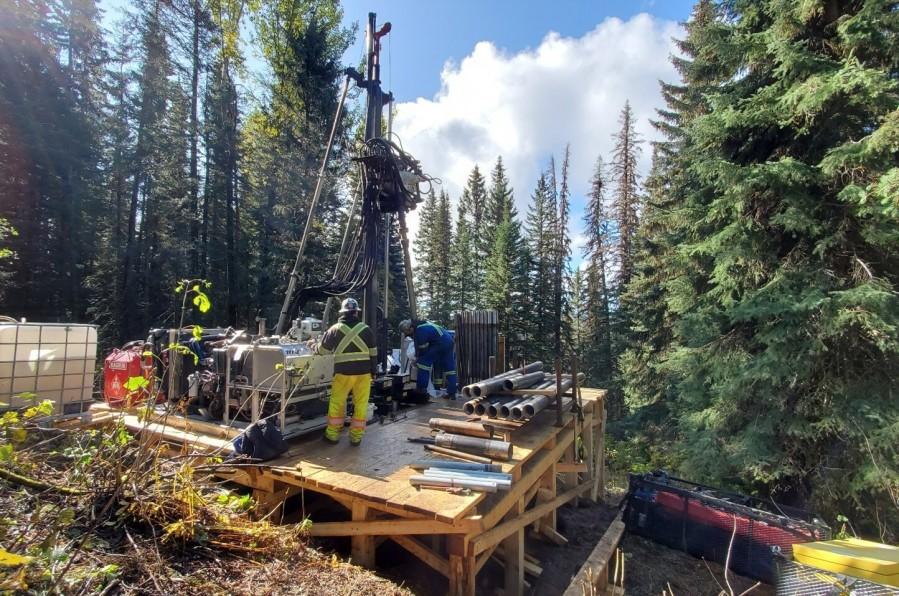

British Columbia has added three early-stage mining projects to its Critical Minerals Office to help speed up environmental assessment and permitting as the province looks to boost rural jobs.
Mining Minister Jagrup Brar made the announcement Friday in Port Hardy, near one of the proposed sites. He also said the projects could bring hundreds of long-term jobs to regions hit by forestry downturns.
The province selected Northisle Copper and Gold Inc. (CVE: NCX) (OTCMKTS: NTCPF) North Island Project, Surge Copper Corp. (CVE: SURG)’s Berg Project and Defense Metals Corp. (CVE: DEFN) (OTCMKTS: DFMTF) Wicheeda Project. Meanwhile, officials said each project meets criteria tied to geology, financial backing and First Nations engagement.
Brar described the projects as promising but still in early development. He said each represents a major potential investment in British Columbia.
The North Island Project alone could create 498 full-time jobs during operations. Further, the Berg and Wicheeda projects could each support about 200 permanent jobs. Those two projects could also generate roughly 400 jobs over the life of each mine. Consequently, the minister framed mining as a replacement for forestry employment lost to U.S. tariffs.
He said rural communities need new economic drivers. Mining, he added, could offer stable work in areas where mills have closed. Brar linked the move to broader provincial reforms. Furthermore, the 2026 budget includes a CAD$3 million increase for the mining ministry.
The funding will support fixed permitting timelines for mineral exploration projects. Additionally, Brar said the province aims to become the first in Canada to formalize such timelines. He declined to provide specific approval dates for the three projects.
Read more: NevGold discovers transformational oxide gold-antimony structure at Limousine Butte
Read more: NevGold expands Bullet Zone discovery as drilling confirms oxide gold-antimony system
Current moment is a rare opportunity
Northisle has completed a preliminary economic assessment for its North Island Project. The study estimates a USD$1.1 billion development cost for the first phase.
Company president and chief executive Sam Lee said the initial build would fund a second phase. Subsequently, the project would reach a planned 29-year mine life. Over that period, the mine could produce about 130,000 ounces of gold per year. It could also generate roughly 70 million pounds of copper annually.
Lee said global demand for copper and gold continues to grow. He also argued the project could supply metals needed for electrification and decarbonization. He said the company plans to work closely with local communities and First Nations. Furthermore, he described responsible development as central to the company’s strategy.
The Mining Association of British Columbia welcomed the announcement. Meanwhile, its president and chief executive, Michael Goehring, called the move a positive step. He said placing projects under the Critical Minerals Office can streamline coordination. However, he argued the province must go further.
Goehring said environmental assessments and Mines Act permits still take too long. Consequently, he urged systemic reforms to make approvals more predictable. He described the current moment as a rare opportunity for the province’s mining sector. In addition, he said durable changes are needed to attract long-term investment.
The Critical Minerals Office works directly with companies, government agencies and First Nations. The office helps identify regulatory requirements early in the process. Officials say the office aligns permitting pathways and prepares projects for future reviews. Furthermore, it evaluates financial strength, geology and community relationships before granting support.
Read more: NevGold expands high grade antimony discovery at Nevada’s Limousine Butte Project
Read more: NevGold targets U.S. critical mineral supply chain with new antimony gold find
Critical minerals are a supply-chain security priority
Brar said other projects may soon receive similar assistance. Meanwhile, the Baptiste Nickel Project near Fort St. James has already gained coordination support. That project is currently seeking public comment. Additionally, Brar said the province will continue reviewing other critical mineral proposals.
He said British Columbia wants to balance economic growth with environmental standards. However, he emphasized the need to move faster as global competition intensifies. The three projects now enter a more coordinated review process under the Critical Minerals Office framework. Consequently, companies and regulators will work more closely as applications advance.
Governments across the West now treat critical minerals as a supply-chain security priority, and they are designing policies to dilute China’s dominance in mining and processing.
In the United States, Washington has combined permitting reform, financial support and official designations to accelerate domestic projects. Furthermore, the FAST-41 framework has forced federal agencies to coordinate reviews under firm public timelines. That structure reduces uncertainty for investors. Consequently, developers can model capital costs with clearer visibility on permitting milestones.
The Stibnite project led by Perpetua Resources Corp (TSE: PPTA) (NASDAQ: PPTA) moved through the FAST-41 process in Idaho. The project targets both gold and antimony, a metal used in munitions and flame retardants.
U.S. officials have also expanded the federal critical minerals list in recent years. Also, lithium and antimony now sit firmly inside Washington’s strategic framework. That classification matters because it unlocks political backing and improves access to loans and grants. Furthermore, it signals to private capital that projects align with national security goals.
Read more: NevGold delivers major growth at Idaho gold project
Read more: NevGold Corp. advances toward gold antimony resource with expanded Nevada drilling
Critical minerals list expands to include antimony, lithium
Lithium sits at the heart of electric vehicle batteries and grid storage systems. Consequently, companies developing lithium deposits can argue they support domestic manufacturing resilience.
Lithium Americas Corp (TSE: LAC) (NYSE: LAC) (FRA: WUC) has advanced its Thacker Pass project in Nevada under that policy umbrella. In addition, federal loan commitments have reinforced its positioning as a cornerstone of U.S. battery supply. Antimony’s inclusion has created similar momentum. The United States imports most of its antimony, much of it refined in China.
Consequently, domestic exploration companies can frame antimony projects as strategic rather than purely speculative. NevGold Corp (CVE: NAU) (OTCMKTS: NAUFF) (FRA: 5E50), which promotes gold-antimony assets in Nevada, also stands to benefit from that narrative shift.
Investors increasingly evaluate such projects through a geopolitical lens. Policymakers now further speak openly about securing supply chains for defence and advanced manufacturing. The European Union has taken a regulatory route through its Critical Raw Materials Act. The bloc has set extraction and processing targets within its borders.
The company has also proposed streamlined permitting for projects deemed strategic. Furthermore, member states must designate a single contact point to cut bureaucratic overlap. Japan has focused on diversification and stockpiling. It has backed overseas rare earth and battery metal projects to reduce reliance on Chinese refiners.
Australia has pursued both upstream and downstream strategies. Canberra released a Critical Minerals Strategy aimed at expanding mining and local processing capacity. The government has also created tax incentives for refining and processing critical minerals domestically. Consequently, Australian producers can move further up the value chain instead of exporting raw concentrate to China.
NevGold Corp is a sponsor of Mugglehead news coverage
.