
American Rare Earths (ASX: ARR) (OTCMKTS: ARRNF) and the University of Wyoming have secured a U.S. research award to study commercial uses for mining byproducts at its Halleck Creek rare earths project.
Announced on Thursday, the funding comes through the National Science Foundation’s Accelerating Research Translation initiative, which targets applied research with near-term commercialization potential. Additionally, the program focuses on moving lab-scale ideas into practical industrial applications.
The American Rare Earths–University of Wyoming partnership received a Seed Translational Acceleration of Research award, a core element of the NSF ART framework. The STAR projects must deliver usable industry outcomes within one year, rather than open-ended academic studies.
University of Wyoming joined the first cohort of institutions selected for the NSF ART initiative. The program will distribute USD$6.3 million over four years to support commercialization-focused research. Further, the funding structure ties progress to milestone-based deliverables.
University officials said the projects aim to support both workforce training and Wyoming-based resource development. Consequently, graduate students and postdoctoral researchers will work alongside industry partners on applied problems.
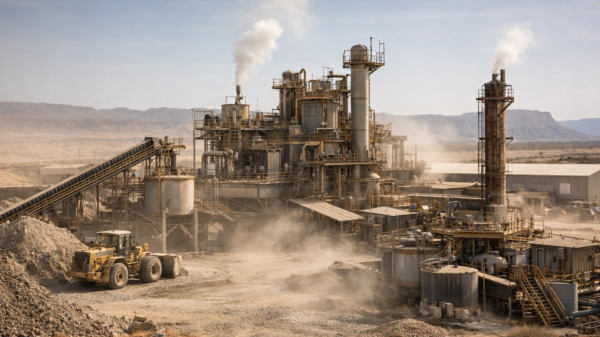
The Halleck Creek research will focus on tailings and other materials left after rare earth element extraction. Additionally, researchers will evaluate whether those byproducts can serve industrial or commercial end uses.
The project team will examine processing requirements, technical feasibility, and economic implications tied to potential applications. Meanwhile, the findings could inform broader development decisions at Halleck Creek.
The work will be led by Tyler Brown, minerals program manager in SER’s Center for Economic Geology Research. He will coordinate closely with Wyoming Rare to analyze material characteristics and performance potential.
Read more: NevGold expands high grade antimony discovery at Nevada’s Limousine Butte Project
Read more: NevGold Corp. advances toward gold-antimony resource with expanded Nevada drilling
Manufacturers use rare earths in most of modern technology
Rare earth tailings often present disposal challenges, however, some contain materials suitable for construction, manufacturing, or specialized industrial inputs. Consequently, successful reuse could lower waste volumes and improve project economics.
Rare earth minerals are a group of 17 elements used for advanced electronics, magnets, and clean energy technologies.
Manufacturers rely on them for smartphones, electric vehicles, wind turbines, and military systems.
Additionally, these materials enable medical imaging, precision guidance, and high-performance alloys across modern industries.
American Rare Earths reached a major metallurgical milestone at Halleck Creek last year. The company upgraded ore from 0.34 per cent total rare earth oxides to 3.72 per cent TREO.
That processing step represented roughly a tenfold increase in rare earth concentration. Additionally, test results showed operators could remove 93.5 per cent of non-rare-earth material early in processing.
Only 6.5 per cent of the original ore would require further refining under the tested flowsheet. Subsequently, the approach could reduce energy use, costs, and downstream processing demands.
Halleck Creek sits in Wyoming and ranks among the larger rare earth resources under development in the United States. Further, the project aligns with federal efforts to strengthen domestic supply chains for critical minerals.
A few of which include expanded funding for geological surveys and mapping to identify new mineral resources. Additionally, agencies streamlined permitting timelines for mining and processing projects.
The government also used the Defense Production Act to support domestic production capacity.
Read more: NevGold’s latest discovery represents near term antimony production potential
Read more: NevGold surges after closing C$10M financing deal
Government has expanded critical minerals list
Federal departments increased grants for research into processing, recycling, and substitution technologies. Meanwhile, officials invested in pilot plants to move innovations beyond laboratory testing. The government also encouraged partnerships between universities, industry, and state governments.
The government has also expanded the critical minerals list to include items like lithium, used in electric car batteries, and antimony, which is used harden lead in batteries, solders, and plastics.
Several companies have stepped up to help the United States fill gaps in the expanded critical minerals list. NevGold Corp (CVE: NAU) (OTCMKTS: NAUFF) (FRA: 5E50) is advancing antimony resources, a metal essential for flame retardants and battery alloys. Lithium Americas (TSE: LAC) (NYSE: LAC) is developing the Thacker Pass lithium project in Nevada, which could supply lithium for electric vehicle batteries and grid storage. Additionally, U.S. Rare Earths (NASDAQ: USAR) and MP Materials (NYSE: MP) are increasing rare earth production and processing capacity.
These firms also pursue downstream processing partnerships, not just mining. Consequently, they aim to reduce dependence on foreign suppliers. Furthermore, several junior explorers are targeting cobalt, nickel, and graphite deposits to support battery and clean-energy supply chains. Policymakers have encouraged these efforts through financing, tax incentives, and streamlined permits.
.
NevGold Corp is a sponsor of Mugglehead news coverage
.