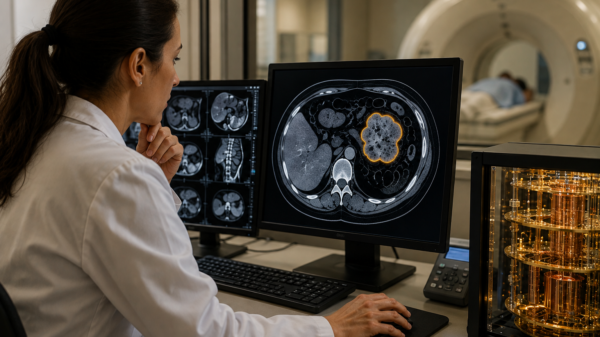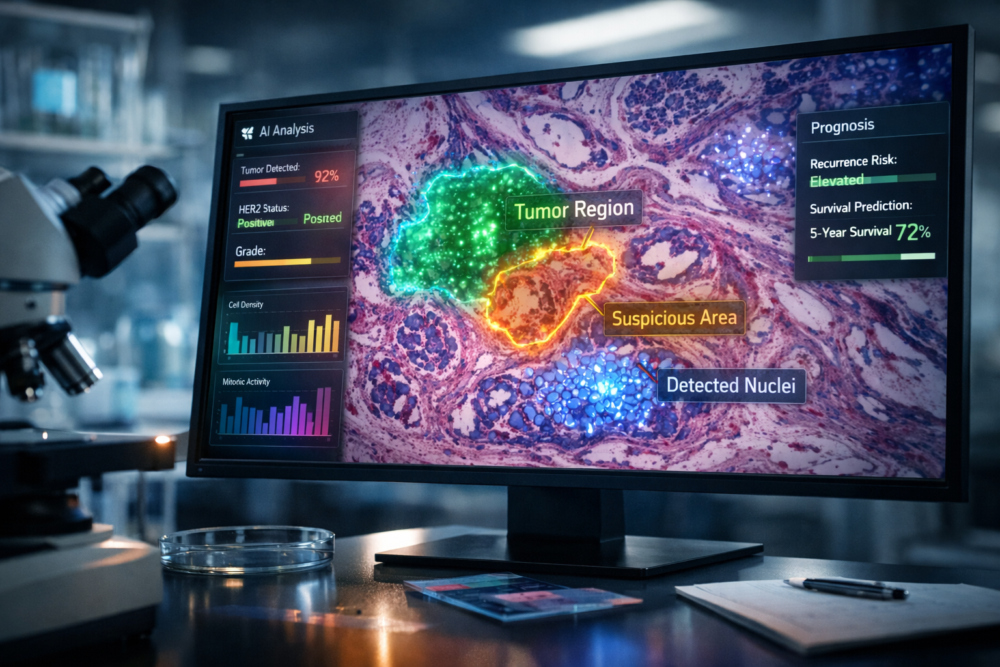

Artificial intelligence is moving deeper into cancer diagnostics, with new research suggesting it could help pathologists detect and evaluate breast tumors with greater precision.
A 2026 review published in Cancers examined how AI tools are being integrated into breast cancer histopathology. The study found that machine learning can improve diagnostic accuracy while also introducing new technical and regulatory challenges.
Histopathology remains the foundation of breast cancer diagnosis. Doctors still rely on microscopes to study stained tissue samples and determine tumor characteristics. However, digital imaging has opened the door for algorithms to assist in that process. Additionally, researchers have trained AI systems to scan these digital slides and identify abnormal tissue patterns. These tools can detect cancerous regions and classify tumor types with high sensitivity.
Early progress came from large benchmarking efforts such as the CAMELYON challenge. In those tests, deep learning models matched expert pathologists in detecting lymph node metastases. Since then, developers have expanded AI applications into broader diagnostic tasks. Models now analyze entire slide images or smaller patches to extract meaningful features.
Furthermore, these systems can assist with repetitive tasks that typically consume significant time. They can flag suspicious regions and improve consistency across different diagnoses. However, researchers caution that many results come from controlled environments. These studies often rely on retrospective datasets that do not reflect real world clinical variability.
Consequently, AI models can struggle when applied outside their training conditions. Differences in scanners, staining methods, and hospital workflows can reduce accuracy. Another concern involves dataset bias. Many training datasets come from a small number of institutions, which can skew results.
Read more: Morgan Freeman is fed up with AI voice deepfakes
Read more: Netflix takes over Ben Affleck’s AI film startup InterPositive
Artificial intelligence is expanding into prediction
Additionally, algorithms may learn patterns specific to those institutions rather than true biological signals. That limitation can create misleading outputs in diverse clinical settings. Despite these issues, researchers continue to position AI as a support tool rather than a replacement. Pathologists remain central to diagnosis, while algorithms provide additional insights.
Meanwhile, AI capabilities are expanding beyond detection into prediction. New models can analyze tissue samples to estimate patient outcomes, including survival rates. These systems also assess recurrence risk and disease progression. As a result, clinicians may gain earlier insights into how aggressive a tumor might be.
In addition, researchers are exploring how AI can predict treatment response. Some models evaluate how patients might react to chemotherapy before surgery begins. This approach could help doctors tailor treatment plans more precisely. It may also reduce unnecessary exposure to ineffective therapies.
Another emerging concept involves virtual immunohistochemistry. Scientists are testing whether AI can infer molecular markers directly from tissue images. For example, algorithms may predict HER2 status or hormone receptor expression without additional lab tests. However, these predictions rely on statistical correlations rather than direct measurement.
Consequently, experts do not consider these tools replacements for established diagnostic methods. Extensive validation will remain necessary before clinical adoption. Furthermore, AI is beginning to integrate multiple data sources. Researchers are combining histology with genomic and clinical data to improve understanding of tumor biology.
This multimodal approach could support precision oncology. Doctors may eventually use these insights to tailor treatments to individual patients. Meanwhile, AI is also improving analysis of tumor infiltrating lymphocytes. These immune cells play a key role in how the body responds to cancer.
Read more: Wonder Studios raises US$12M in seed for AI film production
Read more: AI movie trailers for ‘Titty Killer’ saga pull millions of views on X
Researchers use inconsistent methodologies
Algorithms can map their spatial distribution within tumors. This capability may reveal patterns that traditional methods often miss.
However, several barriers continue to slow adoption in clinical settings. One major issue involves reproducibility across different studies. Researchers often use inconsistent methodologies, which makes results difficult to compare. Problems such as data leakage and poor dataset design can further weaken findings.
Consequently, experts are calling for standardized reporting frameworks. Guidelines such as TRIPOD-AI and CONSORT-AI aim to improve transparency. Regulatory approval presents another challenge. AI diagnostic tools must meet strict safety and accuracy requirements before entering clinical use.
Additionally, only a limited number of systems have received approval so far. Most approved tools function as decision support systems rather than standalone diagnostics. Integration into hospital workflows also remains complex. Healthcare providers must ensure compatibility with existing digital infrastructure.
Furthermore, clinicians will require training to use these systems effectively. Without proper education, adoption could lag despite technological progress. Ethical concerns also continue to shape the discussion. Questions around accountability, bias, and transparency remain unresolved.
However, one issue stands out in particular. Many AI systems operate as “black boxes,” making their decision processes difficult to interpret. Consequently, clinicians may hesitate to rely on tools that cannot clearly explain their reasoning. Trust will remain a key factor in adoption.
At the same time, AI introduces its own variability into diagnostics. While it may reduce differences between human observers, it can create new inconsistencies tied to data and design.
Read more: Prestigious medtech intelligence firm recognizes Breath Diagnostics for innovation
Read more: Breath Diagnostics completes install of advanced mass spectrometry system
Multiple companies are branching into AI
Additionally, companies such as Siemens Healthineers (ETR: SHL) are integrating AI into radiology platforms. Their systems assist clinicians in identifying tumors across CT and MRI scans with greater speed and consistency. These tools can detect subtle abnormalities that human reviewers may miss during high volume workloads.
Meanwhile, GE HealthCare (NASDAQ: GEHC) has deployed AI enabled imaging software designed to prioritize urgent cases. The technology flags scans with suspected malignancies, allowing radiologists to act more quickly. Consequently, hospitals can reduce diagnostic delays and improve patient outcomes.
In addition to imaging, liquid biopsy technologies are gaining traction. These methods analyze blood samples for circulating tumor DNA, offering a less invasive alternative to tissue biopsies. AI models help interpret complex genetic data, identifying cancer signals at earlier stages.
Furthermore, Breath Diagnostics is emerging as a new way to detect cancer. The method looks at chemicals in a person’s breath to find signs of disease. AI then studies these patterns to tell the difference between healthy and cancerous samples.
Breath-based testing could make screening faster and easier. Patients may one day get results from a simple, non-invasive test instead of a biopsy. However, researchers are still working to improve accuracy and confirm results.
Additionally, AI is helping hospitals run more efficiently. It can help manage schedules, staff, and patient flow. As a result, doctors may spend more time caring for patients instead of handling administrative tasks.