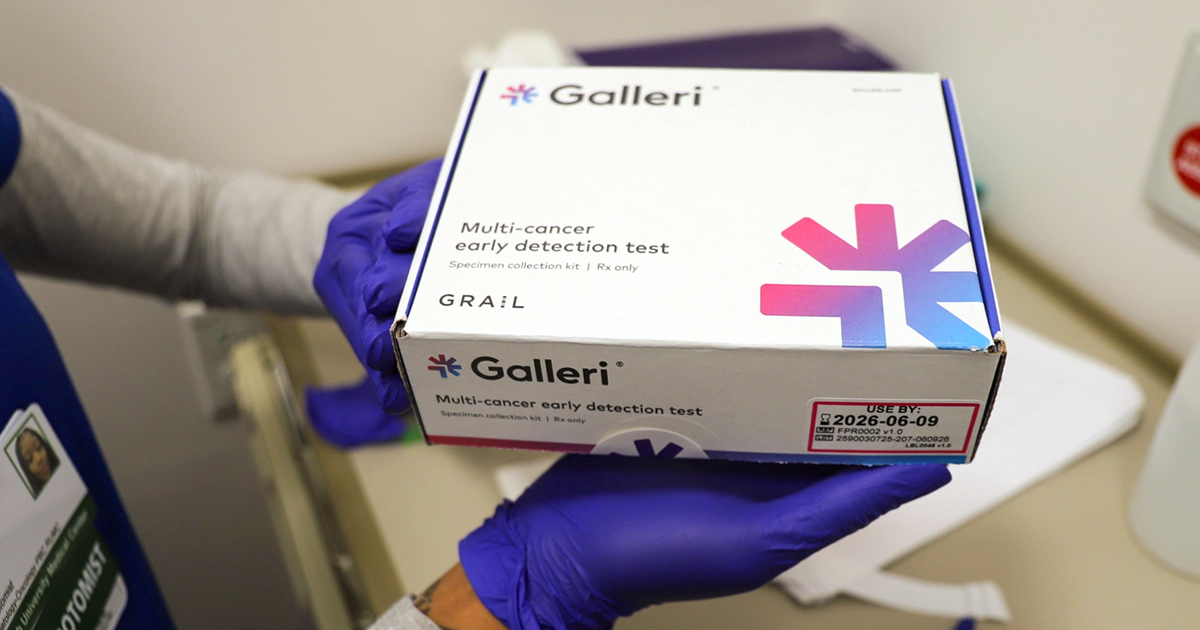

Investors drove Grail Inc (NASDAQ: GRAL) (FRA: NL0) shares down by almost 48 per cent in after-hours trading on Thursday after the company’s multi-cancer early detection test failed to meet its primary endpoint in the landmark NHS-Galleri trial.
In clinical trials, the primary endpoint is the main outcome that researchers design the entire study to prove with statistical significance. For NHS-Galleri, GRAIL set out to show a meaningful reduction in combined Stage III and IV cancer diagnoses when it added the Galleri blood test to standard NHS screenings.
The company reported a favourable trend toward fewer late-stage cancers in a pre-specified group of 12 deadly types after the first round, but the overall primary measure fell short. This trial enrolled 142,000 adults aged 50 to 77 in England and ran for three years with annual blood draws.
The sharp sell-off occurred despite GRAIL beating Wall Street expectations on its fourth-quarter financial results. GRAIL recorded a fourth-quarter net loss of US$99.2 million or US$2.44 per share — far better than the US$4.01 loss analysts expected.
Significantly, the oncology company reported that revenue derived from Galleri throughout 2025 rose by 26 per cent year-over-year to US$136.8 million with more than 185,000 tests sold.
Read more: Breath Diagnostics advances pre-op pneumonia screening with FDA breakthrough designation
Galleri still shows great promise
Secondary results still delivered clear wins for GRAIL. Adding Galleri to standard care slashed Stage IV diagnoses across the 12 cancers in question. Reductions grew each year and exceeded 20 per cent in the second and third rounds.
This test also increased absolute detections of Stage I and II cancers for types doctors usually find late. Overall cancer detection rates jumped fourfold for breast, cervical, colorectal and lung cancers in comparison to standard screening alone.
These topline or preliminary results are “the strongest evidence to date that multi-cancer early detection can shift the stage at which cancers are detected at a population level,” according to chief executive Bob Ragusa. GRAIL will be extending trial follow up by six months to one year and is planning to drop full results in mid-2026.
Despite the setback, GRAIL is still a pioneer in cancer diagnostics. The California-based firm uses next-generation sequencing and machine learning to spot signals from more than 50 cancer types in a single blood draw. It recently completed its FDA Premarket Approval submission and holds US$904 million in cash, giving it runway into 2030.
Despite today’s market reaction, these advances position GRAIL to help doctors catch deadly cancers earlier, when treatment works best and lives stand the greatest chance of being saved.
GRAIL test still very effective. It still reduced the Stage 4 diagnoses. It’s growing at 28% rate. 185k customer took the test.
Imagine even if 1% patients will take this test on HIMS platform then revenue is $12mn. pic.twitter.com/wELAiabDk9
— Stock Stalkk (@StockStalkk) February 20, 2026
Read more: Prestigious medtech intelligence firm recognizes Breath Diagnostics for innovation
Follow Rowan Dunne on LinkedIn
rowan@mugglehead.com