
Researchers in China have created a light based sensor that can detect extremely low levels of cancer biomarkers in blood, potentially paving the way for earlier diagnosis through a simple blood test.
The device identifies molecules linked to disease at concentrations once considered nearly impossible to measure. Biomarkers include proteins, DNA fragments and other biological signals. Doctors use them to assess cancer risk, progression or response to treatment. However, these markers appear in tiny amounts during early stages of illness.
That scarcity makes early detection difficult. Standard laboratory methods often amplify genetic material to make it measurable. Additionally, amplification can take time and add cost. It can also introduce background noise that blurs results. Consequently, very early cancers may escape detection.
Han Zhang, who led the research at Shenzhen University, said the team wanted a direct and precise method. He explained that the group combined DNA nanostructures, quantum dots and CRISPR gene editing tools. Furthermore, they paired those components with a light based technique called second harmonic generation, or SHG.
The researchers published their findings in Optica, a journal of Optica Publishing Group. They reported that the sensor detected lung cancer biomarkers at sub-attomolar levels. That level represents only a few molecules in a sample. Consequently, the device generated a clear optical signal from extremely faint traces.
Zhang said the approach could one day support routine blood screening. He suggested doctors might detect lung cancer before tumors appear on CT scans. Additionally, physicians could track biomarker levels more frequently during treatment.
Read more: Prestigious medtech intelligence firm recognizes Breath Diagnostics for innovation
Read more: Breath Diagnostics completes install of advanced mass spectrometry system
Quantum dots enahcne local optical field
The sensor relies on a thin semiconductor material called molybdenum disulfide, or MoS2. SHG occurs at the surface of this two dimensional material. When light strikes the surface, it converts into light at half the wavelength. However, the signal strength depends on subtle molecular changes at that surface.
To improve sensitivity without chemical amplification, the team engineered nanoscale scaffolds. They built pyramid shaped structures known as DNA tetrahedrons. These structures self-assemble from strands of DNA. Additionally, they allow scientists to position other components with nanometer precision.
The researchers attached tiny quantum dots to the tips of those DNA tetrahedrons. Quantum dots are nanoscale particles that interact strongly with light. They can enhance the local optical field when placed correctly. Consequently, the team positioned them at precise distances from the MoS2 surface.
The quantum dots strengthened the SHG signal under normal conditions. The researchers then introduced CRISPR-Cas12a to detect specific biomarkers. When the Cas12a protein recognized a matching genetic target, it cut the DNA tether. Subsequently, the quantum dots detached from the surface.
That detachment caused a measurable drop in the SHG signal. Because SHG produces minimal background noise, even tiny changes became visible. Consequently, the system translated molecular recognition into a clear optical shift.
Traditional biomarker tests often depend on polymerase chain reaction to amplify signals. However, amplification can complicate workflows and extend turnaround times. Additionally, extra steps increase the risk of contamination. The new sensor bypasses those steps entirely.
Zhang said the team treated DNA as a construction material rather than only a biological molecule. He noted that DNA’s predictable structure lets researchers build organized nanostructures.
Read more: Breath Diagnostics leaders promote their mission at Miami investment conference
Read more: Breath Diagnostics leader speaks at lung cancer education event in Louisville
Sensor passed key test with high sensitivity
To test the device, the researchers targeted miR-21, a microRNA linked to lung cancer. First, they confirmed detection in a simple laboratory buffer. Subsequently, they analyzed human serum samples from lung cancer patients.
The sensor detected miR-21 in patient serum with high sensitivity. It ignored similar RNA strands that did not match the target sequence. Consequently, the system demonstrated strong specificity alongside sensitivity.
Zhang said the results show how optics, nanomaterials and biology can work together in a single platform. He described the integration as a deliberate design strategy. Additionally, he emphasized that the device performed well in samples that resemble real world blood tests.
Early cancer detection remains a major challenge in medicine. Imaging tools often reveal tumors only after significant growth. However, molecular changes appear much earlier in disease development. A sensitive blood test could identify those changes sooner.
Frequent monitoring during treatment also poses logistical challenges. Patients often wait months between imaging scans. Additionally, doctors rely on delayed feedback to adjust therapies. A rapid blood based test could shorten that timeline.
The researchers designed the platform to be programmable. By altering the DNA sequences and CRISPR components, they could target other diseases. Furthermore, the system could detect viruses, bacteria or environmental toxins.
The team now aims to miniaturize the optical setup. They want to shrink bulky laboratory equipment into a portable format. Consequently, future versions might operate at hospital bedsides or small clinics.
Portable diagnostics could also serve remote or low resource regions. Blood collection requires minimal infrastructure compared with advanced imaging. Additionally, a compact optical reader could expand access to early screening.
Read more: Breath Diagnostics opens Respiratory Innovation Summit with captivating presentation
Read more: Breath Diagnostics adopts state-of-the-art mass spectrometer device for lung screening
Multiple companies taking aim at cancer
The researchers plan to refine stability and scalability in future studies. They will also need to validate the sensor in larger patient groups. Regulatory approval would require extensive clinical testing.
The regulatory pathway facing the Shenzhen team reflects a broader race among private innovators seeking faster, less invasive cancer detection tools.
Breath Diagnostics has positioned itself at the forefront of that effort with a radically different approach. The company develops breath based diagnostic systems designed to identify volatile organic compounds linked to cancer and other diseases. Rather than analyzing blood, its technology captures a patient’s breath and runs it through sensitive chemical sensors and machine learning models. The goal is to detect metabolic signatures that tumors release long before symptoms appear.
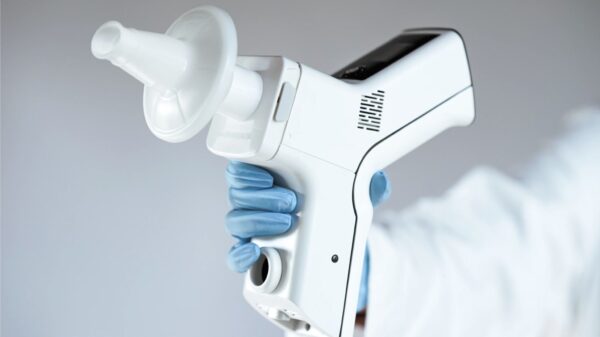
At the center of its strategy is OneBreath, a compact device intended for clinical and potentially at home use. OneBreath functions as a handheld breath analyzer that collects and processes samples in minutes. The system aims to provide rapid screening without needles, imaging suites or laboratory processing. Breath Diagnostics says it is refining sensor arrays and data algorithms to improve accuracy across multiple cancer types, including lung and gastrointestinal cancers.
To fund further trials and product development, the company has launched a Regulation Crowdfunding initiative. That campaign allows retail investors to participate in early-stage financing rounds, broadening access beyond traditional venture capital. The proceeds will support expanded validation studies and regulatory submissions.
Other startups are also advancing novel detection platforms. Delfi Diagnostics uses fragmentomics to identify subtle DNA patterns in circulating tumor DNA. Freenome combines artificial intelligence with blood biomarker analysis to detect early-stage colorectal and other cancers.