
Japan is accelerating a long-running plan to extract rare earth elements from the deep seabed as it seeks to reduce dependence on Chinese supply chains.
The push gained urgency as Beijing tightened export controls during recent trade and security disputes. A state-owned drilling vessel is scheduled to return to port this month after installing extraction equipment far below Japanese waters.
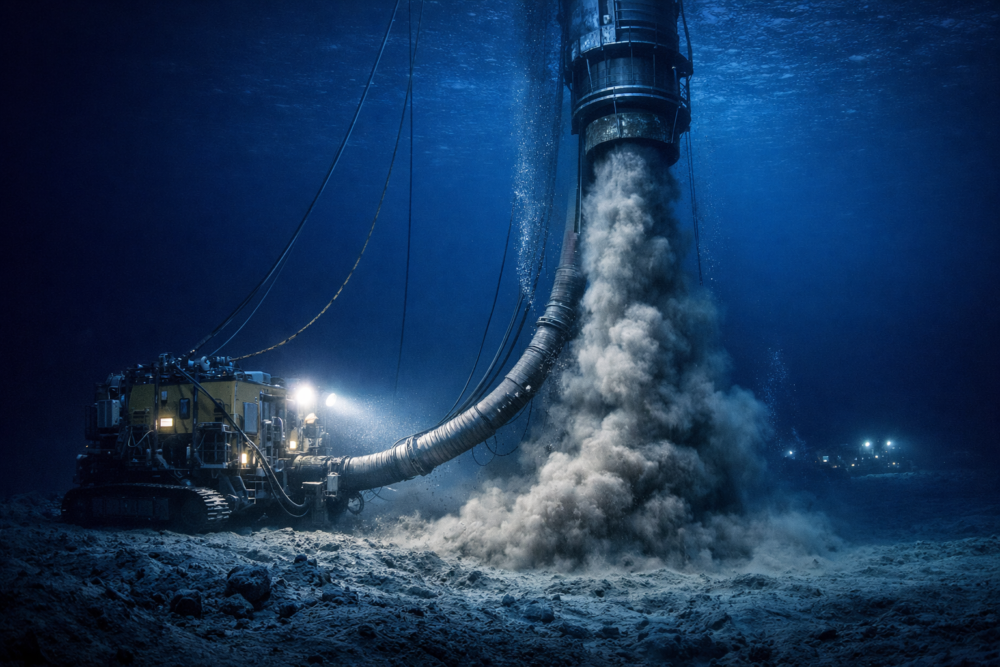
The work occurred near Minamitori Island, a remote coral atoll roughly 2,000 kilometers east of Tokyo. The government plans to begin lifting metal-bearing mud from the seabed for testing as early as February 2027. Officials say the project aims to strengthen economic security rather than chase short-term profits.
Program leaders argue Japan must secure reliable access to materials essential for modern industry. Rare earths support smartphones, electric vehicles, wind turbines, and advanced military systems.
However, China dominates global production and processing, giving it powerful leverage over importing countries. Japanese policymakers remain concerned about supply disruptions following last year’s trade conflict with the United States. More recently, Beijing restricted exports to Japan for products tied to military uses. Consequently, Tokyo has renewed efforts to diversify supply, even at high cost.
Japan already spends heavily on alternatives outside China.
It invested in a rare-earth separation facility in France and backed Australian producer Lynas Rare Earths Ltd. (ASX: LYC). Despite those efforts, Japan still sources about 70 per cent of its rare earth imports from China. Officials say that dependence leaves manufacturers vulnerable during diplomatic disputes.
Mining the seabed will not resolve the issue quickly. Even promising test results would face steep cost and engineering barriers. Large-scale commercial seabed mining has never succeeded anywhere in the world.
Read more: NevGold targets U.S. critical mineral supply chain with new antimony-gold find
Read more: NevGold expands high-grade antimony discovery at Nevada’s Limousine Butte Project
Japan tested excavation of cobalt-rich crusts from ocean floor
The current project lies within Japan’s territorial waters rather than international zones. That distinction allows Tokyo to proceed without navigating unresolved global mining rules. Additionally, the Cabinet Office estimates the system could raise about 350 tons of mud daily. The material would come from depths between five and six kilometers below the surface.
Researchers will analyze samples to identify which rare earths appear and in what concentrations. The next steps will depend entirely on those findings. Meanwhile, the drilling vessel Chikyu has already recovered mud containing rare earth elements. Government officials described the recovery as proof that continuous lifting may be possible.
Japan began exploring seabed minerals decades ago. The effort started in the late 1970s after disruptions in global cobalt supply.
In 2020, Japan successfully tested excavation of cobalt-rich crusts from the ocean floor. That experiment encouraged further investment in deep-sea technologies.
The rare-earth program formally began in 2014. It advanced through several research phases before the current voyage. The Japan Agency for Marine-Earth Science and Technology operates the Chikyu vessel. The ship departed from Shizuoka port in January to deploy the equipment.
However, critics remain skeptical about long-term viability. Some analysts say extreme pressure, darkness, and distance will drive enormous operating costs. They expect any workable system to require steady government subsidies. Conversely, supporters say national security justifies those expenses.
The United States has taken a different approach.
It has moved to speed approval of offshore mineral projects, even in international waters. Former president Donald Trump signed an order promoting offshore critical mineral development. Meanwhile, global regulators continue finalizing environmental safeguards for seabed mining.
Read more: NevGold delivers major growth at Idaho gold project
Read more: GoldMining chooses to retain its NevGold shares for next 18 months
United States has moved aggressively to reduce reliance on China
Japan’s project avoids that controversy by staying within national waters. Additionally, officials stress that environmental assessments will accompany every phase. They argue that controlled testing offers fewer risks than unregulated extraction abroad. Subsequently, Tokyo hopes the data will guide future decisions.
Japanese officials say cost remains secondary to supply stability. They compare the approach to Washington’s support for MP Materials Corp (NYSE: MP). The U.S. government also invested about USD$400 million to revive a dormant California mine. Further, that move aimed to secure domestic rare-earth production on land.
Beyond MP Materials, the United States government has moved aggressively in recent years to reduce reliance on Chinese critical mineral supply chains.
Washington has expanded the use of FAST-41, a federal permitting framework designed to accelerate approvals for strategic infrastructure projects. The process aims to cut years from environmental reviews while maintaining regulatory oversight. Consequently, mining developers now emphasize national security benefits when seeking federal and state support.
One of the most prominent beneficiaries is Perpetua Resources (NASDAQ: PPTA) (TSE: PPTA), which is advancing the Stibnite Gold Project in Idaho. The project carries strategic importance because it would restore domestic antimony production alongside gold.
Antimony is used in munitions, flame retardants, and advanced energy storage technologies.
However, the United States currently imports nearly all of its antimony, largely from China.
As FAST-41 accelerates permitting for nationally significant mineral projects, companies with credible U.S. antimony exposure are gaining visibility. That includes developers like NevGold Corp (CVE: NAU) (OTCMKTS: NAUFF) (FRA: 5E50), which has framed its Nevada assets within the broader push for secure, domestic critical-mineral supply chains.
.
NevGold Corp is a sponsor of Mugglehead news coverage
.