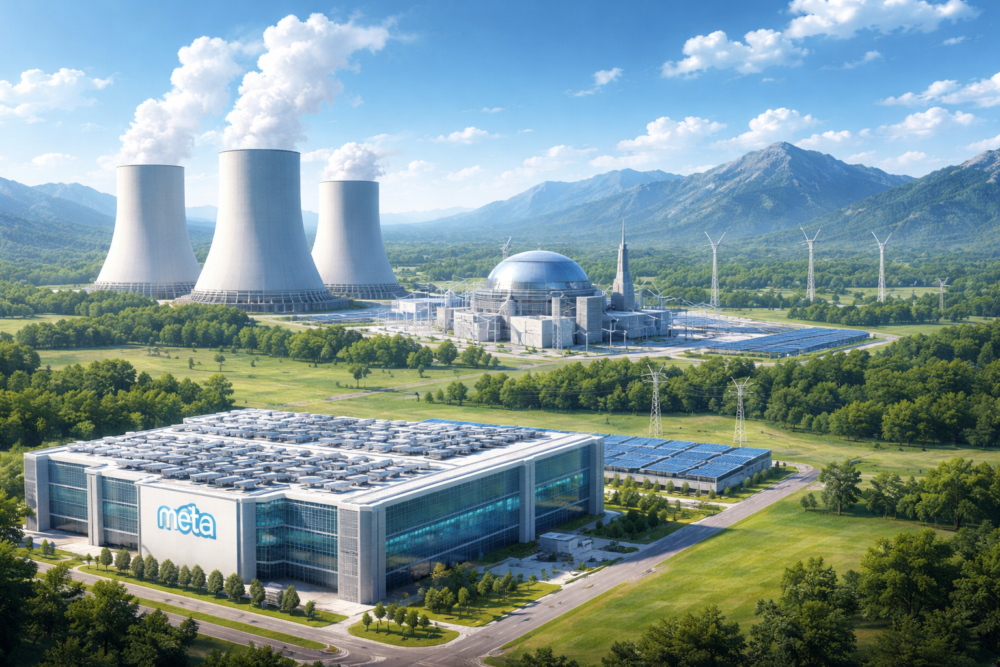

Meta Platforms (NASDAQ: META) has struck a major nuclear power deal with TerraPower to secure long-term electricity for its expanding data center network.
Announced on Friday, TerraPower plans to build up to eight advanced nuclear reactors using its Natrium technology. Together, the plants could supply as much as 2.4 gigawatts of carbon-free electricity.
The partnership comes as Meta faces surging power demand driven by artificial intelligence workloads. Meanwhile, the company is under pressure to meet aggressive climate and energy commitments.
TerraPower launched in 2008 with backing from Bill Gates, Nathan Myhrvold, and John Gilleland. The company focuses on developing safer nuclear systems designed for modern power grids.
Its Natrium design pairs a sodium-cooled fast reactor with molten salt energy storage. Each unit produces a steady 345 megawatts of baseload electricity. Additionally, the built-in storage allows output to rise to about 500 megawatts for more than five hours.
That flexibility makes the system well suited for grids dominated by wind and solar power. However, intermittent renewable generation often struggles to meet peak demand.
TerraPower has already begun construction on its first commercial-scale Natrium project in the United States. The company expects that initial reactor to enter service around 2030.
Under the new agreement, Meta will help fund early development of two Natrium units. In addition, Meta secured rights to power from up to six more reactors. Delivery of those additional units could begin as early as 2032.
Read more: Caterpillar bets on NVIDIA AI to advance autonomy, manufacturing, and supply chains
Read more: Boston Dynamics turns to AI to make humanoid robots safer around people
Meta joined broader industry eforts to revive nuclear
Meta views nuclear energy as essential to maintaining reliability while cutting emissions. The company has pledged to reach net-zero emissions across its value chain by 2030. It has also committed to matching 100 per cent of its operational electricity use with clean energy.
However, Meta acknowledged in its 2024 sustainability report that AI growth complicates those goals.
The company said rising energy and resource demands make decarbonization significantly harder. In late 2024, Meta issued a request for proposals to nuclear developers across the United States. That process targeted between one and four gigawatts of new nuclear capacity. Subsequently, Meta identified advanced nuclear projects as a priority option.
Meta has also joined broader industry efforts to revive nuclear power. Early last year, the company signed a pledge alongside Amazon (NASDAQ: AMZN) and Alphabet Inc (NASDAQ: GOOGL). The pledge supports tripling global nuclear capacity by 2050.
This TerraPower agreement represents Meta’s largest commitment to advanced nuclear technology so far. Additionally, it signals growing interest from technology companies seeking dependable power sources.
A senior Meta energy executive said the company wants scalable solutions that benefit both operations and communities. She added that the Natrium deal emerged from a competitive nuclear selection process. Further, she said next-generation reactors could play a critical role in meeting long-term energy needs.
Other major technology firms have also turned to nuclear power to secure reliable electricity. Microsoft (NASDAQ: MSFT) recently agreed to purchase the defunct Three Mile Island nuclear facility in Pennsylvania to support future data center demand.
Furthermore, Amazon and Alphabet have also invested in small modular reactor developers.
Meanwhile, several utilities are extending reactor lifetimes to meet rising AI-driven demand.