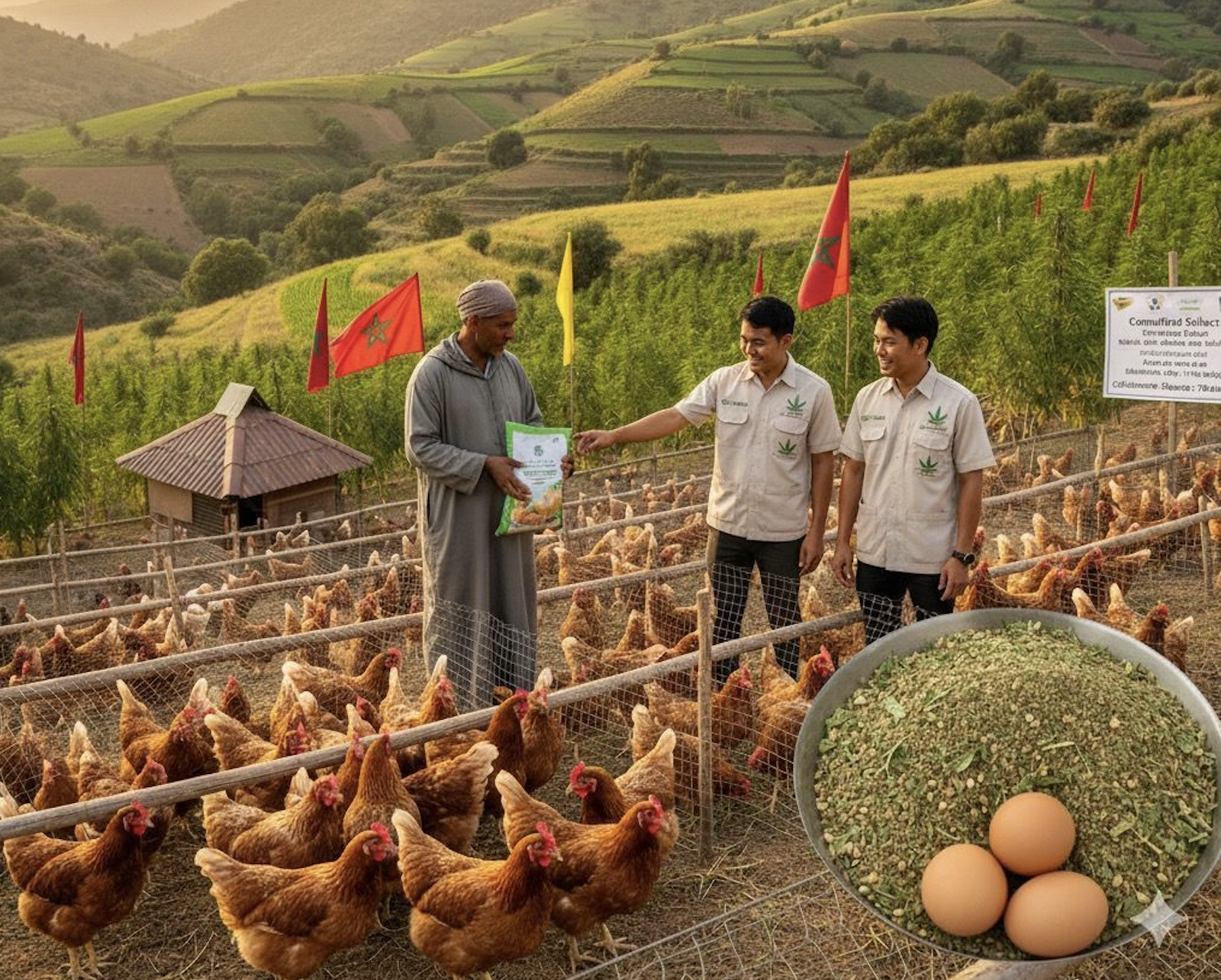

Morocco has launched a 10-month research initiative to examine the possible benefits of using cannabis in poultry feed.
The initiative aims to validate the usefulness of replacing growth-stimulating antibiotics with a derivative from the plant. It seeks to determine the viability of producing such a product at an industrial scale.
The Moroccan Agency for the Regulation of Activities Related to Cannabis announced the decision after signing a framework agreement with the Hassan II Institute of Agronomy and Veterinary Medicine in the capital city of Rabat. This institution is one of Morocco’s leading schools. It specializes in training engineers and veterinarians in agriculture, veterinary sciences, food systems and related fields, while conducting research to support national agricultural development.
The institute’s Veterinary Medicine Department will spearhead the research. Investigators will be assessing how the cannabis-derived compound impacts gut health of chickens and whether it improves their immune systems.
Morocco’s research into poultry feed infused with derivatives from the plant follows in the footsteps of pioneering research completed by researchers in Thailand. This experiment of incorporating cannabis into poultry feed dates back to a 2022 study conducted by scientists at Chiang Mai University.
In the trial, broiler chickens were fed cannabis leaves and biomass, resulting in benefits such as reduced mortality rates and improved meat quality with higher protein, fat and moisture content. Additionally, it provided enhanced immunity against diseases like avian bronchitis and increased profitability through organic farming without adversely affecting growth performance.
This work highlighted cannabis as a potential natural alternative to antibiotics, aligning with Thailand’s progressive cannabis policies for medical and industrial uses.
Morocco’s recent endeavour builds on global precedents like Thailand’s research to explore CBD-based feed formulations for poultry. The Moroccan initiative aims to assess the cannabinoid compound’s role in boosting gut health, immune responses and overall productivity while reducing reliance on antibiotics amid the country’s expanding legal industrial-focused cannabis sector.
Reports on Morocco’s study explicitly reference Thailand’s 2022 findings as an earlier example of cannabis’s potential in animal nutrition. Morocco is following in the footsteps of such innovations without any indicated direct collaboration or information exchange between the two nations. Thailand’s assessment focused on leaves/biomass while Morocco is prioritizing integrating derivatives into chicken food.
The North African nation legalized medical cannabis for medicinal, pharmaceutical and industrial purposes in 2021. Local authorities are yet to establish a recreational market. In mid-2024, the King of Morocco Mohammed VI pardoned nearly 5,000 marijuana farmers of previous convictions as part of national reforms. Additionally, the country produced its first cannabinoid-derived medicinal drug that year, used for the treatment of epilepsy.
In August of 2025, Moroccan suppliers shipped locally-grown medical cannabis to customers in Australia.
Morocco has a reputation as one of world’s top producers of illicit pot and resin/hashish. It has historically been the dominant supplier of hash throughout Europe.
Read more: Morocco launches nation’s first cannabinoid drug for epilepsy treatment
Follow Rowan Dunne on LinkedIn
rowan@mugglehead.com